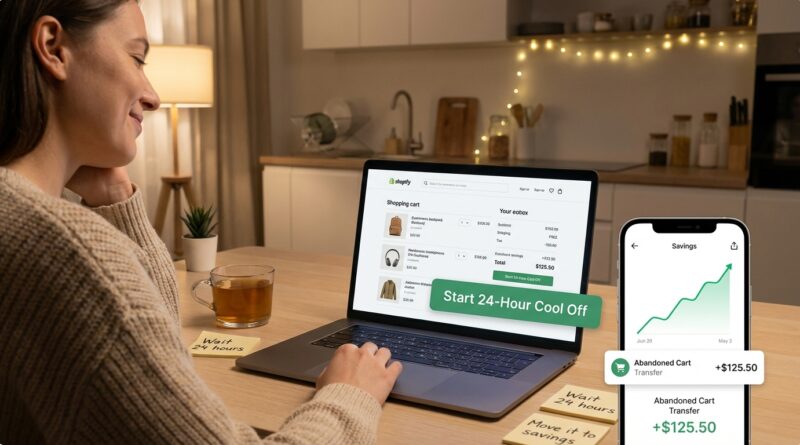
The 24‑Hour ‘Cool Off’ Rule: The Tiny Shopping Habit That Supercharges Your High‑Yield Savings
You are not imagining it. You skip the big splurges, make coffee at home, and still your high-yield savings account barely seems to move. That is frustrating. A lot of the damage comes from tiny impulse buys that slip through because they feel harmless in the moment. A late-night skin care order. A phone accessory you did not plan to buy. A flash sale that somehow ends tonight, even though there is another one next week. The problem is not always your savings account. It is the speed between wanting something and tapping Buy Now. The 24-hour rule is a small habit, but it works because it puts a speed bump between emotion and spending. Even better, when you pair it with a simple move-the-difference-to-savings ritual, your high-yield account finally gets fed on purpose instead of hoping there is money left at the end of the month.
⚡ In a Hurry? Key Takeaways
- The 24-hour rule savings habit for a high yield account means waiting one full day before buying non-essential items, so fewer impulse purchases drain your cash.
- When you decide not to buy, move that exact amount, or part of it, into your high-yield savings account right away.
- This is not about guilt or deprivation. It is a simple default behavior that helps protect your money from constant ads, one-click checkout, and emotional spending.
Why your high-yield savings can still feel stuck
People often think the answer is finding a slightly better APY. That can help, but it is usually not the main issue.
If $18 here, $32 there, and $47 on a sale item keep leaking out, your account never gets the chance to grow. The interest matters. The habit matters more.
That is why the 24 hour rule savings habit high yield account approach works so well. It is not fancy. It just gives your brain time to cool off.
What the 24-hour rule actually is
The rule is simple. For any non-essential purchase, you wait 24 hours before buying it.
Not groceries. Not medicine. Not replacing something urgent you truly need for work or home. This is for wants, upgrades, nice-to-haves, and “it is on sale so maybe I should” purchases.
The basic version
See item. Want item. Do not buy item yet.
Add it to a cart, wishlist, notes app, or even take a screenshot. Then leave it alone for a full day.
After 24 hours, ask three quick questions:
- Do I still want this?
- Would I buy it at full price if there were no countdown timer?
- Will this matter to me next week?
If the answer is still yes, buy it without guilt if it fits your budget. If the answer is no, great. That is money saved.
Why this tiny delay works so well
Shopping apps are built for speed. They want the shortest path possible between emotion and payment. One-click checkout is not there to protect your savings.
The 24-hour pause interrupts that loop.
It gives the excitement time to fade. It also helps you spot the difference between a real need and a temporary urge. Many purchases feel important for about 10 minutes. That is the whole game.
How to pair the rule with your high-yield savings account
This is the part people skip. They do not buy the thing, but the money just sits in checking and gets spent later on something else.
Instead, create a tiny ritual.
The “didn’t buy it, move it” method
- Notice a non-essential purchase you want.
- Wait 24 hours.
- If you decide not to buy it, transfer that amount, or even half of it, into your HYSA immediately.
- Name the transfer something simple like “Skipped Purchase” or “Pause Win.”
That one step turns self-control into visible progress.
Say you were about to spend $40 on a desk gadget you did not really need. You wait a day, decide against it, and move $40 to your high-yield savings. Now your restraint has a receipt.
A step-by-step script you can use today
Here is an easy version to copy:
Step 1: Set your rule
Use the 24-hour wait for anything non-essential over a dollar amount you choose. Many people start with $20 or $30.
Step 2: Make buying slightly harder
Remove saved card info from your favorite shopping apps. Stay logged out when you can. Turn off retailer push alerts and marketing texts.
You are not banning shopping. You are slowing it down.
Step 3: Keep a “Later List”
Use your notes app and create a list called “Wait 24 Hours.” Drop items there instead of checking out.
Step 4: Recheck after a day
If you still want it and it fits your plan, buy it. If not, move the money.
Step 5: Transfer the saved amount to your HYSA
Do it right then. Not tonight. Not this weekend. Right then.
Step 6: Track your wins for one week
Write down each skipped purchase and transfer. You will probably be surprised how fast the total grows.
Real-life example
Imagine this week goes like this:
- $16 phone stand you almost bought from a social ad
- $28 shirt from a flash sale
- $12 kitchen gadget from a late-night scroll
- $35 “treat yourself” beauty order you forgot about by morning
You skip all four after waiting 24 hours. That is $91 moved into your high-yield savings account in one week.
The account interest is the bonus. The behavior is the engine.
Common mistakes that make the rule fail
Using it on everything
If you make the rule too strict, you may quit. Start with non-essential purchases only.
Leaving the money in checking
This is the big one. If you do not move the saved money, it disappears into everyday spending.
Letting “sales” scare you
Most sales come back. If the only reason to buy now is fear, that is a clue.
Feeling guilty if you still buy something
The goal is not to never spend. The goal is to spend on purpose.
Who should use a longer cooling-off period?
If impulse shopping is a repeat problem, 24 hours may not be enough for bigger items.
Try this:
- 24 hours for purchases under $50
- 72 hours for purchases between $50 and $200
- 7 days for anything larger
That keeps the system simple while giving expensive mistakes more time to fade.
Make your environment do some of the work
You do not need more willpower. You need fewer traps.
Try these small fixes:
- Unsubscribe from store emails that trigger you
- Delete shopping apps you use when bored
- Keep your HYSA at a separate bank from checking if transfers feel too easy to reverse
- Set up nicknames for your savings goals so the money feels spoken for
Good money habits work best when they are easy to follow on your worst day, not just your best day.
At a Glance: Comparison
| Feature/Aspect | Details | Verdict |
|---|---|---|
| Core habit | Wait 24 hours before buying non-essential items | Simple, low effort, and highly effective |
| Savings boost | Transfer skipped purchase money into your high-yield savings account right away | Best way to make the habit visible and stick |
| Best use case | Impulse buys, sale pressure, boredom shopping, social ad purchases | Great for people who feel “good with money” but still leak cash |
Conclusion
If your savings has felt flat, do not assume you need a new app, a perfect budget, or some secret finance trick. You may just need a better pause. Prices and ads are coming at people from every direction, so the real edge right now is not a fancier tool. It is a smarter default behavior. The 24-hour rule gives you that. Wait before buying. Then, when you skip something, move the money to your HYSA immediately. That gives you a clear script you can use on your very next purchase. Try it for one week. There is a good chance you will see real dollars pile up faster than you expected.