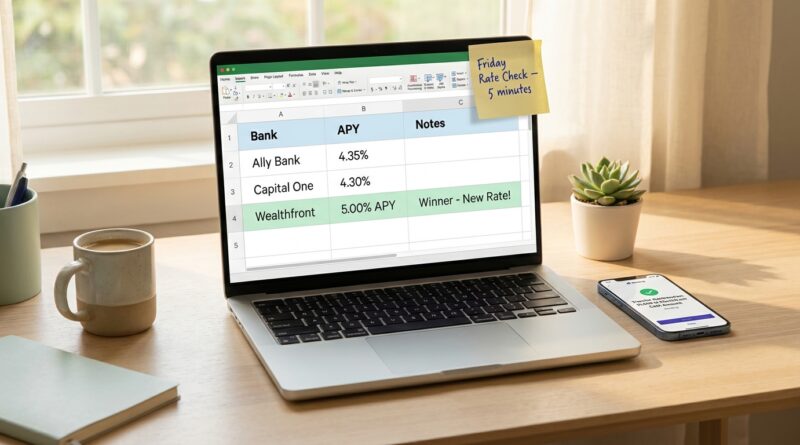
The 24-Hour ‘Rate Check & Switch’ Habit: One Tiny Weekly Routine That Keeps Your Savings Earning Top APY
You did the responsible thing. You found a high-yield savings account, moved your cash, and finally started earning something decent. Then the annoying part started. Rates kept moving. One bank dropped its APY. Another popped up with a better one. Now you are stuck wondering if your money is still in a good spot, and whether switching is worth the hassle. That feeling is common. It is not laziness. It is decision fatigue. The fix is not checking rates every day like it is a part-time job. The fix is one small routine. Give yourself a 24-hour “rate check and switch” window once a week. Spend a few minutes checking your current APY against a short list of top accounts. If your account is less than 0.50% behind, do nothing. If it is 0.50% or more behind, start the switch. That one rule keeps your savings competitive without turning you into a rate chaser.
⚡ In a Hurry? Key Takeaways
- A simple high-yield savings account rate check habit is to review your APY once a week and only switch if you are 0.50% or more behind top offers.
- Set a recurring 24-hour calendar block so you check rates, compare 3 to 5 banks, and decide once instead of worrying all week.
- Do not switch for tiny differences. Make sure any new account is FDIC or NCUA insured, has no surprise fees, and fits how you use your cash.
Why this habit matters more now
High-yield savings rates are still good by recent standards, but they are not sitting still. Banks adjust rates as the Fed moves, as deposit competition heats up, and sometimes for reasons that seem to come out of nowhere.
That means the account that was a great pick three months ago might be only okay today.
This is where many savers lose money quietly. Not thousands overnight. Just enough to be annoying. Maybe your APY slips from near the top of the market to well below it, and you do not notice for six months. On a decent emergency fund, that can mean losing hundreds of dollars a year for no good reason.
The answer is not constant monitoring. It is a repeatable rule.
The 24-hour “Rate Check & Switch” routine
Pick one day each week. Sunday evening works for a lot of people. So does Friday morning. Put a recurring reminder on your phone or calendar called “Savings rate check.” Give it 24 hours, not because the task takes that long, but because that is your decision window.
Inside that window, you do three things.
Step 1: Check your current APY
Log into your bank or open the app and confirm the current annual percentage yield. Not the rate you remember. The current one.
Step 2: Compare it against a short list
Look at 3 to 5 reputable banks or credit unions you would actually use. Keep this list short. You are building a habit, not writing a research paper.
Check for:
- Current APY
- FDIC or NCUA insurance
- Minimum balance requirements
- Monthly fees
- Transfer speed and ease of use
Step 3: Use the 0.50% rule
If your account is less than 0.50% behind the better options, stay put.
If your account is 0.50% or more behind, consider switching.
That threshold matters. It keeps you from moving money every time another bank edges ahead by a tiny amount. Chasing every 0.10% bump is how people burn out.
Why 0.50% is a useful cutoff
Because it is big enough to matter and big enough to reduce noise.
Here is a simple example. If you keep $20,000 in savings, a 0.50% APY gap is roughly $100 per year before taxes. On $50,000, it is about $250. That is real money. Worth noticing.
But a 0.10% difference on the same balance is usually not worth the paperwork, the transfer wait, the new login, and the mental clutter.
Your goal is not perfection. Your goal is to stay near the top without making this your hobby.
How to make the habit take less than 10 minutes
The easiest way is to remove decisions before you need them.
Create a tiny rate-check list
Keep a note on your phone with:
- Your current bank and APY
- Three backup banks you trust
- Your switch rule: “Only move if 0.50% behind”
Use one calendar reminder
Do not trust yourself to “remember later.” Savings habits usually fail in boring moments, not dramatic ones.
Keep your transfer account ready
If your external checking account is already linked to your savings account, switching gets much easier. A lot of people delay because they know setup is a nuisance.
When not to switch
Sometimes the best money move is to stay where you are.
Do not switch if:
- The APY gap is tiny
- The new bank has clunky transfers or bad customer support
- The account has balance hoops, teaser rates, or hidden limits
- You need this money soon and do not want transfer timing headaches
A high APY is important. It is not the only thing that matters.
What to check before opening a new account
This is the non-glamorous part, but it is what keeps a “better rate” from becoming an annoying mistake.
Insurance
Make sure the bank is FDIC insured, or the credit union is NCUA insured, within standard limits.
Fees
A high APY loses its shine fast if there are monthly maintenance fees or odd transfer charges.
Restrictions
Some accounts need a minimum opening deposit or a certain balance to earn the advertised rate.
User experience
If the website is bad, statements are confusing, or transfers take forever, that “top rate” may not feel so top once you start using it.
The biggest mistake savers make
They do the hard part once and then stop paying attention.
Building a cash cushion is not easy. If you already did it, great. Protect it. A good rate on savings is one of the few financial wins that is low-risk, simple, and available to regular people without expert knowledge.
That is why a weekly check matters. It is maintenance, like checking tire pressure or changing the batteries in the smoke detector. Not exciting. Very useful.
If you are also trying to free up more cash to send into savings, The 7-Day ‘No-Spend Streak To HYSA’ Challenge: Turn Zero-Spend Days Into Automatic High-Yield Wins is a smart next step. It pairs nicely with this rate-check habit. One helps you grow the pile. The other helps you keep the pile earning.
A sample weekly routine you can copy
Sunday, 7:00 p.m.
Open your savings app and check your APY.
Sunday, 7:05 p.m.
Compare it against your shortlist of 3 to 5 banks.
Sunday, 7:10 p.m.
Ask one question: “Am I 0.50% or more behind?”
Sunday, 7:11 p.m.
If no, close the tab and enjoy your evening.
Monday, any time
If yes, use the rest of the 24-hour window to confirm details and start the account opening process.
That is it. Not a spreadsheet marathon. Not a finance rabbit hole.
At a Glance: Comparison
| Feature/Aspect | Details | Verdict |
|---|---|---|
| Check frequency | Once a week during a set 24-hour decision window | Often enough to catch meaningful changes without obsessing |
| Switch threshold | Only switch if your APY is 0.50% or more below top comparable accounts | A practical rule that balances value and hassle |
| What to verify | Insurance, fees, minimums, transfer speed, and app usability | Do not chase APY alone. Check the full picture |
Conclusion
Right now, high-yield savings rates are still strong, but they are moving more often as banks react to Fed decisions and compete for deposits. That is exactly why a high-yield savings account rate check habit matters. Many savers did the hard work of building a cash cushion, then quietly lost hundreds a year because they never built a habit to notice when their APY fell behind. The good news is that this does not need to be complicated. A simple weekly check, paired with a clear “only switch if I am 0.50% behind” rule, gives you a concrete way to protect your yield without living on comparison sites or second-guessing yourself all week. Small habit. Real payoff.