The 5-Minute ‘Round-Up To HYSA’ Habit: Turn Every Swipe Into High-Yield Savings Without Thinking
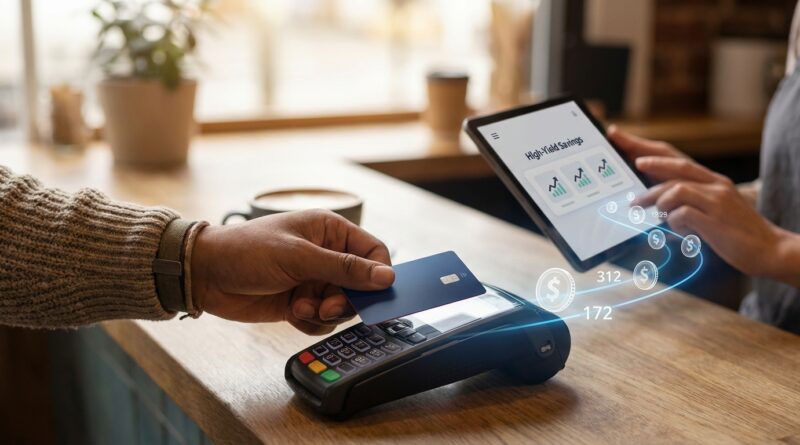
You are not lazy if saving keeps slipping through the cracks. Real life is just loud. You buy groceries, tap for coffee, grab takeout after a long day, and suddenly the month is gone. The usual advice, make a strict budget and move money manually, sounds nice until it starts feeling like extra homework. That is why the habit of using round up savings to high yield account tools is catching on. It works in the background. Every card swipe gets rounded to the next dollar, and the spare change moves into savings without you having to think about it. It is tiny enough not to hurt, but steady enough to add up. Pair that with a high-yield savings account, and those little transfers can earn a lot more than they would in a regular savings account. Five minutes to set up can turn everyday spending into a quiet savings habit that keeps going even when life gets busy.
⚡ In a Hurry? Key Takeaways
- Round-up tools automatically move spare change from purchases into savings, which makes saving easier without a full budget overhaul.
- Set your round-ups to flow into a high-yield savings account so the money earns more while it sits there.
- Check transfer timing, fees, and account minimums first so your new habit stays helpful, not annoying.
Why this habit works when other savings plans do not
Most people do not fail at saving because they do not care. They fail because saving usually asks for perfect timing, extra attention, and willpower right when money feels tight.
Round-ups solve a different problem. They shrink the decision.
Instead of asking, “Can I move $200 to savings this week?” the app asks for pennies and cents from purchases you already made. Buy something for $3.40, and it can move 60 cents. Spend $12.15, and it can move 85 cents. One swipe does not matter much. Fifty swipes in a month absolutely do.
That is why round up savings to high yield account setups feel so doable. They fit real spending habits. People do not spend in neat monthly chunks. They spend in a stream of little taps and clicks.
What “round up to HYSA” actually means
HYSA stands for high-yield savings account. It is simply a savings account that usually pays a much better interest rate than the old-style account attached to many checking accounts.
When you connect a round-up feature to a HYSA, the process usually works like this:
- You use your debit card or linked spending account for normal purchases.
- Each purchase gets rounded up to the next whole dollar.
- The spare change is collected or transferred.
- That money lands in your high-yield savings account.
The beauty is not that each transfer is huge. It is that the whole thing keeps running without needing a pep talk from you every Friday.
The five-minute setup
1. Pick the account that will receive the money
If your bank offers round-ups straight into its own savings account, start there for simplicity. If not, look for a bank or fintech app that lets you send round-up transfers into a separate HYSA.
Try to avoid an account with monthly fees or tricky balance rules. Small savings habits work best when every dollar gets to stay yours.
2. Link your spending account or card
This is usually your main checking account or debit card. Some apps also let you round up credit card purchases, but be careful there. If you carry a balance, interest charges can wipe out the benefit fast.
3. Turn on automatic round-ups
Most apps make this a simple toggle. Some let you choose whether transfers happen one by one or in daily or weekly batches.
Batch transfers are often easier to track.
4. Send the money to a high-yield savings account
This is the important part. If your spare change is going into a low-interest account, you are only doing half the job. The goal is to make those tiny deposits earn more once they arrive.
If you already have a good HYSA, great. If not, it is smart to keep an eye on rates over time. A helpful companion read is The 24-Hour ‘Rate Check & Switch’ Habit: One Tiny Weekly Routine That Keeps Your Savings Earning Top APY, which shows how to make sure your savings does not quietly drift into a weaker rate.
5. Set one simple rule for the money
Give the account a job. Emergency fund. Holiday cash. Car repairs. Summer trip. Vet bills.
Money with a label tends to stay saved.
How much can this really add up to?
Let’s keep it realistic. Round-ups alone probably will not make you rich. But they can absolutely build momentum.
If you make 40 card purchases a month and your average round-up is 50 cents, that is about $20 a month. If your spending is heavier, or your average round-up is closer to 70 or 80 cents, you might save $30 to $50 a month without noticing much difference in daily life.
That means:
- About $240 a year at $20 a month
- About $360 a year at $30 a month
- About $600 a year at $50 a month
Then add interest from a high-yield account, and the total gets a little stronger. No, it is not magic. But it is real money built from behavior you were already going to do anyway.
Who this works best for
This habit is especially useful for people who:
- Forget to move money manually
- Feel intimidated by detailed budgeting
- Want to start an emergency fund with very small amounts
- Use a debit card often
- Need a “set it and leave it alone” system
It is also good for people who keep saying, “I am too broke to save.” That feeling is common, and sometimes true in the sense that cash flow is tight. But round-ups can be gentle enough to work even when larger automatic transfers would bounce or feel stressful.
Where people get tripped up
Round-ups are still real money
The amounts are small, but they still come out of your spending account. If your checking balance runs close to zero, even tiny transfers can create headaches.
If that sounds like you, start with a rule like this: only keep round-ups on during stronger weeks, or pause them when bills are stacked up.
Debit card users usually benefit most
If you put everything on a rewards credit card and pay it off in full, a round-up app can still work. But make sure the transfer is separate from your card payment plan. You do not want to save $18 while revolving debt at 25 percent interest.
Not all apps move money instantly
Some tools collect round-ups and transfer them later. That is normal, but it means you should know the timing. It helps avoid the “wait, where did that $12 go?” moment.
Some accounts are not really high-yield anymore
Rates change. A HYSA that looked great six months ago may no longer be competitive. That is why a quick rate check every so often matters.
A simple way to make the habit stronger
If you want better results without much more effort, use one of these add-ons:
- Double round-ups. Some apps let you save 2x the spare change amount.
- Weekly top-off. Add a fixed $5 or $10 transfer every week alongside round-ups.
- Windfall rule. Any cash-back rewards, rebate app money, or refund goes into the same HYSA.
This is where the system starts to feel less like spare change and more like a real savings engine.
Best use cases for your round-up fund
Round-up savings to high yield account setups shine most for short-term and medium-term goals, such as:
- Starter emergency fund
- Holiday shopping
- Back-to-school costs
- Car maintenance
- Home repair cushion
- Travel sinking fund
It is not the best tool for long-term investing. For that, a retirement or brokerage account makes more sense. But for cash you may need within months or a couple of years, a HYSA is a much better fit.
How to know if your setup is working
Give it 30 days and check three things:
- Did you notice the transfers? If not, good. Friction is low.
- Did your checking account feel squeezed? If yes, adjust the setting.
- Did the savings balance grow faster than expected? That is the win.
The point is progress, not perfection. Even a modest balance can be enough to break the paycheck-to-panic cycle the next time a small emergency shows up.
At a Glance: Comparison
| Feature/Aspect | Details | Verdict |
|---|---|---|
| Ease of use | Once set up, round-ups happen automatically with everyday purchases. | Excellent for people who forget manual transfers. |
| Savings growth | Small deposits add up over time, especially when sent to a high-yield savings account. | Best for building starter funds and short-term goals. |
| Risk and downside | Can be annoying if your checking balance is very tight or if the app has fees or slow transfers. | Safe and useful if you watch fees, timing, and cash flow. |
Conclusion
If saving always seems to lose to real life, this is one of the few habits that works with that reality instead of fighting it. Round-up automations are popping up across banks and fintech apps right now because they match how people actually spend, in small, constant card swipes instead of big, perfect monthly transfers. That is what makes this habit so useful. It takes willpower mostly out of the equation, it pairs naturally with high-yield savings accounts that still pay much more than old-school savings, and it works for people who feel too broke to save in the first place. In one quick setup session, you can turn everyday purchases into a steady trickle of deposits that grow in the background. It is not flashy. It is not dramatic. It is just a smart, low-stress way to build an emergency fund or chip away at a short-term goal without cutting every little joy out of your life.