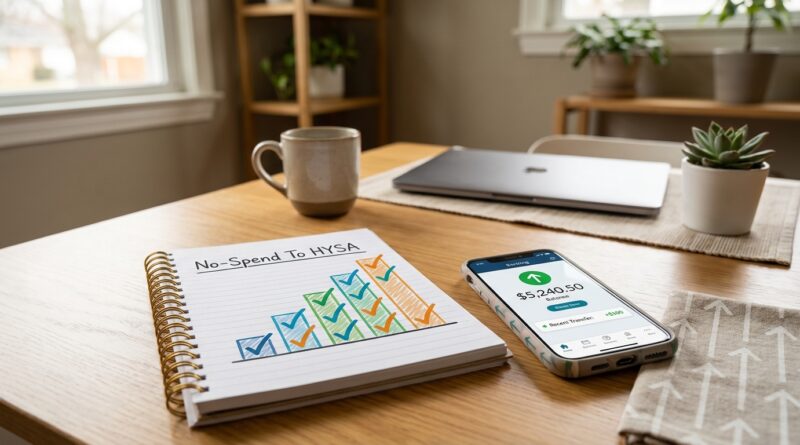
The 7-Day ‘No-Spend Streak To HYSA’ Challenge: Turn Zero-Spend Days Into Automatic High-Yield Wins
You do not need another money challenge that makes real life feel like cheating. That is the problem with a lot of no-spend plans. They sound great on Sunday night, then Tuesday hits, your week gets hectic, and somehow a coffee, a takeout lunch, and two “small” app orders have already slipped through. If that feels familiar, you are not bad with money. You are busy, tired, and living in a world designed to make spending feel easy. A 7-day no spend challenge high yield savings habit works better because it is short, light, and clear. The goal is not to stop living. It is to catch the tiny leaks, count the wins, and move that saved cash into a high-yield savings account automatically. That way your zero-spend days do more than make you feel disciplined for a moment. They actually build something you can see growing.
⚡ In a Hurry? Key Takeaways
- A 7-day no-spend streak works best when you focus on cutting optional daily spending, then transfer the saved amount straight into a high-yield savings account.
- Pick 2 or 3 common impulse categories, set clear rules, and automate transfers on every zero-spend day so the habit sticks.
- This should not replace bill payments or emergency cash. It works best as a low-stress savings boost, not a punishment plan.
Why this challenge works when longer no-spend plans fail
Most people do not quit no-spend challenges because they hate saving money. They quit because the rules are too strict, too vague, or too joyless.
“Spend nothing” sounds simple until you remember you have kids, errands, surprise expenses, social plans, and a brain that gets tempted at exactly the wrong moment.
A 7-day streak is different. It is short enough to feel possible and long enough to show patterns. You start noticing where money drips out. The afternoon snack run. The “treat myself” click. The delivery fee that somehow becomes a $24 dinner.
The bigger win is this. Instead of just not spending, you redirect the money into a high-yield savings account, or HYSA. That gives each zero-spend day a job. It is not about deprivation. It is about converting impulse money into future money.
What counts as a no-spend day?
This is where people get tripped up. A no-spend day is not a day where life stops. It is a day where you avoid nonessential spending.
Usually allowed
Rent, mortgage, utilities, gas for your normal commute, groceries already planned, prescriptions, childcare, and bill payments.
Usually not allowed
Takeout because you did not want to cook, random Amazon buys, convenience-store snacks, extra streaming rentals, impulse beauty buys, and “just browsing” purchases that end with a package at your door.
You can make your own rules, but keep them simple. If the rules need a flowchart, you will not follow them.
The 7-day ‘No-Spend Streak To HYSA’ setup
Here is the easy version.
Step 1: Pick your leak categories
Choose the 2 or 3 places where money quietly disappears. For most people, it is one of these:
- Coffee and drinks
- Takeout and delivery
- Impulse online shopping
- App purchases or digital extras
- Convenience-store stops
Do not try to fix every spending habit at once. Start where you bleed money most often.
Step 2: Give each zero-spend day a dollar value
This part matters. If you skip a $6 coffee and a $14 lunch, move $20 to savings. If you are not sure what you would have spent, use a flat number like $10, $15, or $25 per successful day.
The amount does not have to be perfect. It has to be consistent.
Step 3: Open or use a high-yield savings account
If your savings is still sitting in a low-interest account earning next to nothing, that is wasted momentum. A HYSA pays more interest than a traditional savings account, so the money from your no-spend streak gets a little extra help.
You are not going to get rich on interest alone. But when rates are still decent, every extra dollar does more there than in checking.
Step 4: Automate the transfer
Set up an automatic transfer if your bank allows it, or use a recurring reminder on your phone. Every time you hit a zero-spend day, transfer the amount that night or the next morning.
The faster the money leaves checking, the less likely you are to spend it later.
Step 5: Track the streak, not perfection
Use a notes app, paper calendar, or habit tracker. Mark each no-spend day with a simple check.
The goal is not seven flawless days forever. The goal is to build proof that you can interrupt autopilot spending.
A realistic 7-day example
Let’s say Maya usually spends in these “small” ways during a workweek:
- $5 coffee, three times a week
- $18 lunch out, twice a week
- $22 random online purchase, once a week
- $12 convenience-store stop on the weekend
That is $85 in one week. Not outrageous. Also not nothing.
If Maya uses a 7-day no spend challenge high yield savings habit and avoids those extras for even four days, she might move $40 to $60 into her HYSA that week. Repeat that a few times a month and suddenly her savings starts moving in a way that feels real.
That is the secret. Tiny savings look boring in isolation. Repeated and redirected, they stop being tiny.
How to make the challenge feel easier, not miserable
You do not need to white-knuckle your way through the week. You need friction in the right places.
Delete your fastest spending shortcuts
Remove saved payment methods from your favorite shopping apps. Log out of food delivery apps. Move shopping apps off your home screen.
If spending takes 30 extra seconds, you will dodge more impulse buys than you think.
Prep one backup option
No-spend plans usually fail when you are hungry, rushed, or worn out. Keep one easy meal at home. Pack one snack. Have one low-effort plan for busy nights.
You are not trying to become a meal-prep influencer. You just need a safety valve.
Tell yourself what you can do
“I cannot buy anything fun this week” feels like punishment. “I am protecting four zero-spend days this week” feels doable.
Language matters because your brain listens.
Use a visible savings target
Name the HYSA goal. Emergency cushion. Holiday cash. Car repair buffer. Summer travel fund.
A streak works better when the money has a destination.
What if you break the streak on day two?
Then you are a normal person.
This is where many people give up. One bad day turns into “Well, I blew it.” But a streak challenge is supposed to teach recovery, not perfection.
If you spend on something nonessential, do not scrap the week. Just restart the next day. Count total zero-spend days in the 7-day window. If you hit four out of seven, that is still progress. If you transferred money to savings on those four days, that is still a win.
Think of the streak as a game board, not a moral test.
Why pairing the challenge with a HYSA changes everything
Skipping purchases feels abstract. Watching savings go up feels concrete.
That is why this method sticks better than a generic spending freeze. Your reward is not just self-control. It is a growing balance in an account designed to pay you more than standard savings.
Right now, that matters. Prices are still high. A lot of households feel like they are doing everything right and still treading water. A HYSA will not fix inflation, but it gives your extra cash a better parking spot while you build a cushion.
If you want a slightly longer version of this idea, The 10-Day ‘No-Spend Lite’ Challenge: How To Test-Drive Frugality And Funnel Real Cash Into Your High‑Yield Savings is a good next step. It keeps the same low-pressure spirit without turning your life upside down.
Common mistakes to avoid
Making the rules too strict
If one birthday coffee ruins the entire challenge in your mind, the challenge is too brittle.
Saving “what is left over”
There is usually nothing left over. Move the money right after the win.
Ignoring your biggest triggers
If stress shopping is your weak spot, a challenge that only focuses on groceries will miss the point.
Using the challenge to avoid bigger money problems
This habit helps with leaks. It will not solve under-earning, high debt, or a budget that is already stretched beyond reason. It is one tool, not the whole toolbox.
Who this works best for
This challenge is a great fit if you:
- Keep making small impulse purchases you barely remember
- Want to save without trying a harsh month-long spending ban
- Need a simple system that works during busy weeks
- Like the motivation of visible streaks and quick wins
- Already have, or are willing to open, a high-yield savings account
It may not be the best first step if you are struggling to cover essentials. In that case, start with bill stability, cash flow, and emergency basics first.
At a Glance: Comparison
| Feature/Aspect | Details | Verdict |
|---|---|---|
| Challenge length | Seven days is short enough to start now, but long enough to spot impulse spending patterns. | Good for beginners |
| Savings method | Each zero-spend day triggers a transfer into a high-yield savings account. | Best part of the system |
| Real-life flexibility | Allows essentials and planned bills while targeting optional, impulse spending. | More sustainable than extreme no-spend rules |
Conclusion
A good money habit should help you feel calmer, not cornered. That is why this 7-day no-spend streak works. It is light enough to survive real life, but focused enough to make a difference. And right now, that difference matters. Inflation and higher prices are still squeezing everyday budgets, while high-yield savings rates are strong enough that every extra dollar you tuck away actually counts. This kind of streak-based system helps you catch the tiny leaks that quietly sabotage your goals, move that reclaimed cash into a high-yield account where it can finally earn something, and build a repeatable habit you can use even during busy weeks, side hustles, and family chaos. Start small. Protect a few zero-spend days. Transfer the win. Then watch your savings begin to answer back.