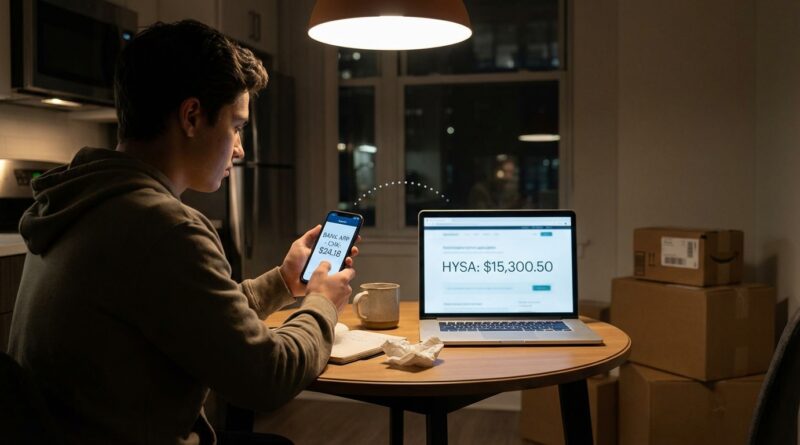
The ‘Bank Distance’ Trick: One Tiny Barrier That Stops You Raiding Your High‑Yield Savings
You are not lazy, careless, or bad at money if you keep moving cash into a high-yield savings account and then pulling it back out a week later. A lot of smart people do this. The problem is not that you do not understand saving. The problem is that your savings account is often set up to be a little too convenient. When stress hits, when a sale pops up, or when you just want relief, that “available balance” starts looking like permission. If you want to know how to stop dipping into high yield savings, the fix is often surprisingly small. Create bank distance. In plain English, keep your savings at a different bank than your checking. That one tiny barrier adds just enough friction to stop impulse transfers without trapping your money. You still have access. You just do not have instant access, and that pause can save you from future-you.
⚡ In a Hurry? Key Takeaways
- The best way to stop dipping into high-yield savings is to keep it at a separate bank from your everyday checking account.
- Remove instant transfer shortcuts, hide the account from your main app view, and give the money a job like “taxes,” “house fund,” or “3-month emergency cushion.”
- You are not locking your money away forever. You are building a speed bump that protects your goals while still keeping the cash safe and accessible.
Why high-yield savings can be too easy to raid
High-yield savings accounts are great. Rates near 5 percent are nothing to sneeze at. But many people accidentally build the perfect system for saving and spending from the same pile.
Here is what usually happens. You open a HYSA linked directly to your checking account. Transfers are fast. The app is on your phone. Both balances sit on the same dashboard. You feel organized. Responsible, even.
Then life gets loud.
A rough week. A car repair. A birthday dinner you want to say yes to. A “limited-time” sale. You tell yourself, “I will replace it next paycheck.” Sometimes you do. Sometimes you do not.
That is why the biggest leak is often not the interest rate. It is behavior. Easy transfers into savings also mean easy transfers out.
The “bank distance” trick
Bank distance means keeping your main spending account and your main savings account at different banks.
That is it. Nothing fancy.
Your paycheck can still land in checking at your regular bank. Your savings can still earn a strong rate at an online bank. But instead of being one tap away, the money now requires a little effort. Maybe it takes one business day. Maybe you need to log into a different app. Maybe you have to remember a separate password.
That tiny bit of friction matters a lot.
Why this works so well
People often think discipline is the answer. It helps, sure. But systems beat willpower most days.
Bank distance works because it creates a pause between the urge and the action. And that pause is where better decisions happen.
You go from, “I want this right now,” to, “Do I want this enough to start a transfer and wait?”
A surprising number of purchases do not survive that question.
How to set up bank distance without making your life harder
The goal is not to make your money impossible to reach. This is not about punishment. It is about making your savings slightly inconvenient for impulse spending and still available for real needs.
1. Put your HYSA at a different bank than checking
If your checking is at a big brick-and-mortar bank, consider keeping your savings at a separate online bank. If your HYSA is already at the same place as checking, this may be your sign to move it.
Look for a bank with:
- Strong FDIC or NCUA protection
- No monthly fees
- A competitive APY
- Easy ACH transfers, but not instant spending tools tied to the account
2. Do not order the debit card if one is offered
Some savings products blur the line between saving and spending. If the account comes with a card, ask yourself if that helps your goal or hurts it.
For most people trying to stop dipping into savings, a debit card is a bad idea.
3. Unlink it from your budgeting home screen if possible
If your banking app shows your savings every time you open it, your brain starts treating that number like available cash. If your app lets you hide accounts or reorder them, move savings lower or out of sight.
Out of sight is not childish. It is practical.
4. Rename the account for the job it is doing
“Savings” is vague. Vague money gets spent.
Better names are:
- Emergency Fund. Touch Only for True Emergencies
- Home Down Payment
- Quarterly Taxes
- Next Car Fund
- 3 Months of Bills
Specific money is harder to steal from yourself.
5. Keep a smaller “comfort buffer” in checking
One reason people keep raiding savings is that checking feels too tight. Every surprise expense feels like a crisis.
Give yourself a little breathing room. Maybe that means keeping an extra $300 to $1,000 in checking, depending on your life. That buffer can handle the small nonsense so you do not keep poking holes in long-term savings.
What bank distance is not
It is not a replacement for an emergency fund.
It is not a rule that says you can never use your savings.
And it is definitely not about feeling guilty for spending on things you enjoy.
The whole point is to protect the money that has an important job while leaving room in the rest of your budget for real life.
If you are still building that savings habit, a steady transfer system can help. I like the idea behind The $27.39 Daily ‘Skim’: A Weirdly Specific Habit That Can Add $10,000 To Your High-Yield Savings This Year because it focuses on making saving smaller and more repeatable. That works even better when the money then lands somewhere with a bit of distance.
When you actually should transfer money back out
This is important. Bank distance should block impulse spending, not real needs.
Good reasons to use your savings include:
- An actual emergency
- A planned expense the fund was built for
- A temporary cash-flow gap you can clearly explain and recover from
Bad reasons usually sound like this:
- “I had a stressful week”
- “It is on sale”
- “I deserve it”
- “I will probably put it back later”
You do deserve nice things, by the way. The trick is to buy them from your spending plan, not from the money meant to protect your future.
A simple setup you can copy
If you want a practical version, try this:
Your checking account
- Paycheck lands here
- Bills and card payments come from here
- Keep a small buffer for everyday surprises
Your HYSA at a separate bank
- Emergency fund
- Sinking funds for bigger goals
- Automatic transfer set for payday
Your rule
No transfer out of savings on the same day as the urge. Wait 24 hours unless it is a true emergency.
That one rule alone can stop a lot of nonsense spending.
If you need even more friction
Some people need a taller speed bump. That is okay too.
You can add more friction by:
- Using a bank with slightly slower ACH timing
- Turning off account notifications that spotlight your savings balance
- Not saving the login in your password manager on your phone
- Checking the balance only once a week or once a month
- Splitting emergency savings from goal savings into separate buckets
You are not trying to trick yourself in a bad way. You are building guardrails. We do this in other parts of life all the time. Passwords. Speed limits. Child locks. Bank distance is the money version of that.
At a Glance: Comparison
| Feature/Aspect | Details | Verdict |
|---|---|---|
| Same-bank checking and HYSA | Fast, simple transfers both ways. Very convenient, but easy to raid during stress or impulse moments. | Good for convenience, weaker for behavior control. |
| Separate-bank “bank distance” setup | Savings stays accessible, but requires an extra step and usually a wait. That pause reduces emotional transfers. | Best balance of access and protection for most people. |
| Extra friction tools | No debit card, hidden app view, named savings goals, 24-hour waiting rule, checking buffer. | Great add-ons if you know you spend emotionally. |
Conclusion
High-yield savings accounts are still one of the best low-drama places to park cash, especially with top rates hovering near 5 percent. But for a lot of people, the real problem is not finding a better APY. It is stopping the back-and-forth transfers that quietly undo progress. If you have been wondering how to stop dipping into high yield savings, do not assume you need more self-control. You may just need one tiny barrier. Bank distance keeps your freedom to spend on what you love while protecting the goals that matter most. It uses psychology instead of white-knuckle willpower. And that is the part many money articles skip. Opening another account is easy. Designing it so the money actually stays put long enough to grow, that is the smart move.