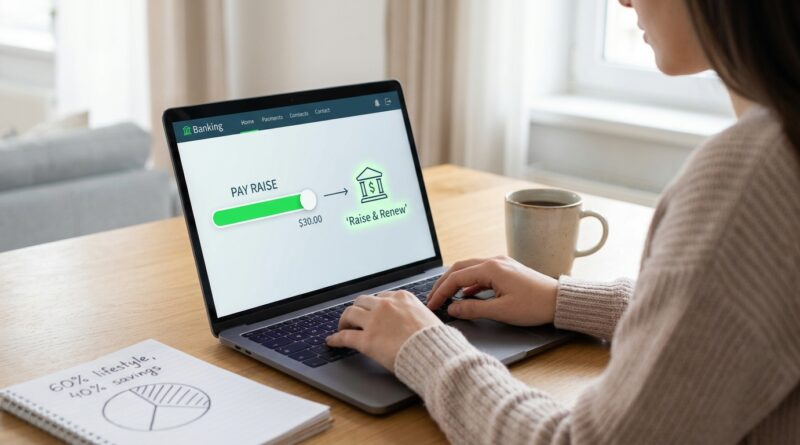
The ‘Raise & Renew’ HYSA Habit: Turn Every Annual Raise Into A Lifetime Savings Jump
You get a raise, feel relieved for about five minutes, and then somehow nothing changes. That is not you being bad with money. It is just how lifestyle creep works. A little more takeout here, a couple of upgrades there, one “why not” Target trip, and suddenly the extra pay is gone. A year later, your savings account looks almost the same, which is frustrating when you know you are earning more. The fix is surprisingly simple. Treat raise day like a reset button. Before the extra money blends into your checking account, send most or all of that increase straight into a high yield savings account. If you want the plain-English version of how to use a raise to build savings in a high yield savings account, it is this: save the raise before you get used to spending it. That one habit can make your next pay bump feel useful for more than a weekend.
⚡ In a Hurry? Key Takeaways
- When you get a raise, move the increase, or a big chunk of it, straight to a high yield savings account before you start spending it.
- Update your direct deposit or automatic transfer the same week your new paycheck starts.
- This works best in an FDIC- or NCUA-insured high yield savings account, where your money stays safer and earns more than a typical big-bank savings account.
Why raises disappear so fast
Most raises do not vanish in one dramatic splurge. They leak away in small, forgettable ways.
You start saying yes to lunch out a little more often. You stop waiting for sales. You upgrade a few subscriptions. None of it feels reckless. But over time, your new income becomes your new normal.
That is why so many people say, “I make more, but I still feel broke.” The raise helped your cash flow, but it never got a job.
The smarter move is to give that new money a home right away. A high yield savings account, or HYSA, is a great first stop because it keeps the money accessible while paying real interest.
The Raise & Renew habit, explained simply
Here is the habit in one sentence: every time your pay goes up, your savings goes up too.
Think of it as a mini New Year for your money. You do not need a total budget overhaul. You just need one fresh decision when your raise hits.
How it works
If your paycheck rises by $100 per pay period after taxes, send that $100, or maybe $75 of it, straight into your HYSA automatically.
You are not cutting your current lifestyle. You are skimming off money you were not relying on before.
That is what makes this habit feel realistic. It is not extreme. It is clean, quick, and hard to miss once it is automated.
How to use a raise to build savings in a high yield savings account
If you want to start this with your very next raise, follow these steps.
1. Find your real raise amount after taxes
Do not use the headline number from your manager or HR email. Look at your updated take-home pay.
Maybe your salary went up by $3,000 a year, but your actual paycheck only increased by $78 every two weeks. That $78 is the number that matters for your plan.
2. Pick your split
You do not have to save 100 percent of the raise, though that is the fastest way to build momentum.
Try one of these easy options:
- Save 100 percent of the raise if your current budget already works.
- Save 75 percent and use 25 percent for breathing room.
- Save 50 percent if you are paying off debt and need flexibility.
The best split is the one you will actually keep doing.
3. Set up the transfer right away
Timing matters. The first paycheck with your raise is the danger zone. If it lands in checking and sits there, it starts looking spendable.
Instead, set up one of these:
- A payroll split that sends part of your paycheck directly to your HYSA.
- An automatic transfer scheduled for payday.
If your bank makes it easy, name the account something specific like “Next Car,” “Emergency Fund,” or “House Buffer.” People save more consistently when the money has a purpose.
4. Renew the habit every year
This is the part people skip. One raise helps. Repeating the move year after year is what changes your future.
That is why I like calling it Raise & Renew. Every annual bump is your signal to review your account, increase the transfer, and keep the cycle going.
Why a high yield savings account makes this even better right now
For years, regular savings accounts at big banks paid so little that it barely felt worth thinking about. That is not the case right now.
Many high yield savings accounts still pay much more than old-school savings accounts. That means your raise is doing two jobs at once. First, it adds new money. Second, the account itself pays you more interest on top of that.
No, a HYSA will not make you rich overnight. But it is one of the easiest places to park short-term and medium-term savings while still earning something meaningful.
Just make sure the account is FDIC-insured at a bank, or NCUA-insured at a credit union, and check for fees or minimum balance rules.
A quick example
Let’s say your take-home pay goes up by $150 a month after a raise.
If you send that full $150 into a HYSA every month, you save $1,800 in a year, not counting interest. Keep doing that with each future raise, and the number gets much bigger than most people expect.
Even if you start smaller, say $75 a month, you are still building a cushion with money you probably would have spent without noticing.
That is the quiet power of this habit. It does not need drama to work.
What if you need part of the raise for real life?
That is completely fine.
If rent went up, child care costs more, or groceries are eating you alive, do not force a perfect savings target. Save a piece of the raise, not necessarily all of it.
Even 20 percent is better than zero. The habit matters more than the starting amount.
A good rule is this: if your bills truly need 70 percent of the raise, try to protect the other 30 percent for savings. Build the muscle first. Increase it later when life calms down.
Make it even easier with a second savings habit
If you like the idea of automating “found money,” pair this method with smaller everyday savings too. One smart companion strategy is The ‘Round‑Up Receipt’ HYSA Habit: Turn Every Card Swipe Into Automatic Savings.
That approach catches loose change from normal spending, while the Raise & Renew habit captures bigger jumps in income. Together, they create a steady stream into savings without making you feel deprived.
Mistakes to avoid
Waiting too long
The longer you wait, the more likely the raise becomes part of your everyday spending.
Keeping the money in checking
Checking accounts are for motion. Savings accounts are for intention. If the raise stays mixed in with bill money, it is easier to spend by accident.
Choosing a low-paying savings account out of habit
If your old bank is paying next to nothing, that is a missed chance. Compare rates and move the money where it can work harder.
Making the plan too strict
If saving the entire raise makes you feel squeezed, scale it back. A plan you can live with beats a perfect plan you quit in two months.
At a Glance: Comparison
| Feature/Aspect | Details | Verdict |
|---|---|---|
| Saving your raise automatically | Set payroll split or payday transfer so the extra income goes to your HYSA before you can spend it | Best way to stop lifestyle creep |
| Using a regular low-rate savings account | Money is still saved, but it earns much less interest at many traditional banks | Better than nothing, but not ideal |
| Saving only what is left at month’s end | Relies on willpower and usually gets eaten up by random spending | Least reliable option |
Conclusion
Raises should help you move forward, not just fund slightly more expensive habits you barely notice. Right now, a lot of employers are handing out cost-of-living bumps and review-season raises, and high yield savings accounts are still paying far more than many brick-and-mortar banks. That mix can be genuinely useful, but only if you capture the raise before it quietly disappears. Treat each pay bump like a mini New Year for your money. Update the transfer. Renew the habit. That one small move fights the “I make more but feel just as broke” problem and puts fresh dollars into an account that is finally paying real interest. No extreme frugality required. Just a smarter home for money that was likely to drift away anyway.