The 10-Minute ‘Rate Check Sunday’ Habit: Stop Leaving HYSA Interest On The Table
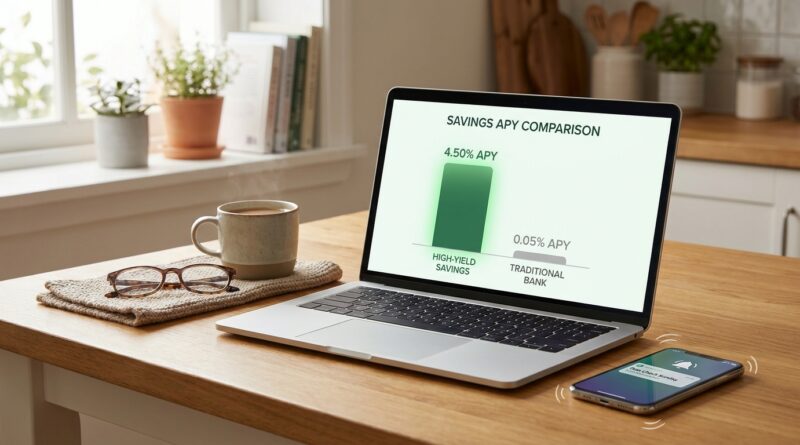
It is annoying to know your savings could be earning more, but feel like keeping up with rates is basically a part-time job. That is where a simple weekly high-yield savings account rate check habit can help. Right now, some high-yield savings accounts are still paying around 4 percent to 5 percent APY, while many traditional savings accounts are stuck close to zero. That gap is not small. It is real money you are giving up for doing nothing. The good news is you do not need to chase every tiny rate bump or open a new account every week. A 10-minute “Rate Check Sunday” routine gives you a calmer way to stay current. You check your account’s APY, compare it with a few leading HYSAs, and only make a move if the difference is big enough to matter. It is low effort, easy to repeat, and a smart way to stop leaving interest on the table.
⚡ In a Hurry? Key Takeaways
- A weekly high-yield savings account rate check habit helps you spot when your savings rate has fallen behind without obsessing over every headline.
- Set a simple rule, like only switching if your APY is at least 0.50 to 1.00 percentage point below a top FDIC- or NCUA-insured option.
- Always check insurance coverage, transfer timing, and any account requirements before moving money. The highest rate is not worth hassle or risk.
Why this habit matters right now
Savings rates are not at panic levels, but they are still high enough to matter. That is the key point. If your money is sitting in a legacy savings account earning 0.01 percent or 0.10 percent, you are missing out on one of the easiest wins in personal finance.
Let’s make it real. If you keep $10,000 in an account earning 0.10 percent, you will earn about $10 over a year, before taxes. Put that same money in a HYSA earning 4.50 percent, and you are closer to $450. That is a huge difference for the same cash, with the same basic job: sitting safely and staying available.
The problem is not that people do not care. It is that rates move, banks change offers, and nobody wants to spend their Sunday turning into a spreadsheet goblin.
What “Rate Check Sunday” actually looks like
This is not a full financial review. It is a tiny routine. Ten minutes. Once a week. Same day, same time if possible.
Step 1: Check your current APY
Log into your bank and find the annual percentage yield, or APY, on your savings account. Not the promotional headline from when you opened it. The current APY.
Write it down in a note on your phone, a sticky note, or a simple spreadsheet. The goal is not perfection. The goal is to know your actual number.
Step 2: Compare it with 3 to 5 competitive HYSAs
Look at a handful of reputable banks or credit unions offering high-yield savings accounts. You do not need to scan the whole internet. Just compare against a short list of well-known options that are FDIC-insured or NCUA-insured.
This gives you a realistic “top of market” snapshot without sending you into rate-chasing mode.
Step 3: Use a switch threshold
This is the part that saves your sanity. Decide in advance what counts as “worth moving.” For many people, a gap of 0.50 percentage point is enough to pay attention. A gap of 0.75 to 1.00 percentage point is often enough to act.
Example: If your account is at 3.80 percent and top accounts are at 4.10 percent, you probably do nothing. If your account is at 2.90 percent and solid competitors are at 4.40 percent, that is worth a closer look.
Step 4: Check the fine print before moving
Do not look at APY alone. Check for minimum balance rules, transfer delays, monthly transaction limits, app quality, customer support, and whether the rate is a short promo.
A slightly lower rate at a better bank can be the smarter choice if it is easier to use and less likely to annoy you.
The golden rule: do not switch for crumbs
This is where a lot of people burn out. They move money for every tiny bump, then get tired, miss a transfer, or end up with five accounts they barely remember opening.
Do not do that.
Your weekly high-yield savings account rate check habit should help you capture most of the upside, not every last penny. There is a big difference.
If the gap is small, stay put. If the gap is large and likely to stick, move. That one rule keeps this whole system manageable.
How to decide if switching is actually worth it
Ask yourself these three questions.
1. How much cash is in the account?
The more money you keep in savings, the more a rate gap matters. A 1 percent difference on $1,000 is not life-changing. On $25,000, it gets your attention.
2. Is the new rate stable or just a flashy promo?
If the new bank is shouting about a special rate that disappears after three months, be careful. A steady, competitive account is usually better than a teaser.
3. Will the move create hassle?
If switching means changing linked accounts, updating direct deposit, or worrying about transfer holds during an emergency, factor that in. Convenience has value too.
A simple Rate Check Sunday template
Here is a routine you can repeat every week:
- Open your current savings account and note the APY.
- Check 3 to 5 competitive HYSA rates.
- Compare the gap.
- If the gap is less than 0.50 percent, do nothing.
- If the gap is 0.50 to 0.99 percent, add it to a watch list.
- If the gap is 1.00 percent or more, review whether switching makes sense.
- Confirm FDIC or NCUA insurance before opening anything new.
That is it. No rabbit holes. No 47 browser tabs.
Common mistakes to avoid
Chasing every headline
News about rates can make it sound like you need to react immediately. Usually, you do not. Weekly is enough for most savers.
Ignoring your current bank’s quiet rate cuts
Some banks are happy to let old accounts drift lower while newer customers get better offers. Your account may not be as competitive as you think.
Forgetting about insurance
This one matters. Stick with accounts covered by FDIC insurance at banks or NCUA insurance at credit unions, within coverage limits.
Moving emergency savings somewhere inconvenient
Your emergency fund still needs to be easy to reach. Yield matters, but access matters too.
Who should use this habit most
This works especially well for people who:
- Keep a healthy emergency fund in cash
- Have not checked their savings APY in months or years
- Feel overwhelmed by rate changes
- Want better returns without constant account hopping
If that sounds like you, this habit is a very good fit.
Make it even easier
If you want a lighter version of this routine, take a look at The 5-Minute ‘Spring Sweep To HYSA’ Habit: Turn One Weekly Checkup Into Year-Round High-Yield Gains. It is a good companion if you want a simple framework for keeping your savings competitive without turning it into a project.
At a Glance: Comparison
| Feature/Aspect | Details | Verdict |
|---|---|---|
| Weekly check frequency | A once-a-week review is enough for most people to track meaningful changes without overthinking it. | Best balance of awareness and low effort |
| Switch threshold | A gap of 0.50 to 1.00 percentage point usually separates “interesting” from “worth moving.” | Use a rule so emotion does not run the show |
| Safety and convenience | FDIC or NCUA insurance, easy transfers, and a usable app matter almost as much as headline APY. | Do not pick rate alone |
Conclusion
You do not need to become a rate nerd to make smarter savings moves. A weekly high-yield savings account rate check habit gives you a simple way to stay on top of a fast-changing market without burning yourself out. Rates are holding steady but still historically high, and the spread between old-school savings and competitive HYSAs is still massive. If you compare your APY once a week and only act when the gap is big enough, you will capture most of the benefit with a fraction of the hassle. That is the sweet spot. Small habit, real payoff.