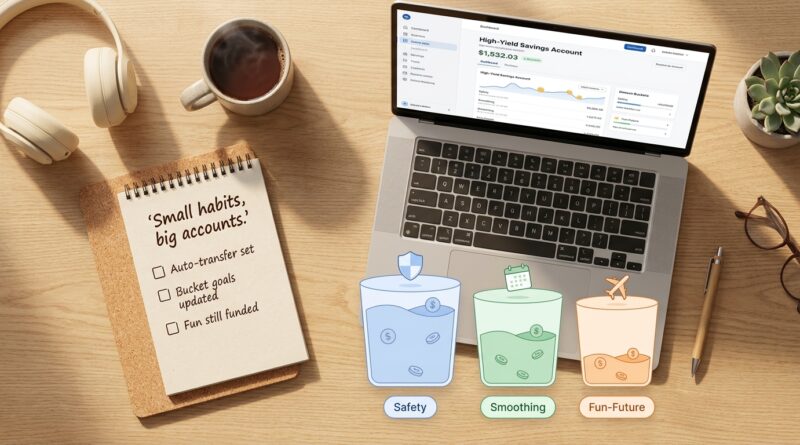
The 3-Bucket HYSA Habit: One High-Yield Account, Three Mental ‘Buckets,’ Zero Overwhelm
You are not failing at saving. Your system is. That is the part a lot of money advice skips. You open a high-yield savings account because it feels like the grown-up move, then one car repair, one rent shortfall, or one rough week later, the whole balance gets raided. Now the account that was supposed to make you feel secure just feels like another reminder that money never sits still. If that sounds familiar, take a breath. You do not need five bank accounts, a color-coded spreadsheet, or the energy to chase every tiny APY change. A simple high yield savings account strategy for beginners is often better: keep one HYSA, but split it into three mental buckets with clear jobs. One bucket is for emergencies. One is for near-term bills or known expenses. One is for guilt-free fun. Same account. Three purposes. A lot less chaos.
⚡ In a Hurry? Key Takeaways
- The easiest beginner strategy is one high-yield savings account with three mental buckets: emergency, near-term bills, and fun.
- Set target amounts for each bucket, then automate small weekly transfers so you are not relying on motivation.
- This method protects your savings from all-or-nothing withdrawals and helps you keep earning interest while rates are still decent.
Why one big savings pile feels so stressful
When every dollar in your HYSA sits in one undifferentiated lump, your brain treats it like one big “available” number. That is where the yo-yo starts.
You might have $2,000 saved. Sounds good on paper. But if $800 is really next month’s rent buffer, $700 is your baby emergency fund, and $100 is money you hoped to use for a birthday dinner, then you do not actually have a clean $2,000 to play with.
Without labels, every withdrawal feels like you are stealing from your future self. And every deposit feels too small to matter.
That emotional mess is why many beginners keep bouncing between “I need to save everything” and “Forget it, I already ruined it.”
The 3-bucket HYSA habit
This is the simple fix. Keep one high-yield savings account. Inside your head, or in a notes app, divide it into three buckets.
Bucket 1: Emergency
This is the “life happened” bucket. Car trouble. Urgent travel. A medical copay. A sudden reduction in hours at work.
For most beginners, the first target does not need to be three to six months of expenses right away. That number can feel so huge that people quit before they start. A better first milestone is $500, then $1,000, then one month of bare-bones expenses.
Bucket 2: Near-term bills
This is the bucket that keeps your checking account from turning into a panic room. Think next month’s rent cushion, annual insurance, holiday spending, back-to-school costs, or a bill you know is coming.
This bucket is important because it reduces the odds that you will drain your emergency money for something that was never really an emergency.
Bucket 3: Fun
Yes, fun gets a bucket too.
This is where a lot of financial plans quietly fall apart. If your savings system has no room for real life, it becomes punishment. A small fun bucket helps you spend on purpose instead of blowing up your budget out of frustration. Coffee with a friend, a cheap weekend outing, birthday gifts, takeout after a brutal week. It counts.
Why this works better than opening multiple accounts right away
You can absolutely open separate accounts later if that helps you. Some banks even let you create savings “vaults” or named goals inside one account. But for many people, especially beginners, one account is easier to manage.
Less admin. Fewer passwords. Fewer transfer rules. Less chance you forget where your money is.
The trick is not complexity. The trick is clarity.
A good high yield savings account strategy for beginners should lower the mental load, not raise it.
How to set up your three buckets in 15 minutes
Step 1: Write down your current HYSA balance
Use the real number. No shame attached.
Step 2: Give every current dollar a job
Take that balance and assign it across the three buckets. Example:
- Emergency: $600
- Near-term bills: $300
- Fun: $100
Total: $1,000
You are not moving money into separate places unless your bank supports that feature. You are just naming what each part of the balance is for.
Step 3: Pick target amounts
Keep these realistic. The goal is momentum.
- Emergency target: $1,000 to start
- Near-term bills target: one month of rent buffer, or the next known big bill
- Fun target: $100 to $300, depending on your income
Step 4: Automate tiny weekly transfers
Weekly beats monthly for many people because it feels more manageable. It also works better if your income is uneven.
Example automation:
- $20 a week to Emergency
- $15 a week to Near-term bills
- $5 a week to Fun
That is $40 a week total. Not tiny for everyone, of course. If that is too much, cut it down. Even $10, split three ways, counts.
Step 5: Track it somewhere stupidly simple
Use your phone notes app, a sticky note, or a basic spreadsheet. Example:
- HYSA total balance: $1,240
- Emergency: $760
- Near-term bills: $380
- Fun: $100
That is enough. You do not need a dashboard worthy of a finance startup.
The rule that makes the system work
When you withdraw money, subtract it from the right bucket only.
If your tire blows out, that comes from Emergency. If you use money for a holiday gift, that comes from Fun. If you pull cash because your checking account is short before rent clears, that comes from Near-term bills.
This matters because it keeps one bad week from wiping out your whole sense of progress.
You are no longer saying, “I had savings, and now I do not.” You are saying, “I used the bucket that was built for this.”
What if your income is irregular?
This system still works. You just use percentages instead of fixed amounts.
Let’s say any time money comes in, you move 5 percent to savings. Then inside your three-bucket plan, you assign it like this:
- 50 percent to Emergency
- 35 percent to Near-term bills
- 15 percent to Fun
If you have a stronger need for rent stability right now, flip those numbers. The point is to decide once, ahead of time, so every payday does not become a fresh debate.
How often should you chase a better APY?
Less often than the internet suggests.
If your current HYSA is from a reputable, FDIC- or NCUA-insured institution and the rate is still competitive, you probably do not need to switch every time another bank is 0.15 percent higher.
Rates are still useful. They matter. But the gap between “best possible rate” and “pretty good rate” is often smaller than the cost of having a system you never actually stick with.
For most readers, behavior beats optimization. A solid habit in a decent account usually wins over a perfect APY in an account you keep emptying.
Common mistakes beginners make
Making the emergency goal too big, too fast
If your target feels impossible, you will avoid looking at it. Start smaller. Build proof that you can do this.
Using the emergency bucket for predictable expenses
Car registration is annoying, but if it happens every year, it is not an emergency. That belongs in Near-term bills.
Skipping the fun bucket
This is the one people love to judge, but it is practical. Small planned joy is cheaper than burnout spending.
Moving money manually every single time
If you can automate deposits, do it. Willpower is unreliable. Systems are better.
A beginner example that feels real
Imagine Maya has $75 left most weeks after bills, groceries, and gas. She opens one HYSA and sets these weekly transfers:
- $35 to Emergency
- $25 to Near-term bills
- $15 to Fun
After 10 weeks, she has not become a finance influencer. She has just built structure.
- Emergency: $350
- Near-term bills: $250
- Fun: $150
Then a surprise prescription costs $90. Old system: she would pull money from savings and feel like she was back at zero. New system: she uses Emergency, updates the note, and keeps going.
That shift sounds small. It is not. It is how saving starts to feel steady instead of fragile.
At a Glance: Comparison
| Feature/Aspect | Details | Verdict |
|---|---|---|
| Number of accounts | One HYSA, tracked as three mental buckets | Best for simplicity and follow-through |
| Savings method | Small weekly automated transfers with set targets for each bucket | More realistic than waiting for “extra money” |
| Main benefit | Prevents every withdrawal from wiping out your sense of progress | Strong emotional and practical win for beginners |
Conclusion
You do not need the perfect bank, the perfect rate, or a perfect month to start saving better. You need a system that matches real life. That is why the three-bucket habit is so useful right now. Rates are still fairly high, even if they are starting to drift down, and most people are tired of advice that just throws bank names and percentages at them. One HYSA with three clear jobs turns all that noise into something you can actually use every week. You make one decision about your targets, automate small transfers, and stop treating every life event like proof you cannot save. For people who feel late, stretched thin, or inconsistent, this is an easy on-ramp. Simple counts. Progress counts. And if your money habits have felt messy until now, that does not mean you are bad at this. It usually just means no one handed you a structure that was kind enough to stick.