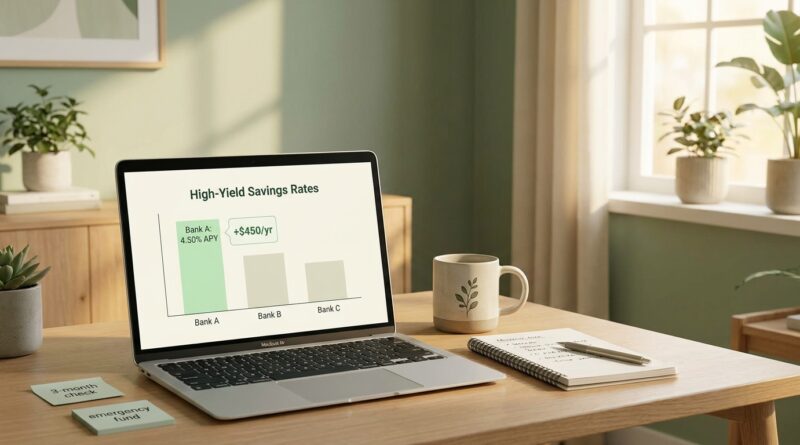
The ‘3‑Month HYSA Snapshot’ Habit: One 10‑Minute Check That Quietly Adds Hundreds In Interest
You did the hard part already. You moved your cash into a high-yield savings account and stopped letting it rot in a big bank account paying almost nothing. Then the annoying part started. Rates moved. Headlines got noisy. One site says yields are falling, another says there are still great deals, and now you are wondering if your “good” account quietly became mediocre. If that sounds familiar, you do not need to become a part-time bank shopper. A simple 3-month HYSA snapshot can keep your savings on track in about 10 minutes. That is the sweet spot for people asking, “how often should I check my high yield savings account rate?” Not every day. Not every week. Just often enough to catch a meaningful drop, compare your account to the market, and decide whether it is worth making one clean move that could add hundreds of dollars in interest over a year.
⚡ In a Hurry? Key Takeaways
- For most people, checking your high-yield savings account rate every 3 months is enough.
- Compare your APY to 3 to 5 competing accounts, and act only if your rate is clearly lagging.
- Do not chase tiny differences. Focus on FDIC or NCUA insurance, ease of use, and whether a switch would meaningfully boost your interest.
The 3-Month Snapshot Habit, Explained
The idea is simple. Put one recurring reminder on your calendar every 3 months. When it pops up, spend 10 minutes checking whether your savings account is still competitive.
This is not obsessive rate-chasing. It is basic maintenance, like checking the air in your tires. Most of the time, you will look, confirm your account is still solid, and move on with your life.
That is why this habit works so well. It respects your time.
So, How Often Should I Check My High Yield Savings Account Rate?
For most savers, every 3 months is the right answer.
Why not monthly? Because savings rates usually do not change enough in 30 days to justify a switch. Why not once a year? Because a once-great account can drift far enough behind in 12 months that you leave real money on the table.
A 3-month check gives you a practical middle path:
- Often enough to catch a meaningful rate drop
- Not so often that you burn out
- Easy to remember with the seasons or calendar quarters
If you like a lighter, more frequent routine, you might also like The ‘Payday Rate-Check’ Habit: One 3‑Minute Move That Quietly Keeps Your Savings Earning Top Interest. But if weekly or biweekly checks make your eyes glaze over, the 3-month snapshot is the better fit.
What to Do During Your 10-Minute Check
1. Look up your current APY
Log in and check the annual percentage yield, or APY, on your account. Do not assume it stayed the same as when you opened it.
2. Compare it with a few well-known competitors
You do not need a giant spreadsheet. Just compare your account with 3 to 5 reputable high-yield savings accounts.
Look for the current APY, any minimum balance requirements, and any odd rules. Some banks offer a great-looking rate with extra strings attached. Skip the gimmicks if they make your life harder.
3. Ask one simple question
Is my account still close enough to the better options, or am I clearly behind?
“Close enough” depends on your balance. If your rate is just a little lower, staying put may be the smart move. If it is much lower, a switch may be worth it.
4. Check the basics before moving
Make sure the new bank is FDIC-insured, or NCUA-insured if it is a credit union. Also check transfer speed, app quality, and whether customer service seems decent. A slightly better rate is not worth a giant headache.
When a Rate Difference Actually Matters
This is where people either freeze up or overreact.
Let’s say you have $20,000 in your emergency fund.
- At 4.00% APY, you would earn about $800 in a year.
- At 4.80% APY, you would earn about $960 in a year.
That is a difference of about $160 per year.
Now bump that balance to $40,000, and the gap becomes about $320 per year.
That is real money. Not life-changing money, but enough to matter.
On the other hand, if you are deciding whether to move your money for a 0.10% bump, the payoff may be tiny. That is when people end up doing paperwork for pennies.
A Good Rule for Deciding Whether to Switch
Try this simple filter.
- If your account is within about 0.25% to 0.40% of strong competitors, staying put is usually fine.
- If your account trails by 0.50% or more, it is worth taking a harder look.
- If your balance is large, even smaller gaps can matter.
This keeps you from hopping banks every time a new flashy rate appears. You want a better account, not a new hobby.
Why Big Banks Still Cost Savers So Much
This is the part that surprises people. Many traditional big-bank savings accounts still pay rates so low they are basically decorative.
Meanwhile, many online high-yield accounts still pay several times the national average, even after rates have drifted down from recent highs.
So yes, moving from a near-zero savings account to a decent HYSA is the big win. After that, the 3-month snapshot helps you protect that win without becoming obsessed.
What Not to Do
Do not check every headline
Financial news is built to make normal rate movement sound dramatic. That does not mean you need to react.
Do not chase teaser rates blindly
Some rates look amazing at first glance, but come with balance caps, direct deposit requirements, or a short promotional window.
Do not ignore convenience
Your emergency fund should be easy to reach when you need it. A bank that pays a little more but makes transfers slow or confusing may not be worth it.
Do not forget your goal
Your HYSA is there to keep cash safe, liquid, and earning decent interest. It is not supposed to feel like day trading.
Who Should Check More Often?
Every 3 months works for most people, but a few savers may want a faster rhythm.
- People with very large cash balances
- Anyone still sitting in a questionable account they opened years ago
- Savers during a period of fast-moving rate cuts
If that sounds like you, a monthly glance might make sense for a while. But for the average emergency fund saver, quarterly is plenty.
Make the Habit Stupidly Easy
The best money habits are the ones you will actually keep.
Here is a simple setup:
- Create a calendar event every 3 months
- Name it “HYSA Snapshot”
- Keep a note with your current APY and 3 comparison banks
- Only switch if the math says the gain is meaningful
That is it. No elaborate system. No finance rabbit hole.
At a Glance: Comparison
| Feature/Aspect | Details | Verdict |
|---|---|---|
| How often to check | Every 3 months for most savers, with occasional monthly checks during fast rate changes | Best balance between staying informed and avoiding burnout |
| When to switch banks | Consider moving if your APY trails strong competitors by about 0.50% or more, especially on larger balances | Worth it when the interest gain is meaningful |
| What matters besides APY | FDIC or NCUA insurance, transfer speed, ease of use, and lack of gimmicky requirements | A slightly lower rate can be fine if the account is simple and reliable |
Conclusion
You do not need to babysit your savings account to get good results. With high-yield savings rates drifting down from recent highs and big banks still paying close to nothing, a lot of savers are either stuck or tired of chasing every small change. The 3-month HYSA snapshot is the middle path that actually works. In a few minutes, you can see whether your emergency fund is still earning a strong rate or whether one smart move could put a few hundred extra dollars in your pocket over the next year. That is the whole point. Keep it simple, keep it safe, and make sure your cash is still pulling its weight.