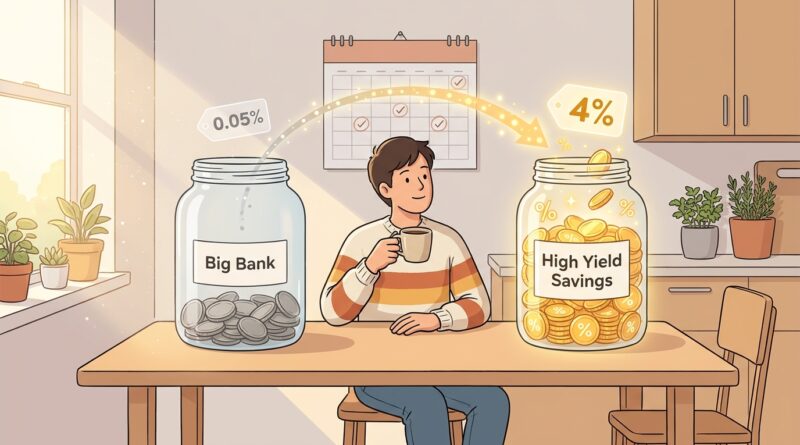
The ‘Big Bank Drain’ Check: One 5‑Minute Habit That Stops Your Savings Leaking Away In Low Interest Accounts
You know that nagging feeling. Your paycheck lands, your savings sit at a big bank, and somewhere in the back of your mind you keep hearing that online accounts are paying way more. But life is busy. You do not want to compare 27 banks, read tiny rate disclosures, or spend your Saturday building a spreadsheet just to fix one money habit. So the cash stays put, earning next to nothing.
That is where the “Big Bank Drain” check comes in. Once a week, take five minutes to look at your savings balance, keep a buffer in your regular bank, and move the extra cash to a high yield savings account. That tiny habit helps you stop the quiet leak. You are not cutting coffee, canceling a streaming service, or trying to be perfect. You are simply making sure your money is parked in the place that pays it better. If you have been wondering how to move money from big bank to high yield savings, this is the simple, low-stress way to start.
⚡ In a Hurry? Key Takeaways
- The fastest fix is to keep a small working cushion at your big bank and sweep the extra into a high yield savings account once a week.
- Set a simple transfer rule, like “anything over $2,000 in savings moves on Friday,” so you do not have to rethink it every time.
- FDIC-insured online high yield savings accounts are generally just as safe for cash as traditional bank savings, but usually pay far more.
Why this matters more than most people realize
Big banks are good at being familiar. They are not always good at paying you for your deposits.
Right now, many traditional savings accounts still pay a tiny fraction of a percent, while online high yield savings accounts can pay several times more. That gap sounds boring until you do the math.
A quick real-world example
Let’s say you keep $15,000 in a big bank savings account earning 0.10% APY. That gets you about $15 a year in interest.
If that same money sits in a high yield savings account earning 4.25% APY, you would earn about $637 a year.
That is a difference of roughly $622. For doing almost nothing.
No budgeting app can beat that kind of easy win if your cash is sitting in the wrong place.
The 5-minute “Big Bank Drain” check
This habit is intentionally small. The goal is not to optimize every penny. The goal is to stop the leak.
Step 1: Pick your big bank buffer
Decide how much cash should stay at your regular bank for convenience. This is your “do not touch” working cushion.
For many people, that might be:
- $500 for basic breathing room
- $1,000 if your bills are tight
- One month of regular spending if you like more cushion
This money stays at the big bank because it is connected to your checking account, debit card, and bill pay. It is there to keep life easy.
Step 2: Check your current savings balance once a week
Pick one day. Friday works well. So does Sunday night.
Open your banking app. Look at your savings balance. Ask one question:
Is there more here than my buffer amount?
Step 3: Move the excess to your high yield savings account
If your savings balance is above your buffer, transfer the difference.
Example:
- Your big bank savings buffer is $2,000
- Your current big bank savings balance is $3,350
- You move $1,350 to your high yield savings account
Done. That is the whole ritual.
How to move money from big bank to high yield savings without making it a project
This is the part people put off, mostly because they assume it will be annoying. Usually, it is much simpler than expected.
Option 1: Link the accounts and transfer online
This is the easiest route for most people.
- Open a high yield savings account at an FDIC-insured bank.
- Link your big bank checking or savings account to it.
- Verify the link, often through instant login or two small test deposits.
- Start transferring money as needed.
Transfers often take 1 to 3 business days. That is normal.
Option 2: Set up recurring transfers
If you want even less friction, automate part of the process.
You could schedule:
- $100 every week
- $250 every payday
- Anything above your chosen threshold, checked manually once a week
Automation helps. But even if you do not automate, the five-minute check is enough to make a real difference.
Option 3: Move new savings, not every dollar
If you are nervous, start small. You do not need to transfer your entire savings balance on day one.
Try moving only new cash that builds up each week. That gives you time to get comfortable with the process and see how transfers work at your bank.
What not to move
This is where people get tripped up. A high yield savings account is great for savings. It is not always the best parking spot for every dollar.
Usually, keep these at your main bank:
- Your everyday checking money
- Cash needed for bills due this week
- A small emergency cushion for same-day access
Usually, move these to high yield savings:
- Emergency fund money beyond your basic buffer
- Vacation savings
- Home repair cash
- Tax set-asides
- Any short-term savings you do not need today
If you want a cleaner system after you move the money, read The ‘Bucket Booster’ HYSA Habit: One Weekly Sort That Makes Every Dollar Work Harder. It is a smart next step once your cash is finally in the right account.
How to avoid analysis paralysis
This is a big reason people delay. There are so many accounts, rates, promos, and reviews that it starts to feel easier to do nothing.
Do not let the perfect account stop you from opening a good one.
Use this simple filter
- FDIC insured
- No monthly fee
- No minimum balance you cannot comfortably meet
- A competitive APY
- A website or app you can actually stand using
That is enough to get started.
Rates change. You are not marrying the account. You are just moving your cash out of the low-interest waiting room.
Common worries, answered plainly
“Is online banking safe?”
If the bank is FDIC insured and you stay within coverage limits, your deposits have the same basic federal protection as they do at a traditional bank.
“What if I need the money fast?”
That is why you keep a buffer at your regular bank. The high yield account is for money you do not need this afternoon.
“Will moving money hurt my credit?”
No. Moving cash between your own deposit accounts does not affect your credit score.
“What if rates drop later?”
They might. But if your big bank is paying almost nothing now, earning a better rate in the meantime still puts you ahead.
A simple weekly script to make this automatic in your brain
Here is the habit in one sentence:
Every Friday, I check my big bank savings. If it is above my buffer, I move the extra to my high yield savings account.
That is the whole system.
No giant money makeover. No guilt. No spreadsheet required.
At a Glance: Comparison
| Feature/Aspect | Details | Verdict |
|---|---|---|
| Big bank savings rate | Often pays very little interest, even on large balances. | Fine for convenience, poor for long-term parking. |
| High yield savings account | Usually offers a much higher APY, especially from online banks. | Best home for cash you do not need immediately. |
| Weekly drain check | Takes about five minutes to keep only your buffer at the big bank and move the rest. | Simple, realistic, and easy to stick with. |
Conclusion
You do not need a stricter budget to earn more from your savings. You just need your cash in a better place. Right now, the gap between many big bank savings rates and online high yield accounts is wide enough that ordinary savers can lose hundreds of dollars a year by doing nothing. That is real money. The good news is the fix does not have to be complicated. A five-minute weekly drain check gives busy people a simple ritual: keep a comfortable buffer where life is easy, and move the extra where it actually earns something. It cuts through decision fatigue, turns “I should really do that” into one small repeatable action, and helps your money start pulling its weight without giving up a single small pleasure.