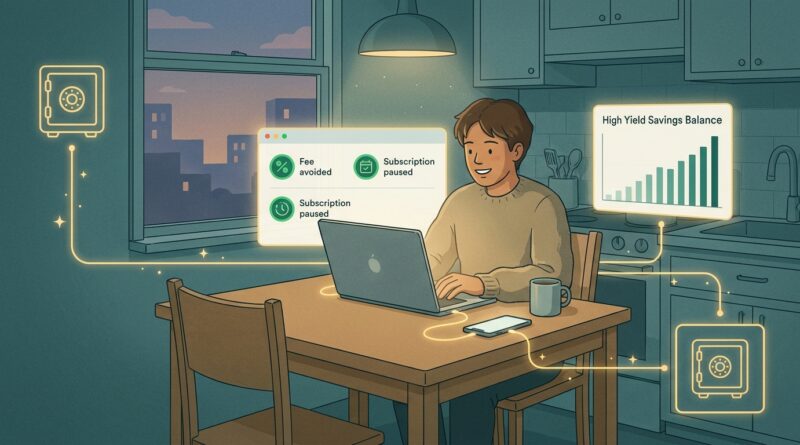
The ‘Freeze-Your-Flow’ Habit: One Alert Tweak That Quietly Keeps More Cash In Your High‑Yield Savings
You finally did the responsible thing. You moved money into a high yield savings account, started earning real interest, and felt like your cash was finally pulling its weight. Then life happened. A subscription renewed. A bill hit a day early. Your checking dipped lower than expected, and a fee landed before you even noticed. That kind of money leak is maddening because it is rarely one big mistake. It is a string of tiny misses that add up fast. The fix is not checking your accounts ten times a day. It is setting one simple “freeze-your-flow” habit. In plain English, that means turning on a small group of bank alerts that warn you the second money starts moving the wrong way. If you want better high yield savings account habits to avoid fees and money leaks, this is one of the easiest wins you can set up in under fifteen minutes.
⚡ In a Hurry? Key Takeaways
- Use low-balance, large-transaction, and subscription or debit alerts on your checking account, not just your savings.
- Set your low-balance alert lower than your comfort zone but higher than zero, so you have time to act before a fee hits.
- One overdraft or late fee can erase months of savings interest, so real-time alerts often protect more money than chasing a slightly higher APY.
Why this habit matters more than most people think
When people compare savings accounts, they usually focus on APY. That makes sense. The rate is easy to see, easy to compare, and feels like the whole game.
It is not.
The money often slips away somewhere else. Usually from checking. That is where autopay bills, streaming renewals, annual app charges, and everyday card swipes can create problems before your next paycheck shows up.
If your high yield savings account earns $20 or $30 in interest this month, one overdraft fee can wipe that out in seconds. A late fee can do the same. So if you want solid high yield savings account habits to avoid fees and money leaks, protecting the path between checking and savings matters just as much as the rate itself.
What the “freeze-your-flow” habit actually is
This is not a budgeting app. It is not a spreadsheet. It is not a Sunday night ritual you will forget in two weeks.
The habit is simple. You tell your bank to alert you when your money flow looks off, so you can pause the damage before it gets worse.
The three alerts most people need
Start with these:
- Low-balance alert on checking. This is your early warning system.
- Transaction alert above a dollar amount you choose. Good for catching surprise charges fast.
- Debit card or ACH withdrawal alert. Useful for subscription renewals, utility pulls, and forgotten trial charges.
If your bank allows it, send these by push notification and text. Email is fine as backup, but email is where alerts go to nap.
Why checking alerts protect savings
This is the part people miss. The threat to your savings balance is often indirect.
Your savings might be earning well. But if checking takes a hit and you cover it by moving money out of savings, your balance stops growing. If you do not catch it in time, you might get a fee first and then transfer money after the damage is done.
That is why the best alert system watches the account where trouble starts, not just the account you are trying to grow.
How to set your alert thresholds without making yourself crazy
The trick is to set alerts early enough to help, but not so often that you ignore them.
Low-balance alert
Do not set this at $5. That is basically an after-the-fact notification.
Set it at the point where you still have time to respond. For many people, that is one of these:
- The amount of your smallest paycheck buffer
- One week of normal bills
- $100, $250, or $500, depending on your account habits
Example. If your checking account usually floats around $1,200 and drops to $400 before payday, maybe your alert should be $500. That gives you time to move money, delay a purchase, or double-check pending payments.
Large-transaction alert
Pick a number that catches “wait, what was that?” spending without pinging you for groceries.
That might be $50 for a tight budget. It might be $100 or $200 for a larger one.
Withdrawal and autopay alerts
If your bank lets you get notified for every debit or ACH withdrawal, turn it on. This is one of the easiest ways to spot forgotten subscriptions and duplicate charges on the same day they happen.
The quiet culprits these alerts catch
Here is where this habit earns its keep.
Forgotten subscriptions
You meant to cancel. You did not. Now the annual renewal hits at the worst possible time.
Bill timing issues
Your paycheck lands Friday. Your credit card autopay pulls Thursday night. Close, but not close enough.
Free trials that were not free for long
That app you tested for three days quietly became a monthly charge.
Duplicate transactions or weird card activity
Sometimes it is a billing mistake. Sometimes it is fraud. Either way, catching it fast matters.
Small “harmless” charges
A few $8 to $15 charges may not feel like a big deal alone. But they are exactly the kind of leaks that chip away at your momentum.
How to build the system in 15 minutes
You do not need fancy tools. Just open your bank app or website and look for Alerts, Notifications, or Account Settings.
Step 1: Set a low-balance alert on checking
Choose an amount that gives you a little breathing room. Not zero. Not almost zero.
Step 2: Turn on debit card transaction alerts
If your bank gives you options, choose all card transactions or all transactions over your chosen threshold.
Step 3: Turn on ACH or withdrawal alerts
This catches autopays and subscription pulls that do not always show as card charges.
Step 4: Use text or push alerts
Texts and app alerts are harder to miss than email. If you can, use both.
Step 5: Create one simple response rule
When an alert hits, do one of these within 24 hours:
- Approve it
- Cancel it
- Move money
- Call the bank or merchant
That is the “freeze” part of freeze-your-flow. You stop the leak while it is still small.
What not to do
A few common mistakes make alerts less useful.
Do not turn on every alert possible
Too many notifications train you to swipe them away. Keep the list tight and meaningful.
Do not only watch savings
Your savings may be the goal, but checking is usually the battlefield.
Do not assume autopay is always harmless
Autopay is convenient. It is not perfect. Payment dates, annual renewals, and surprise price increases still happen.
Do not wait until the end of the month to review charges
By then the money is already gone, and fixing it can be harder.
This works even if you hate budgeting
That is the beauty of it. This habit is defensive, not demanding.
You are not trying to become a finance hobbyist. You are just adding a tripwire to your money. When something odd happens, you know about it right away. That small timing advantage can save more money than hours of trying to manually track every purchase.
If your bank’s alerts are weak, try this backup plan
Some banks have great notification settings. Others are clunky.
If yours is limited, use these workarounds:
- Set alerts through your credit card app for purchases and autopays
- Use your banking app’s widget or daily balance snapshot if available
- Move recurring subscriptions to one card so charges are easier to spot
- Keep a slightly larger checking cushion than you think you need
The main goal is not perfection. It is faster visibility.
At a Glance: Comparison
| Feature/Aspect | Details | Verdict |
|---|---|---|
| Low-balance alerts | Warn you before checking gets too low and before overdraft risk gets real. | Most useful alert for preventing fees. |
| Transaction and withdrawal alerts | Catch subscriptions, autopays, and surprise charges as they happen. | Best for stopping money leaks early. |
| Chasing a slightly higher APY | Can help over time, but does not stop fees or timing mistakes from eating your gains. | Worth doing, but only after leak protection is in place. |
Conclusion
If you are trying to grow your cash, the smartest move is not always finding the flashiest rate. Often it is plugging the boring little leaks that keep draining the bucket. Right now a lot of savers are focused on chasing the highest APY, but the quiet way people are losing money is through overdraft fees, forgotten subscriptions and bill timing issues that hit their checking before paychecks land. A single overdraft or late fee can wipe out months of interest. A low-effort alert system fixes that without turning your week into one more budgeting chore. Set the tripwires once, let your bank do the watching, and step in only when something needs attention. That is a practical habit that protects the money you already worked hard to save.