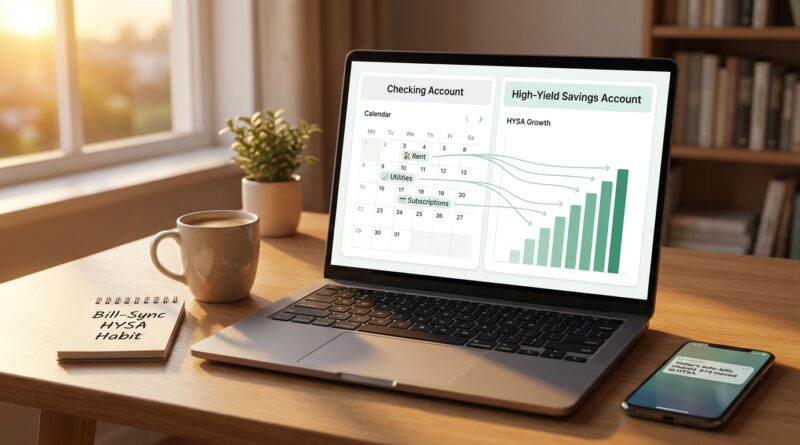
The ‘Bill-Sync HYSA Habit’: Turn Every Auto-Pay Into Quiet High-Yield Savings
You did the responsible thing. You opened a high-yield savings account. Then real life kept happening. Rent hits. The phone bill clears. Insurance pops up. Groceries somehow cost more again. By the time you think, “I should move money into savings,” the month already feels too fragile. That is why so many good intentions turn into random transfers instead of a real high-yield savings account automation habit. The fix is not saving harder. It is saving on a schedule that already makes sense. I like what I call the bill-sync HYSA habit. Every time an auto-pay bill goes out, a smaller, matching transfer goes into your high-yield savings account. Not huge. Just steady. Your bills become the rhythm. Your savings grows quietly in the background. And because the timing is predictable, you are less likely to move money over in a panic, then pull it right back two days later.
⚡ In a Hurry? Key Takeaways
- Link a small HYSA transfer to each major auto-pay so saving happens automatically and on a rhythm you already trust.
- Start with fixed bills like rent, utilities, phone, or insurance, then assign a matching transfer amount you can keep up with.
- Keep a checking cushion so you avoid overdrafts. The goal is quiet interest growth, not creating a cash crunch.
Why this habit works better than random transfers
A lot of people treat savings like a leftover category. If there is extra money at the end of the month, great. If not, maybe next month.
The problem is that checking accounts are busy places. Money lands there, waits there, and gets picked off by bills all month long. So even if you have enough to save, it rarely feels safe.
The bill-sync approach changes the feeling. Instead of asking, “Do I have enough to move today?” you decide once and automate it. Every bill becomes a little savings trigger.
That is the real power of a high-yield savings account automation habit. It removes emotion from the transfer. And emotion is usually what messes up consistency.
What the bill-sync HYSA habit actually looks like
It is simple.
Pick a few bills that already run on auto-pay. Then connect each one to a same-day or next-day transfer into your high-yield savings account.
Example setup
If your bills look like this:
- Phone bill on the 5th
- Car insurance on the 12th
- Streaming and internet on the 18th
- Electric bill on the 25th
Your HYSA transfers might look like this:
- $20 on the 5th
- $25 on the 12th
- $15 on the 18th
- $20 on the 25th
That is $80 a month going into savings without one giant painful transfer. Over a year, that is $960 before interest. And because it sits in a high-yield account instead of old-school checking, it has a chance to earn something while it waits.
Why busy people tend to stick with it
This method works because it borrows a schedule you already follow. You do not need a new app obsession. You do not need to check rates every afternoon. You do not need a perfect budgeting spreadsheet.
You just use the bill dates already sitting on your calendar.
That makes this especially helpful for people with irregular income or messy mid-month cash flow. A single giant transfer can feel risky. Smaller transfers tied to known bill dates feel manageable.
If you liked the idea of making saving feel less like another login chore, you might also like The ‘One-Login HYSA Habit’: Turn Your Existing Bank App Into A Quiet High-Yield Money Machine. It tackles the same problem from the app side instead of the bill-timing side.
How to set it up without causing overdraft stress
1. Start with fixed bills, not surprise bills
Use bills that are stable and predictable. Rent, insurance, internet, phone, subscriptions. Skip anything that swings wildly at first, like power bills in peak summer or a credit card payment that changes every month.
2. Make the savings transfer smaller than you think
This habit should feel boring. That is a compliment. If each transfer is so big that you start second-guessing it, it is too big.
Try a flat dollar amount, not a percentage, at least in the beginning. Ten dollars, fifteen dollars, twenty-five dollars. The amount matters less than the consistency.
3. Leave a checking buffer
This is the safety valve. Keep a cushion in checking that you do not mentally spend. Maybe it is $100. Maybe it is $300. Maybe it is one week of basic bills.
That way, one awkward timing issue does not force you to cancel the whole system.
4. Schedule transfers for the same day or the day after
Some people like the savings transfer to happen the same day the bill is paid. Others prefer the day after, just to make sure the bill has fully cleared. Either is fine. The key is that the pairing stays consistent.
5. Review once a month, not every day
If you stare at your accounts all week, you will be tempted to tinker. Review monthly. See what worked. Adjust one or two transfers if needed. Then leave it alone.
Good matches for the bill-sync method
This habit is great for:
- People who forget to transfer money manually
- People who get nervous moving a big lump sum into savings
- People with several auto-pay bills spread across the month
- People who want a practical high-yield savings account automation habit without building a whole new budget system
When this habit needs a tweak
It is not perfect for every setup.
If your checking account regularly gets close to zero, fix the buffer first. If your bills are all charged within two or three days, spreading out your transfers may not help much. In that case, you may want to tie transfers to payday instead.
And if your HYSA takes a few business days to move money back to checking, do not use this account as your only emergency cash source. Keep some liquidity nearby.
Small ways to make it even better
Round up with each bill category
If the phone bill is $67, save $13. If insurance is $118, save $22. You create neat mental math and land at an even $100 for the month.
Use separate nicknames inside your HYSA
If your bank allows buckets or goal labels, name one “bill buffer” or “quiet savings.” Silly? Maybe. Effective? Yes. Labels help non-techies and techies alike remember what the money is for.
Increase one transfer every three months
Not all of them. Just one. Bump a $15 transfer to $20. That tiny increase is easier to absorb than a dramatic overhaul.
What kind of interest difference can this make?
No, this is not a get-rich trick. It is better than that. It is realistic.
Money sitting in checking usually earns little to nothing. Money moving steadily into a high-yield savings account earns more while staying relatively accessible. If rates stay meaningfully above old savings account levels, this habit can add real money over time, especially when those transfers happen early and regularly instead of only when you “feel caught up.”
That is the overlooked part. Rhythm matters. Not just the rate.
At a Glance: Comparison
| Feature/Aspect | Details | Verdict |
|---|---|---|
| Savings timing | Transfers happen alongside existing auto-pay bills instead of whenever you remember. | Much easier to stick with |
| Cash-flow stress | Several small transfers usually feel safer than one big monthly move, especially with a checking buffer. | Lower stress for most households |
| Interest potential | Money reaches the high-yield account more regularly instead of sitting idle in checking. | Better use of cash you already have |
Conclusion
If your high-yield savings account exists mostly in theory, not in practice, this is a gentle fix. Right now a lot of people are parking cash in high-yield accounts but not getting the full benefit because transfers are random and emotional instead of rhythmic. Tying a predictable HYSA transfer to your automated bills gives you a simple, low-stress way to earn more on money that would otherwise sit around in checking waiting to be spent. It is practical. It works with busy lives. And it is especially useful when paychecks and expenses do not line up neatly. Use your bill schedule as a savings metronome. Start small, keep a buffer, and let the habit do the heavy lifting. That tiny shift can add up to hundreds of dollars in interest over time, without asking you to give up the things you enjoy.