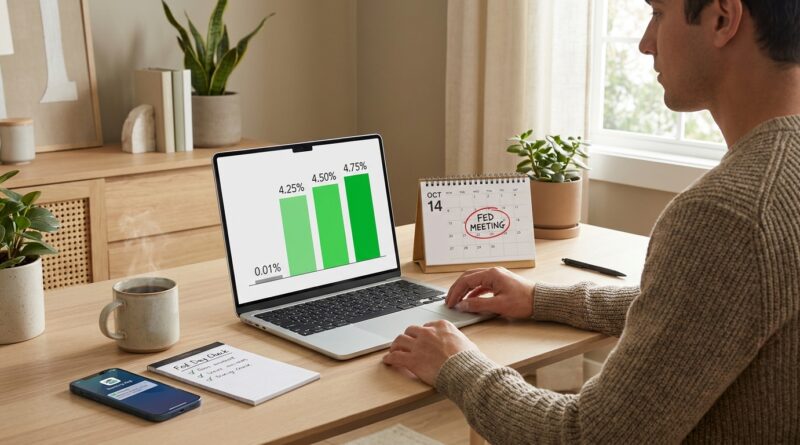
The ‘Fed Day Check’ HYSA Habit: One Tiny Rate Peek That Can Add Thousands In Extra Interest
You keep hearing that savings accounts are paying 4 percent, 4.5 percent, even more. Then you open your own bank app and see a rate that looks like pocket lint. It is frustrating, especially when you know you should do something, but you do not want to spend your weekend decoding Fed headlines and comparing 27 banks. The good news is you do not need a brand new money system. You just need one tiny habit. I call it the Fed Day Check. Every time the Federal Reserve announces a rate decision, take five minutes to peek at your savings rate. If your cash is still parked in a big-bank account earning 0.01 percent, that quick check can be the nudge that moves your money into a high yield savings account and puts real interest back in your pocket.
⚡ In a Hurry? Key Takeaways
- A simple Fed rate hike high yield savings habit is to check your savings APY after each Fed meeting and compare it with top HYSA rates.
- If your account is far below competitive rates, move your emergency fund or extra cash to an FDIC-insured or NCUA-insured high yield account.
- This is a low-stress way to avoid earning near-zero interest, and it can add hundreds or even thousands over time without changing your budget.
Why this tiny habit matters
Most people do not ignore their savings on purpose. Life is just busy. Your checking account, credit cards, bills, and work all scream for attention. Your savings account does not. It sits quietly in the corner, earning almost nothing.
That is why Fed day is useful. The news cycle does the remembering for you. When headlines start talking about hikes, pauses, or cuts, that is your cue to look at one number. Your APY.
You are not trying to predict the economy. You are just asking a basic question. Is my cash still in the right place?
What the “Fed Day Check” actually looks like
Keep it simple. On the day of a Fed announcement, or the day after, do these three things:
1. Check your current savings rate
Log into your bank app and find the APY on your savings account. If you have to hunt for it, that tells you something already.
2. Compare it with current HYSA rates
Look at a trusted rate roundup or a few well-known online banks and credit unions. You do not need a spreadsheet. Just get a feel for the going rate.
3. Decide if the gap is big enough to act
If your account is earning 0.01 percent and competitive accounts are paying above 4 percent, this is not a tiny difference. It is the difference between your money working and your money napping.
How much money are we really talking about?
This is where the habit gets real.
Say you have $10,000 in a traditional savings account earning 0.01 percent. Over a year, you would make about $1 before taxes. Move that same money to a high yield savings account paying 4.50 percent APY, and you could earn about $450 over a year, assuming the rate stayed the same.
That is not a rounding error. That is groceries, a car repair, holiday spending, or a solid start on your emergency fund.
If you keep more cash on hand, the gap gets bigger fast. With $25,000, the difference can be over $1,000 a year.
Who should use this habit?
This works best for money you want safe and fairly accessible.
- Emergency funds
- Home repair funds
- Travel savings
- Tax money you are setting aside
- Cash for a near-term purchase
It is not about chasing every last decimal point. It is about not leaving good interest on the table when rates move.
What counts as “too low”?
There is no magic line, but here is a good rule of thumb.
If your savings rate is dramatically below what solid high yield accounts are offering, it is worth a closer look. If top accounts are around 4.25 percent to 4.75 percent and yours is 0.01 percent, 0.10 percent, or even 1 percent, your bank is probably not trying very hard for your savings.
If your account is already competitive, great. Your Fed Day Check still paid off, because you confirmed you are in good shape.
Do not overcomplicate the switch
This is where people get stuck. They imagine paperwork, branch visits, hidden catches, and money floating in limbo for two weeks.
In reality, opening a HYSA is usually pretty straightforward. Most online banks let you apply in minutes, link your existing checking account, and transfer funds electronically.
Before you move money, check these basics:
- FDIC insurance for banks or NCUA insurance for credit unions
- No monthly maintenance fee
- No minimum balance you cannot comfortably meet
- Easy transfers to and from your checking account
- A clean app or website you will actually use
If you want a slightly more active version of this routine, our guide to The ‘Rate Hike Sweep’ HYSA Habit: One 10‑Minute Move Every Time the Fed Talks pairs nicely with the Fed Day Check. Think of this article as the easy entry point.
Common worries, answered simply
“Is my money safe in an online bank?”
Usually, yes, if the institution is FDIC-insured or NCUA-insured and you stay within coverage limits. Online does not mean unregulated. It just means no local branch.
“Will I lose access to my money?”
Not really, but it may not be instant like moving money between two accounts at the same bank. Transfers can take a couple of business days. That is why many people keep everyday spending money in checking and emergency cash in HYSA.
“What if rates fall later?”
Then you check again after the next Fed meeting. That is the whole beauty of the habit. It is light maintenance, not a one-time perfect decision.
“Should I move everything?”
Not necessarily. Keep enough in checking for bills and regular spending. Move the cash that is meant to sit safely and earn something while it waits.
How often should you do this?
Only once per Fed meeting is enough for most people. The Federal Reserve typically meets eight times a year. That means you are not signing up for daily tracking or obsessive rate chasing. You are attaching one financial check-in to a news event that is already hard to miss.
That makes this habit realistic. And realistic habits are the ones that stick.
At a Glance: Comparison
| Feature/Aspect | Details | Verdict |
|---|---|---|
| Big-bank savings account | Often easy to keep, but many still pay near-zero interest like 0.01 percent | Convenient, but usually a poor place for idle cash |
| High yield savings account | Typically offers much higher APYs, with online access and federal insurance when properly covered | Best fit for emergency funds and short-term cash |
| Fed Day Check habit | A quick post-Fed reminder to compare your rate and decide if action is needed | Low effort, high payoff for busy savers |
Conclusion
Searches for high yield savings accounts spike every time the Fed makes news, and that makes sense. People want to know what a rate hike means for their money. The trick is turning that headline into one small action. A once-per-Fed-meeting check-in is easy to remember, easy to do, and surprisingly valuable. It helps you avoid getting stranded in a 0.01 percent account, keeps your cash earning something meaningful, and can add real dollars over the next year without asking you to become an amateur economist. Five minutes, a quick rate peek, and your savings gets a lot smarter.