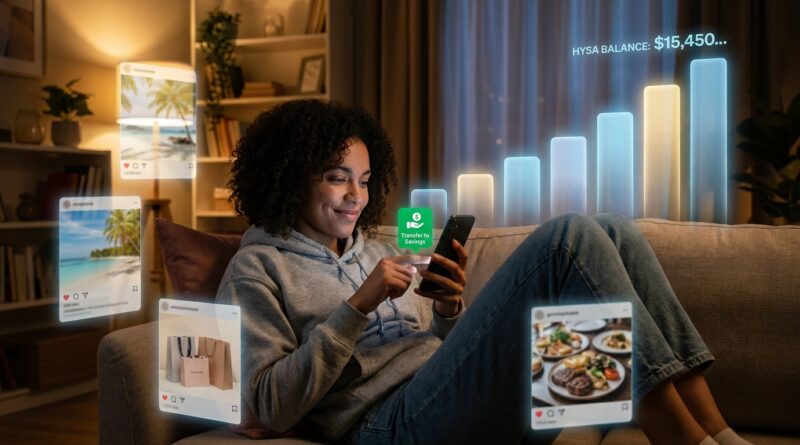
The ‘FOMO Filter’ HYSA Habit: Turn Social Media Envy Into Automatic Savings Wins
That little sting you feel when someone on your feed is posting airport lounge selfies, VIP concert clips, or a “just because” luxury dinner is real. It is not you being petty. It is financial FOMO, and it can quietly wreck a budget faster than one big splurge. A ticket here, a rushed order there, a weekend brunch you did not even want that much. Suddenly your savings account is doing all the suffering.
A smarter fix is not deleting every app or pretending money stress does not exist. It is building a simple reflex. Every time social media makes you want to spend, move a small amount into a high-yield savings account instead. Think of it as a FOMO Filter. The trigger stays the same, but the outcome changes. Instead of funding someone else’s highlight reel, you fund your own safety net, trip fund, or “I can breathe” cushion. That is the heart of high yield savings habits for social media financial FOMO. Small, automatic, and surprisingly effective.
⚡ In a Hurry? Key Takeaways
- A FOMO Filter means turning social media spending urges into automatic transfers to a high-yield savings account.
- Start with a rule you can keep, like saving $5, $10, or the cost of the thing you almost bought each time a post tempts you.
- Use an FDIC-insured or NCUA-insured account and keep the transfer amount small enough that you do not create overdraft stress.
What the “FOMO Filter” HYSA habit actually is
The idea is simple. Social media gives you a trigger. Instead of answering that feeling with spending, you answer it with saving.
Let’s say you see a friend heading to Miami for the weekend. Your brain says, “I need to book something too.” Your FOMO Filter says, “Cool. Transfer $15 to my HYSA first.”
That one move does three useful things. It slows you down. It breaks the scroll-spend loop. It helps your money grow in an account that actually pays decent interest.
A high-yield savings account, or HYSA, is just a savings account that usually pays much more interest than a basic savings account at a traditional bank. It is not magic. It will not make you rich overnight. But it is a better parking spot for short-term savings than a near-zero-interest account.
Why this works better than “just use self-control”
Most people do not overspend because they are bad with money. They overspend because modern apps are very good at making life look urgent, glamorous, and oddly affordable for about 10 seconds.
That is the dangerous window. You feel behind. You want relief. One tap promises relief.
The FOMO Filter works because it gives that emotion somewhere else to go. You are not trying to become a robot. You are building a new habit loop.
The old loop
See post. Feel behind. Spend.
The new loop
See post. Feel behind. Save first. Decide later.
That pause matters. Once the transfer happens, the emotional heat tends to drop. You may still buy the thing. But often, you will not.
How to set up high yield savings habits for social media financial FOMO
1. Pick one HYSA for this job
Do not mix this money into your regular checking account if you can help it. Open a separate high-yield savings account and give it a name that feels personal.
Good examples:
- FOMO Filter
- Soft Life Fund
- Stay Calm Money
- Concerts Without Guilt
- Trip Fund
Naming helps more than people think. It turns abstract saving into a visible goal.
2. Choose your transfer rule
This is the heart of the habit. Keep it easy.
You can use one of these rules:
- The Flat Rule: Every envy trigger equals a $5 or $10 transfer.
- The Half Rule: If you are tempted to spend $40, transfer $20 first.
- The Almost-Bought Rule: If you add something to cart because of a post, move that exact amount to savings and wait 24 hours.
- The Weekend Scroll Rule: Every Friday or Saturday night envy spiral gets one transfer, no matter what.
If money is tight, start tiny. Even $3 counts. The win is the pattern, not the brag-worthy amount.
3. Make transfers stupidly easy
If moving money takes seven screens and a login code you can never find, you will not do it.
Set up your HYSA app in advance. Save the external transfer link. Turn on biometric login. Favorite the account. Remove friction wherever you can.
If your bank allows automatic recurring transfers, you can also create a backup plan: an automatic $25 or $50 weekly transfer that keeps your habit alive even when you forget.
4. Create one note on your phone
Call it “Saved Instead.” Each time you use the FOMO Filter, jot down what triggered you.
For example:
- “Influencer hotel reel. Saved $10.”
- “Friend’s festival post. Saved $15.”
- “Designer bag unboxing. Saved $20.”
This sounds small, but it helps you spot patterns. Maybe travel posts get you every time. Maybe late-night scrolling is your weak point. Once you see the pattern, you can handle it better.
What this habit protects you from
Impulse spending disguised as “living a little”
There is nothing wrong with fun. The problem is buying things to catch up with people who are not living your exact life, budget, debt load, or goals.
Social media rarely shows the credit card bill, the Klarna payments, or the fact that somebody’s “casual” trip was partly paid for by a brand deal.
Stress spending during expensive times
When prices are up, even small impulse buys hit harder. A few food deliveries, event fees, rideshares, and “treat yourself” purchases can eat a month’s margin fast.
A HYSA habit gives that money somewhere better to go.
The shame spiral
This may be the biggest one. People often overspend, feel bad, then avoid looking at their accounts. That makes everything worse.
The FOMO Filter creates a tiny win in the middle of an emotional moment. That is powerful. You stop proving to yourself that you are failing. You start proving that you can respond differently.
What if you still want the trip, brunch, or concert?
Then great. Save for it on purpose.
This habit is not about becoming the person who never goes anywhere. It is about replacing reactive spending with intentional spending.
Here is the better version of the same story:
You see the trip post. You transfer $20 to your Travel HYSA. Two months later, you book your own weekend away with less panic and less credit card regret.
That is a much better “soft life” than fake calm with real debt.
A good starter formula for beginners
If you want something plug-and-play, use this:
- Open one HYSA called “FOMO Filter.”
- Set an automatic weekly transfer of $25.
- Add a manual $10 transfer any time social media makes you want to spend.
- Wait 24 hours before buying anything over $30 that was inspired by a post.
That is it. No spreadsheet required. No finance degree needed.
Important guardrails so this does not backfire
Do not overdraft yourself to “win” at saving
If your checking account is tight, lower the transfer amount. The point is to build a habit, not create fees.
Keep emergency savings separate if possible
Your FOMO money can live in the same HYSA, but a separate bucket or named goal helps. You do not want concert temptation mixed up with rent backup money.
Use an insured account
Stick with banks insured by the FDIC or credit unions insured by the NCUA, within standard coverage limits. That keeps your savings protected if the institution fails.
Do not chase every “money flex” online either
Financial FOMO is not just travel and clothes. It can also be crypto wins, stock screenshots, and dramatic “I made six figures in a month” posts. If a post makes you feel rushed, that is your cue to slow down, not copy it.
Signs the habit is working
- You pause before buying things you saw online.
- Your savings balance inches up without drama.
- You feel less resentful while scrolling.
- You stop treating every invite or trend like an emergency.
- You can say yes to some fun things because you actually planned for them.
That last one matters. Good money habits are not supposed to make life smaller. They are supposed to make your choices calmer.
At a Glance: Comparison
| Feature/Aspect | Details | Verdict |
|---|---|---|
| Main habit | Turn social media spending triggers into small HYSA transfers | Simple and easy to start |
| Best transfer amount | Usually $5 to $20 per trigger, or a flat weekly backup transfer | Keep it small enough to stay consistent |
| Biggest benefit | Reduces impulse spending while building real savings in a higher-interest account | Worth trying if scrolling makes you spend |
Conclusion
Financial FOMO is everywhere right now. You scroll past business-class seats, sold-out tours, expensive skincare hauls, and “casual” luxury weekends, and it is easy to feel like you are falling behind. Fresh research says more than half of Americans have made a financial move because of what they saw online, and plenty admit that scrolling pushes them to spend when they meant to save. That is exactly why the FOMO Filter works. It gives you a concrete move to make in the moment. Not someday. Right then. A small transfer into a high-yield savings account will not solve every money problem, but it can interrupt the envy-spend cycle and help protect your cash during an expensive, anxious time. You do not have to quit your social life or log off forever. You just need a better reflex. Save first. Decide later.