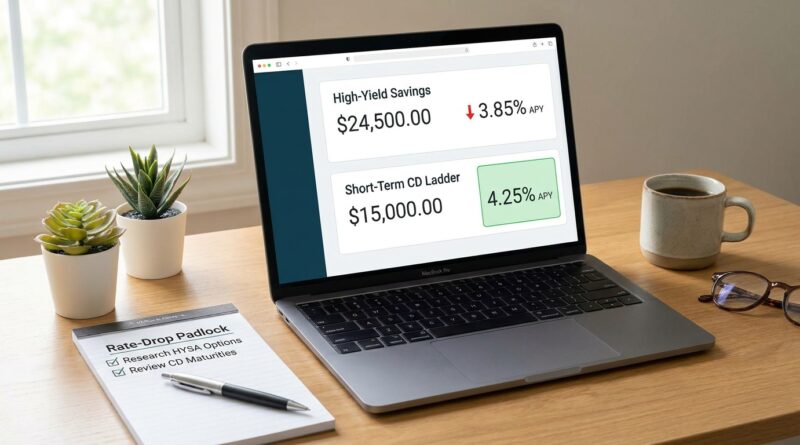
The ‘Rate‑Drop Padlock’ Habit: One Pre‑Fed Move That Protects Your HYSA From Falling Yields
You did the smart thing. You moved cash into a high-yield savings account, finally started earning real interest, and felt like your money was pulling its weight. Then the rate-cut chatter started again. Now every Fed headline feels like a small threat to your savings account. That is frustrating, especially if you do not want a part-time job chasing bank promos and moving money every few weeks.
The good news is you do not need to guess, panic, or keep one eye glued to the news. A simple “rate-drop padlock” habit can protect you. The idea is easy: before rates fall, decide what amount of cash would stay in your HYSA, what amount could move to a CD or Treasury if your APY drops below your comfort line, and exactly where that money would go. That one pre-fed move gives you a plan before emotion gets involved. If you want to protect high yield savings when interest rates drop, this is the low-stress way to do it.
⚡ In a Hurry? Key Takeaways
- The best way to protect high yield savings when interest rates drop is to set a personal “move line” now, before your HYSA rate slips.
- Keep your emergency cash liquid, but pre-pick a backup home like a CD or Treasury for money you will not need right away.
- This is about protecting yield without giving up safety, access, or FDIC and government-backed options.
What the “Rate-Drop Padlock” Habit Actually Is
Think of it as a tiny written plan for your savings.
You choose one number that matters. For example, you might say, “If my HYSA drops below 4.25%, I will review moving part of my balance.” That is your trigger.
Then you split your cash into buckets:
- Cash you need anytime, like your emergency fund base
- Cash for the next 3 to 12 months
- Cash you will not need for a year or more
The first bucket usually stays in the HYSA no matter what. The second and third buckets are the ones you can protect if rates start sliding.
Why This Works Better Than Watching Every Fed Meeting
Most people do not lose money because they chose the “wrong” savings account. They lose a bit at a time because they react late.
By the time your bank emails you about a lower APY, better options may have already moved lower too.
That is why the habit matters. It turns a vague fear into a rule. No drama. No doom-scrolling. Just a monthly check and a clear next step.
How to Protect High Yield Savings When Interest Rates Drop
1. Pick your “don’t-ignore-this” rate
This is your personal floor. Not the national average. Not whatever a headline says. Your number.
A good way to set it is to compare your current HYSA rate with what else is available right now. If your account is at 4.60% and competitive options are around 4.50% to 4.75%, there is no reason to move in a rush. But if your bank drops you to 3.80% while other safe options still pay more, that is worth action.
2. Decide how much must stay liquid
Be honest here. Emergency money is not supposed to be squeezed for every last fraction of a percent.
If you need immediate access to $10,000, keep that in the HYSA. That is the “do not touch” layer. The rate-drop padlock habit is mostly for the money above that layer.
3. Pre-pick one backup option
This is the move most people skip.
Do not wait until rates fall to start researching CDs, Treasury bills, or another HYSA. Pick your backup now. Write it down. Save the link. Know the minimum deposit and term length.
Your backup could be:
- A no-penalty CD if you want some flexibility
- A regular CD if you are sure you will not need the money during the term
- A Treasury bill if you want a short-term government-backed option
- A second HYSA if your current bank gets uncompetitive fast
4. Set a once-a-month check
Not daily. Not every time someone on TV says “Fed.”
Once a month is enough for most savers. Check your current APY, compare it with your trigger, and see whether your backup option still looks better.
If your money is still sitting in an old low-interest account somewhere, it is also worth reading The ‘Big Bank Drain’ Check: One 5‑Minute Habit That Stops Your Savings Leaking Away In Low Interest Accounts. It pairs well with this habit because there is no point protecting yield in one account while another account quietly earns next to nothing.
What to Move, and What to Leave Alone
This is where people can overdo it.
You do not need to lock up your whole savings balance just because rates might dip. A better approach is partial protection.
Leave this in your HYSA
- Your core emergency fund
- Money for bills or irregular expenses coming soon
- Cash you may need without notice
Consider moving this if rates fall
- Extra emergency fund cash beyond your comfort base
- Vacation or tax money you will not need for several months
- House, car, or tuition savings with a known timeline
That way, you keep convenience where it matters and protect yield where you can.
The Best Backup Choices for a Rate-Drop World
Option 1: Another HYSA
This is the easiest move. If your current bank cuts rates faster than competitors, switching part of your money to a stronger HYSA can buy you time.
Just watch for teaser rates, balance requirements, and transfer delays.
Option 2: No-penalty CD
This is a nice middle ground for nervous savers. You may get a fixed rate without fully giving up access. Terms vary by bank, so read the withdrawal rules carefully.
Option 3: Standard CD
If you know you will not touch the money, a CD can lock in today’s yield before savings rates drift lower. This makes sense for short-term goals with a clear date.
Option 4: Treasury bills
T-bills can be a smart option for cash you will not need immediately. They are backed by the U.S. government, and interest is exempt from state and local income tax. The trade-off is a little more setup and a bit less simplicity than a savings account.
Mistakes to Avoid
Chasing every tiny rate difference
If your account drops by 0.10%, you do not need to redecorate your whole savings strategy. Focus on meaningful gaps, not noise.
Locking up emergency money
A higher rate is nice. Fast access is nicer when your car dies on a Tuesday.
Ignoring account limits and timing
Transfers can take days. Some products have minimums. Some banks are slow. Check the mechanics before you need to act.
Assuming your bank will stay competitive
Some banks move quickly when rates rise, then quickly in the other direction when rates fall. Keep an eye on them.
A Simple Monthly Checklist
Here is the whole habit in plain English:
- Check your HYSA APY.
- Compare it with your personal trigger rate.
- Review your backup option.
- Confirm how much cash must stay liquid.
- Move only the amount you already decided could be moved.
That is it. Five minutes. Once a month.
At a Glance: Comparison
| Feature/Aspect | Details | Verdict |
|---|---|---|
| HYSA only | Simple, liquid, easy to manage, but rate can fall anytime | Best for core emergency cash |
| HYSA plus CD | Lets you lock in part of your yield while keeping some cash accessible | Strong choice for money not needed soon |
| HYSA plus Treasury bill | Can offer competitive short-term returns with government backing | Good for savers comfortable with a little setup |
Conclusion
Rates will move. That part is out of your hands. What you can control is whether you are forced to react late. Right now savers are stuck between rising prices and the real risk that today’s generous HYSA yields will not last. A focused rate-drop protection habit gives you one clear action for this environment: know exactly when and how you would shift part of your savings into a better vehicle, instead of reacting in a panic after the rates have already fallen. It turns vague anxiety about “what if the Fed cuts again” into a calm checklist you touch once a month, so your emergency fund and short-term goals keep earning strong interest with almost no extra effort.