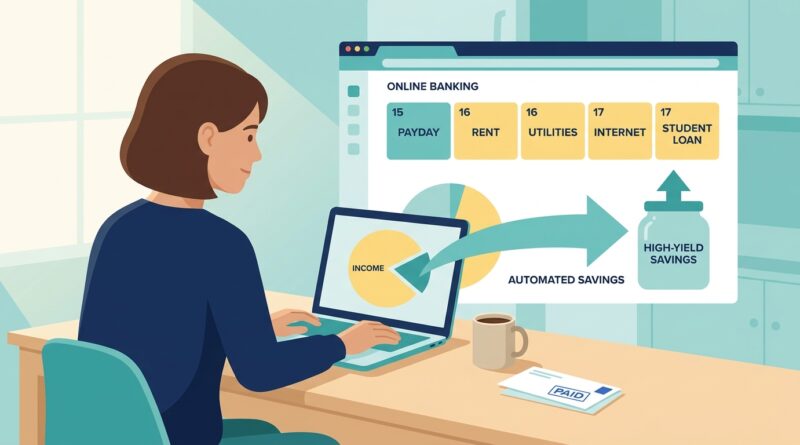
The ‘Bill-Sync HYSA’ Habit: Match Your Due Dates And Grow Savings On Autopilot
If your paycheck lands on the 1st and 15th, but your bills seem to attack on the 3rd, 8th, 12th, 19th, and 27th, you are not bad with money. You are dealing with bad timing. That mismatch is what makes checking accounts feel empty even when you make enough to cover your basics. It is also why late fees, overdraft charges, and that “I’ll move money to savings next week” promise keep showing up. A simple fix is the Bill-Sync HYSA habit. You line up due dates with your pay schedule, keep a small bills buffer in checking, and automate transfers so money goes to the right place before you can accidentally spend it. The result is less stress, fewer junk fees, and steady deposits into a high yield savings account. Not because you found more willpower, but because your money finally has a schedule that makes sense.
⚡ In a Hurry? Key Takeaways
- The best high yield savings account habits to automate bills and savings start with fixing bill timing, not chasing the absolute top APY.
- Move due dates closer to payday, automate bill money to checking, then automate a separate transfer to your HYSA the same day or the day after you get paid.
- Keep a small checking buffer so one mistimed charge does not trigger overdrafts or force you to pull money back from savings.
Why this habit works better than trying harder
Most people think the problem is spending. Sometimes it is. But often the real problem is timing.
Your income comes in chunks. Your bills do not. So even if the math works for the month, the calendar works against you during the month.
That is where the Bill-Sync HYSA habit helps. It turns a messy flow of money into a simple system:
Step 1. Match due dates to payday
Many lenders, utilities, phone companies, and insurers will let you change your due date. If you get paid twice a month, try grouping most bills right after each paycheck.
Example:
- Paycheck 1 covers rent, internet, and insurance
- Paycheck 2 covers credit card, phone, utilities, and savings
Now your bills are tied to income instead of random dates.
Step 2. Keep bill money in checking
Checking is your workhorse account. It is not where you grow money. It is where you stage money that needs to leave soon.
Once due dates are grouped, estimate how much from each paycheck needs to stay in checking to cover the next round of bills.
Step 3. Send the rest automatically to your HYSA
This is the part people skip. Savings should not get “whatever is left.” It should get a scheduled transfer.
Even a modest automatic transfer into a HYSA is powerful because it gets your money earning more interest right away instead of sitting idle in checking.
What “Bill-Sync HYSA” looks like in real life
Let’s say you bring home $2,000 every two weeks.
Your bills total about $2,800 a month. Groceries, gas, and day-to-day spending are another $900. That leaves only a little room. So timing matters a lot.
Here is a cleaner setup:
Paycheck A arrives on the 1st
- $1,100 stays in checking for rent and insurance due on the 3rd and 5th
- $150 goes to a spending bucket for groceries and gas
- $100 goes automatically to your HYSA
Paycheck B arrives on the 15th
- $800 stays in checking for utilities, phone, and card payment due on the 18th to 22nd
- $250 goes to spending
- $150 goes automatically to your HYSA
That is not flashy. It is not a money hack with fireworks. But it is exactly how you stop the leak.
How to set it up without making your life harder
1. Make a one-page bill map
Write down:
- Bill name
- Current due date
- Amount
- Can the due date be changed?
- Which paycheck should cover it?
You do not need a fancy app. Notes app, spreadsheet, or paper is fine.
2. Ask for new due dates
Call or log in to each biller. Look for “change due date” or “payment date options.” Many companies allow this once every few months or once per year.
Aim to cluster bills within 2 to 5 days after each payday.
3. Build a checking buffer first
Before you get aggressive with HYSA transfers, keep a small cushion in checking. Even $100 to $300 can help prevent overdrafts from a gas station hold, subscription renewal, or autopay posting earlier than expected.
This matters. A high yield savings account is helpful, but not if you keep pulling money back out because checking runs too tight.
4. Turn on autopay carefully
Autopay is great when your calendar is clean. Set bills to pull from checking only after your paycheck has landed.
Then set your HYSA transfer for the same day, or one day later, after your required bills amount is left behind.
5. Review once a month
Not every day. Not every hour. Once a month is enough for most people.
Check for:
- Changed bill amounts
- Annual subscriptions
- Utility spikes
- Payday dates that shift because of holidays
The biggest mistake people make with HYSAs
They treat the HYSA like the whole plan.
The account matters, yes. A better APY is nice. But if your cash flow is chaotic, a slightly higher rate will not save you from late fees or bounced payments.
That is why the best high yield savings account habits to automate bills and savings start with the calendar. Once your flow is stable, then the HYSA can do its job.
If you get a raise later, pair this habit with The ‘Pay-Yourself-Raise’ HYSA Habit: Turn Every Pay Bump Into Automatic Wealth. It is a smart next step because it helps you increase savings automatically without feeling the squeeze all at once.
Who this habit is best for
This works especially well if:
- You get paid biweekly or semi-monthly
- Your bills are scattered all over the month
- You often transfer money back and forth to avoid overdrafts
- You mean to save, but checking always gets there first
It is also useful if your income is decent on paper but still feels tight in practice. That usually means your system is clunky, not that you have failed.
When to be careful
Do not set transfers too aggressively at first.
If your bill amounts swing a lot, start with a smaller automatic HYSA transfer until you have one or two months of clean data. It is better to save $50 consistently than to set $300 and keep canceling it.
Also, make sure your HYSA is still easy enough to access for real emergencies. Savings should be slightly out of reach, not locked in a vault you cannot open when life happens.
At a Glance: Comparison
| Feature/Aspect | Details | Verdict |
|---|---|---|
| Main goal | Match bill due dates with payday, then automate savings into a HYSA | Best for fixing cash-flow stress |
| What you need | A checking account, a HYSA, autopay, and a small buffer in checking | Simple setup, high payoff |
| Biggest risk | Setting transfers too high before your bill timing is stable | Start small and adjust |
Conclusion
Right now, a lot of advice is telling people to chase a slightly higher APY. That is fine, but it misses the bigger problem. Broken cash flow is what keeps many people stuck. Money comes in on one day, bills hit on five others, and savings gets the leftovers. The Bill-Sync HYSA habit fixes that timing gap. You stop overdrafting. You cut junk fees. You feed your high yield savings account consistently without needing more willpower or a bigger paycheck. And in today’s rate environment, every automatic transfer that lands on time means more of your money starts earning sooner instead of sitting around in checking doing nothing. That is real progress, even if it looks boring on the surface.