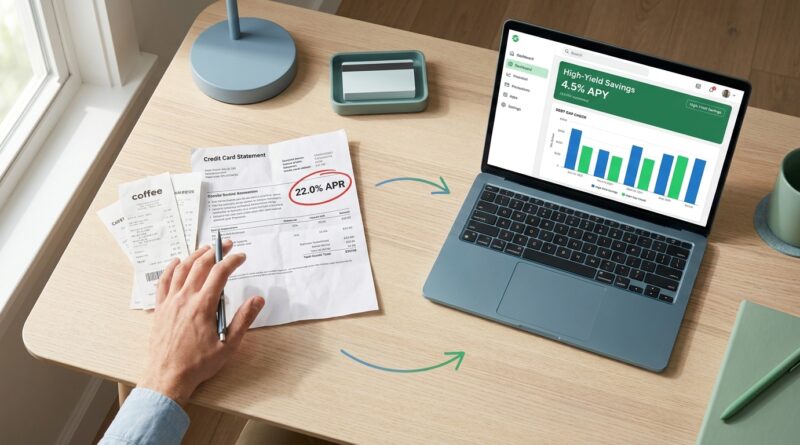
The ‘Debt Gap’ HYSA Habit: One Tiny Check That Can Save You Thousands In Interest
You are not imagining the math. It feels awful to watch your high-yield savings account finally earn decent interest while your credit card balance quietly charges you three, four, or even five times more. You did the “good” thing by saving. You built a cushion. But if that same month you paid 24 percent APR on card debt and earned 4.5 percent in your HYSA, the bank is still coming out way ahead. That is the debt gap.
The tiny habit that fixes it is simple. Once a month, do a two-minute debt gap check. Compare the interest rate you earn on savings to the interest rate you pay on any revolving debt. If the debt rate is much higher, and you still have an emergency buffer left after the payment, move extra cash toward the card. It is not dramatic. It is not a fancy spreadsheet trick. But it can save you hundreds or thousands over time, especially now that many households are carrying both cash savings and expensive card balances at the same time.
⚡ In a Hurry? Key Takeaways
- If you are asking, “should I pay off high interest debt or keep money in high yield savings,” the answer is usually to pay down the high-interest debt first, after keeping a basic emergency fund.
- Use one monthly rule: if your card APR is far above your HYSA rate, send extra money to the card until the gap is gone or your emergency cushion hits your floor.
- Do not drain savings to zero. Keep enough cash for real emergencies so you do not end up back on the card next month.
Why this feels so backwards
A lot of people are doing two “smart” things at once. They opened a HYSA because regular savings accounts pay next to nothing. They also kept making at least the minimum payment on their credit cards. On paper, that sounds responsible.
But the rates are not even close.
A solid HYSA might pay around 4 percent to 5 percent, depending on the market. A credit card balance might cost 20 percent to 30 percent. So while your savings grows a little, your debt can grow much faster.
That mismatch is the debt gap. And it is sneaky because your savings balance looks healthy. The credit card damage is often buried in the statement.
The tiny check that changes the decision
Step 1: Look at your HYSA APY
Open your savings app or website and note the annual percentage yield, or APY. That is the rate your money is earning.
Step 2: Look at your credit card APR
Check your latest statement for the purchase APR. If you carry balances on more than one card, write down all of them.
Step 3: Ask one question
Is my debt costing me a lot more than my savings is earning?
If the answer is yes, which it usually is with revolving credit card debt, that is your signal. Unless that savings money is needed to keep your emergency fund intact, extra dollars should usually go to the debt.
A simple rule you can actually live with
Here is the habit in plain English:
Keep a set emergency fund floor. Above that floor, use extra cash to attack any debt whose interest rate is clearly higher than your HYSA rate.
That emergency fund floor could be $1,000, one month of expenses, or whatever number keeps you from reaching for the card when life gets messy. The exact amount depends on how stable your income is, whether you have kids, and how much surprise spending tends to hit your household.
What matters is having a line.
Once savings is above that line, stop treating every dollar in the HYSA like it is untouchable if you are also paying 25 percent on a card balance.
Example: how the debt gap burns money
Let’s say you have $8,000 in a HYSA earning 4.5 percent. That might earn roughly $360 a year before taxes.
Now say you also carry a $5,000 credit card balance at 24 percent APR. Very roughly, that debt could cost about $1,200 a year if the balance hangs around.
So yes, your savings is “working.” But your debt is working much harder against you.
That is why the answer to “should I pay off high interest debt or keep money in high yield savings” is so often: keep enough cash for emergencies, then hit the high-interest debt hard.
When keeping more cash in savings does make sense
This is not a guilt trip to empty your savings account tonight.
There are a few times when holding extra cash is the safer move:
- Your job feels shaky and you may need a bigger cushion soon.
- You have a big known expense coming, like rent, tuition, car repairs, or a medical bill.
- Your card has a true 0 percent promo period that still has time left.
- Using savings to pay debt would leave you with no buffer, which could push you right back into borrowing.
The point is not “always drain savings.” The point is “stop ignoring the rate gap.”
How to do the debt gap check each month
Use this 5-minute routine
- Check HYSA APY.
- Check each debt APR.
- Set your emergency fund floor.
- See how much savings is above that floor.
- Send part or all of that extra amount to the highest-rate debt.
Put it on your calendar the same day you pay bills. First Sunday of the month. Payday. Whatever you will actually remember.
Start small if you freeze up
If moving a big chunk feels scary, do a partial transfer. Even $100 or $250 above your emergency floor sent to a 25 percent card is usually doing more for you than sitting in a 4.5 percent HYSA.
Progress counts.
The emotional trap: savings feels safe, debt feels abstract
This is where a lot of smart people get stuck.
Cash in savings feels comforting because you can see it. Credit card interest feels less real because it arrives in small statement lines and monthly totals. But one of those numbers is helping you slowly. The other may be hurting you fast.
That is why a behavior-based rule works better than waiting until you “feel ready.” You are not trying to win a debate with yourself every month. You are just following a quick check.
What about low-interest debt?
If the debt is low-rate, the answer can be different.
A mortgage at 3 percent, a subsidized student loan, or a promo balance at 0 percent is not the same as a credit card charging 27 percent. In those cases, keeping more money in a HYSA can make more sense, especially if your savings rate is competitive and you need liquidity.
This habit is really for expensive debt. The kind that quietly eats your financial progress while you focus on the nice-looking savings balance.
Common mistakes to avoid
Keeping too much in savings “just in case”
An emergency fund is smart. A giant pile of cash next to maxed-out cards is often expensive comfort.
Paying debt, then running the cards back up
If this keeps happening, the issue may be spending gaps or irregular bills, not just rates. In that case, keep a slightly larger cushion and work on smoothing out monthly cash flow.
Forgetting taxes on HYSA interest
Your HYSA earnings may be taxable. That makes the real benefit a little lower. Credit card interest, on the other hand, is still fully costing you.
The best version of this habit
The strongest version is boring. That is a compliment.
Every month, you check rates. You protect your emergency floor. You send extra money where it stops the most damage. Then you repeat.
You do not need a finance degree. You do not need a color-coded budget binder. You just need to stop treating savings and debt as two separate stories when they are really one math problem.
At a Glance: Comparison
| Feature/Aspect | Details | Verdict |
|---|---|---|
| HYSA earnings | Often around 4 percent to 5 percent APY, and taxable in many cases | Good place for emergency cash, but usually not enough to beat card interest |
| Credit card interest | Often 20 percent to 30 percent APR on revolving balances | Usually the bigger financial fire to put out first |
| Best monthly move | Keep an emergency fund floor, then use extra cash to pay the highest-rate debt | Simple, repeatable habit that can save serious money over time |
Conclusion
If you have been wondering whether you should feel proud of your HYSA or worried about your credit card balance, the honest answer is probably both. Rising savings rates are nice. But they do not cancel out expensive revolving debt. The good news is you do not need a huge life overhaul to fix this. A quick monthly debt gap check gives you a clear rule. Keep your emergency cushion. Compare your rates. Then move extra cash where it does the most good. That one low-effort habit can help you stop subsidizing the bank with high-interest debt while your savings earns a much smaller return. For anyone juggling a HYSA and lingering balances right now, it is one of the simplest money checks you can start this week.