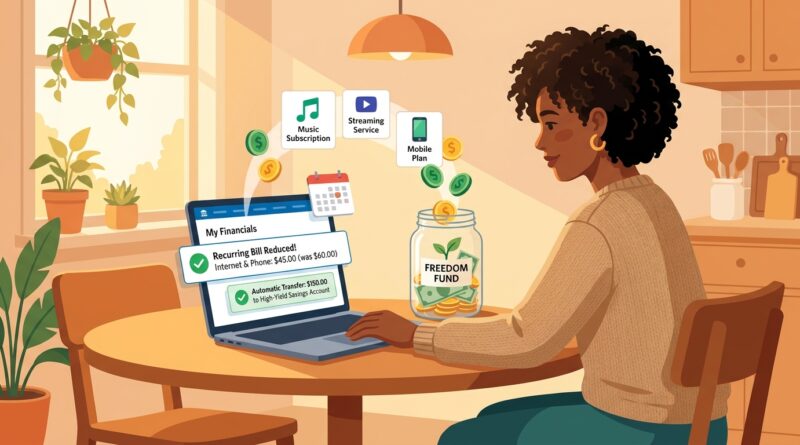
The ‘Freedom Fund Auto-Boost’ Habit: Turn Every Tiny Bill Drop Into High-Yield Savings Without Feeling It
You know the feeling. You finally cancel a streaming service, talk your phone bill down by $12, or get a cheaper car insurance rate. You expect that little win to help. Then a couple of weeks pass, you check your account, and somehow nothing changed. The savings vanished into takeout, app charges, and those tiny card taps that barely register in the moment. That is frustrating because you did the hard part already. You cut the bill. The problem is the money never got a new job. One of the smartest high yield savings habits is to auto-move every bill drop straight into savings the moment it happens. Not next month. Not when you remember. Right away. I call it Freedom Fund Auto-Boost. Every time a monthly cost falls, you raise your automatic transfer by that exact amount and send it to a high-yield savings account. You keep your lifestyle, lose almost nothing, and slowly build real breathing room.
⚡ In a Hurry? Key Takeaways
- The habit is simple. Every time a recurring bill drops, increase your automatic transfer to high-yield savings by that same amount.
- Start with canceled subscriptions, cheaper insurance, and lower phone plans because those savings repeat every month.
- This works best when the transfer is automatic and sent to a separate high-yield savings account, so the money is harder to casually spend.
Why tiny bill drops disappear so fast
Most people do not fail because they are bad at money. They fail because small savings are easy to absorb. A $7 price drop does not feel life-changing. A $14 discount on your internet bill does not make you rich. So the money stays in checking, where it quietly gets mixed into normal spending.
That is why the usual advice can feel annoying. “Just spend less” is not a system. It is a pep talk. And pep talks stop working when life gets busy.
The better move is to catch the savings before your habits do.
What the Freedom Fund Auto-Boost habit actually is
Here is the whole habit in one sentence. When a recurring monthly bill drops, raise your automatic savings transfer by the exact same amount.
Examples help:
- You cancel a $15.99 subscription. Increase your monthly auto-transfer by $16.
- Your car insurance falls from $132 to $118. Increase savings by $14 a month.
- You negotiate your phone plan down by $10. Move that $10 to savings every month.
That is it. You are not finding extra money. You are redirecting money that was already leaving your life.
Why this works so well for high yield savings habits
This habit works because it does not feel like a cut. You were already living without that money once the bill went down. So moving it to savings usually causes very little pain.
It also turns random financial wins into a permanent system. One canceled app is not exciting. But five little savings moves, stacked over a year, can mean an extra $40, $60, or $100 going into savings every month.
And when that money sits in a high-yield savings account, it starts earning something meaningful. Not life-changing overnight money, but real interest instead of basically nothing.
How to set it up in 10 minutes
1. Pick one savings account for your freedom fund
Use a separate high-yield savings account, not your main checking account. The separation matters. If the money stays in checking, it still looks spendable.
2. Find your current automatic transfer
Maybe you already move $25 or $50 a month to savings. Great. That is your starting point.
3. Look for recent bill drops
Check the last three to six months for:
- Canceled subscriptions
- Lower insurance premiums
- Cheaper phone plans
- Internet promos
- Refinanced or renegotiated services
- Memberships you paused or dropped
4. Add up the monthly difference
If Netflix went away and saved $15.49, your phone bill dropped $8, and insurance fell $11, that is about $34 more you can auto-save each month.
5. Increase your transfer today
Do it while the bill change is fresh. If you wait, the money will get absorbed into ordinary spending and the moment will pass.
A real-world example
Let us say Maria cuts three things:
- Streaming subscription: $11
- Gym add-on she never used: $9
- Insurance discount after shopping around: $18
That is $38 a month.
If she raises her automatic high-yield savings transfer by $38, she probably will not feel much difference because that money was already going out before. But after one year, she has put away $456, plus interest. After two years, she is getting close to a four-figure cushion from changes that felt small at the time.
Where people mess this up
They celebrate the lower bill but never change the transfer
This is the big one. A lower bill only helps if you give the savings a destination.
They save the money “mentally”
People tell themselves, “I will just spend less and keep the difference.” Usually that does not happen. Money in checking has a way of finding a use.
They make it too complicated
You do not need a spreadsheet with 19 tabs. You need one rule. Bill goes down, savings transfer goes up.
Make the habit even stronger
If you like this approach, pair it with income-based automation too. A good companion read is The ‘Raise Lock-In’ Habit: How To Turn Every Pay Bump Into Automatic High-Yield Savings Before Lifestyle Creep Eats It. That one catches bigger wins from raises. This one catches the quieter monthly leaks and fixes them for good.
Together, they create a very simple money system. Bigger paycheck. Save part of the increase. Smaller bill. Save the difference. No constant willpower required.
Best categories to use first
If you want quick wins, start here:
- Subscriptions. Easy to cancel, easy to forget, perfect for redirecting.
- Insurance. Even a small rate drop can create a steady monthly savings stream.
- Phone plans. These often stay overpriced until you ask questions.
- Internet and utilities. Promo rates, plan changes, and usage drops can all create room.
These are some of the most practical high yield savings habits because they are tied to recurring costs, not one-time luck.
What if the savings amount changes?
Round up if you want to keep it simple.
Saved $13.27? Make it a $14 transfer increase. If a seasonal bill changes later, you can adjust. The goal is not perfect math. The goal is building a system that catches money before it disappears.
At a Glance: Comparison
| Feature/Aspect | Details | Verdict |
|---|---|---|
| Effort required | One quick transfer update when a bill drops | Low effort, high payoff |
| Impact on daily life | Usually painless because you were already paying the higher bill before | Easy to stick with |
| Best destination for the money | Separate high-yield savings account with automatic transfers | Strong choice for building a freedom fund |
Conclusion
Rates on high-yield savings accounts are finally good enough to matter, but that only helps if money actually gets into the account. That is where this habit shines. Instead of obsessing over every coffee or opening account after account, you use the quiet savings already hiding in lower bills. Every canceled subscription, cheaper phone plan, or reduced insurance premium becomes a permanent boost to your freedom fund. Set it once, automate it, and let those tiny wins stack up in the background. That is the kind of money habit people actually keep because it works without asking you to feel deprived every day.