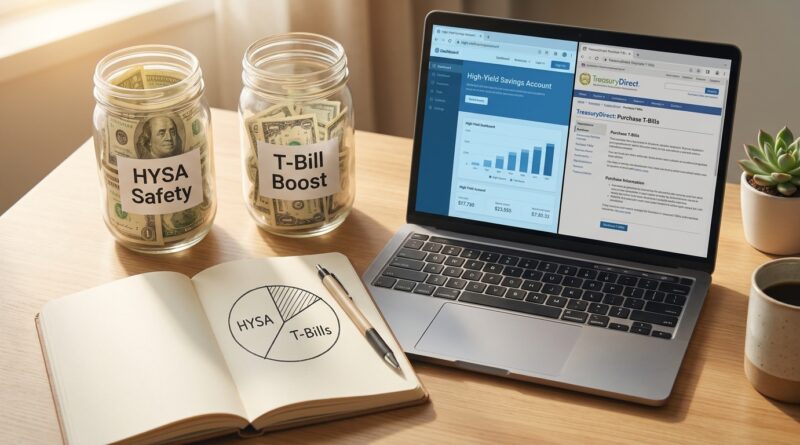
The ‘HYSA + T‑Bill Tag Team’ Habit: One Simple Split That Protects Your Cash And Squeezes Out Extra Yield
It is annoying to do the “responsible” thing with your emergency fund and still feel like you might be missing out. You park your cash in a high-yield savings account, then a headline pops up saying Treasury bills are paying more. A week later, savings rates shift again. Suddenly, keeping cash safe starts to feel weirdly stressful.
The good news is you do not have to pick one side and defend it forever. For most people, the better move is a simple split. Keep the money you may need quickly in a HYSA, and move the chunk you are less likely to touch soon into short-term T-bills. That is the HYSA plus T-bill tag team. It keeps your emergency fund usable, adds a little extra yield, and avoids the all-or-nothing thinking that makes saving feel harder than it should. If you want a practical HYSA vs Treasury bills emergency fund strategy, this is the low-drama version that works in real life.
⚡ In a Hurry? Key Takeaways
- A mix of HYSA and short-term Treasury bills is often the best emergency fund setup, not an all-in switch to one or the other.
- Start simple. Keep 1 to 3 months of expenses in your HYSA, then put the rest of your emergency fund into 4-week to 13-week T-bills.
- Both can be very safe, but a HYSA wins on instant access while T-bills often win on yield and may have a tax edge at the state level.
Why this debate keeps popping up
Because both options are good. That is what makes this confusing.
A high-yield savings account is easy. Your money sits there, earns interest, and is ready when life gets expensive. Car repair. Vet bill. Layoff. Leaky roof. It is boring in the best way.
Treasury bills, or T-bills, are also very safe. They are short-term U.S. government debt. You buy them at a discount and get the full value back when they mature. Right now, short-term Treasuries often pay a little more than many savings accounts, which makes savers wonder if their cash should move.
That question leads to a common mistake. People think they need to choose one winner. Usually, they do not.
The simple habit that works
Think of your emergency fund in layers, not one giant pile.
Layer 1: Your fast cash
This is your HYSA money. It is for the expenses that cannot wait and the moments when convenience matters more than squeezing out every last dollar of yield.
For many households, that means keeping 1 to 3 months of core expenses in a HYSA. If your income is irregular, or your job feels shaky, lean toward the higher end.
Layer 2: Your backup cash
This is where short-term T-bills can fit. If your full emergency fund target is 4 to 6 months of expenses, the amount above your first 1 to 3 months can go into Treasury bills with short maturities.
You are still protecting the money. You are just asking a portion of it to work a bit harder.
HYSA vs Treasury bills emergency fund strategy, in plain English
If you want the shortest version, here it is.
Use a HYSA for speed. Use T-bills for a little more yield. Split based on how soon you might need the money.
That is it. That is the strategy.
What a real-world split can look like
Let’s say your monthly must-pay expenses are $3,000, and you want a 6-month emergency fund. That puts your target at $18,000.
One reasonable setup could look like this:
- $6,000 to $9,000 in a HYSA
- $9,000 to $12,000 in short-term T-bills
If you are very cautious, keep more in savings. If you have a stable job, another cash buffer, or a two-income household, you might be comfortable moving more into T-bills.
The point is not to copy someone else’s exact ratio. The point is to build a split you will actually keep.
Why a HYSA still deserves a spot
Do not let yield-chasing talk you out of convenience.
A HYSA gives you:
- Quick access to money
- No maturity dates to track
- No auction schedule to learn
- A simple place for direct deposits or automatic transfers
That matters in an emergency. The best emergency fund is not the one with the absolute top rate on paper. It is the one that is safe, accessible, and calm.
Why T-bills are worth considering
T-bills can make sense for the part of your emergency fund you are less likely to touch right away.
They offer a few nice perks:
- Yields are often competitive, and sometimes better than HYSAs
- They are backed by the U.S. government
- Interest is exempt from state and local income taxes
- Short terms let you avoid locking money up for years
That tax break will not matter equally for everyone, but if you live in a high-tax state, it can make T-bills look even better.
The part that scares people, and why it is manageable
Most people are not really afraid of T-bills. They are afraid of making their money annoying.
Fair concern.
You do not want your emergency fund to turn into a spreadsheet hobby. So keep the system simple. Buy short-term bills only. Think 4-week, 8-week, or 13-week maturities. That way, some of your money is regularly coming due.
You can even build a basic ladder, which just means buying T-bills that mature at different times. Nothing fancy. Maybe one chunk matures this month, another next month, another after that.
If you need cash, you can use your HYSA first. If the emergency gets bigger, a T-bill may be maturing soon anyway.
How much should stay in HYSA?
Ask yourself three questions:
- How stable is my income?
- How likely am I to need this money fast?
- Will I actually keep up with a T-bill system, even a simple one?
If your job is less stable, your expenses are unpredictable, or you hate admin tasks, keep more in the HYSA. If your finances are steady and you do not mind a little setup, a bigger T-bill slice may be fine.
This is personal finance, not a math contest.
What not to do
Do not move everything out of savings just because rates are a bit higher elsewhere
The extra yield can be nice, but emergency funds exist to lower stress, not create it.
Do not chase every rate move
Rates change. Constantly hopping between accounts and products can eat up your time and attention for a very small gain.
Do not overcomplicate the ladder
A simple recurring setup beats a clever one you stop maintaining after two months.
A good starter plan for beginners
If you want a low-effort version of this strategy, try this:
- Keep the first 2 months of expenses in a HYSA.
- Put the rest of your emergency fund into 13-week T-bills.
- When each T-bill matures, decide whether to roll it over or move some back to savings.
- Check your split only when rates change a lot or your life changes.
That could be a new job, a move, a new baby, rising housing costs, or anything else that changes how much easy-access cash you want nearby.
Who should skip the T-bill part for now?
Some people are better off staying with a plain HYSA, at least for the moment.
- If your emergency fund is still small and growing
- If you are using this money often for true cash-flow gaps
- If you need one account that is dead simple
- If a tiny extra yield is not worth even minor hassle to you
That is not “doing it wrong.” It is matching the tool to your life.
Who gets the most out of the split?
This habit tends to work best for savers who already have a decent emergency cushion and want a smarter parking place for part of it.
If your fund is fully built, your finances are fairly steady, and you like the idea of earning a bit more without taking stock market risk, this setup can be a sweet spot.
At a Glance: Comparison
| Feature/Aspect | Details | Verdict |
|---|---|---|
| Access to cash | HYSA money is usually available quickly. T-bills are easiest if you wait for maturity, though short terms help. | HYSA wins for immediate emergencies. |
| Yield potential | Short-term T-bills often pay a bit more than top savings accounts, though rates can change. | T-bills often win on income. |
| Ease and upkeep | A HYSA is simpler to manage. T-bills take a little setup and attention, especially if you build a ladder. | Split the difference for the best balance. |
Conclusion
You do not need to jump ship entirely every time rates shift. Top high-yield savings accounts are still doing a solid job, and short-term Treasuries are often paying a little more right now. That is exactly why the HYSA plus T-bill split makes sense. It gives you ready cash where you need it and a bit of extra yield where you can afford to wait. More important, it keeps your emergency fund calm, useful, and easy to stick with. For most savers, that is the real win. Small, steady tweaks like this are how balances grow without turning your money into a second job.