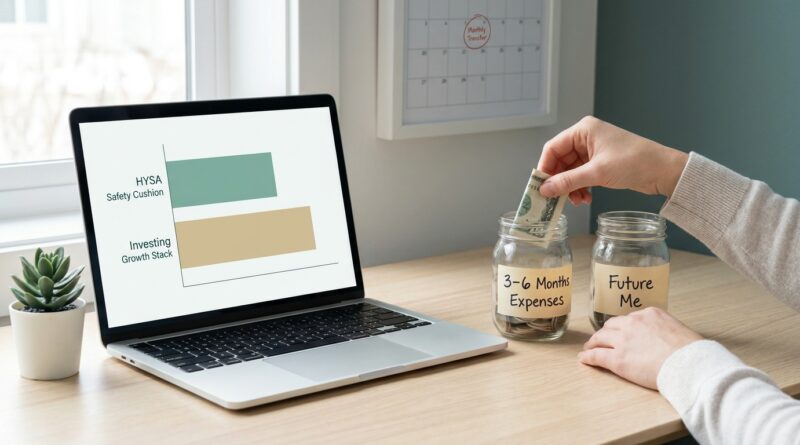
The ‘HYSA Cutoff’ Habit: Exactly How Much To Keep Safe Before You Start Investing
If you have been refreshing HYSA rates every week and still feeling unsure, you are not alone. A lot of smart savers are stuck here. They want cash to feel safe, easy to reach, and ready for surprises. But at some point, “playing it safe” turns into parking too much money on the sidelines while inflation and missed market growth quietly eat away at the bigger picture. That is the real problem. It is usually not that your savings account is bad. It is that you have not picked a clear cutoff. If you are asking how much should I keep in a high yield savings account vs investing, the answer is usually simpler than people think. Keep enough cash to cover near-term needs and your personal stress level. Invest the rest on purpose, automatically, and without treating every tiny APY change like a five-alarm fire.
⚡ In a Hurry? Key Takeaways
- Most people should keep 3 to 6 months of core expenses in a HYSA, then invest extra money meant for goals more than 5 years away.
- Pick one personal cash cutoff, automate your HYSA balance target, and send every extra dollar to a simple index fund plan.
- A HYSA protects short-term money and emergencies. Investing gives long-term growth. You usually need both, not one or the other.
The HYSA cutoff habit in plain English
The habit is simple. You decide on one number that makes you feel safe, not invincible. That is your cash comfort line.
Once your HYSA reaches that line, new extra money stops piling up there. It starts going to investing instead.
This matters because a high yield savings account has a job. It is for stability, emergencies, and money you may need soon. It is not supposed to carry your entire financial future.
Investing has a different job. It is for money you will not need for years, so it has time to ride through market dips and grow.
How much should I keep in a high yield savings account vs investing?
Here is the short answer.
Keep in a HYSA
Use your high yield savings account for:
- Your emergency fund
- Monthly bill buffer
- Planned expenses in the next 1 to 3 years
- Anything that would cause panic if the value dropped right before you needed it
Invest
Invest money that:
- You will not need for at least 5 years
- Is above your emergency fund target
- Is meant for retirement or long-term wealth building
- Can stay put during market ups and downs
For many households, that means keeping 3 to 6 months of essential expenses in a HYSA. If your income is irregular, your job feels shaky, or you just sleep better with more cushion, 6 to 12 months can be reasonable.
If your job is very stable and you have dual incomes, lower fixed bills, and no dependents, you may be fine closer to 3 months.
Why people get stuck with too much cash
It usually starts with good intentions. You build savings. You finally feel a little breathing room. Then rates go up, and your HYSA starts looking productive.
So you keep feeding it.
Then one bank offers 4.35%. Another offers 4.50%. Then 4.40%. You start comparing tiny differences that barely move the needle, while thousands of dollars that could be invested for the next decade just sit there.
That does not mean cash is bad. It means the account may have quietly outgrown its job.
How to find your personal cash comfort line
This is where the habit becomes useful. Do this once, and you can stop re-deciding it every month.
Step 1: Add up your core monthly expenses
Focus on the bills you must pay no matter what:
- Housing
- Utilities
- Groceries
- Insurance
- Transportation
- Minimum debt payments
- Childcare or health basics
Do not use your full lifestyle spending unless that is what you truly need to protect. The goal is survival and stability, not keeping every convenience alive during a rough patch.
Step 2: Multiply by your comfort level
Use this simple guide:
- 3 months: Very stable job, two incomes, low anxiety about market swings
- 6 months: Good default for most people
- 9 to 12 months: Variable income, self-employed, single income household, health concerns, or you just want more breathing room
Step 3: Add near-term planned expenses
If you know you will need cash for a move, car repair, tax bill, or vacation in the next year or two, add that on top of your emergency fund.
Do not invest money you already have a short-term job for.
Step 4: Call that your cutoff
That total is your HYSA cutoff.
Once the account hits that number, future extra money goes elsewhere. Usually that means a low-cost index fund inside a brokerage account, IRA, or workplace retirement plan.
A simple example
Let’s say your core monthly expenses are $3,500.
You choose 6 months of emergency savings. That gives you $21,000.
You also expect a $4,000 car expense within the next year.
Your HYSA cutoff becomes $25,000.
That means:
- First $25,000 stays in cash
- Every extra dollar above that gets invested
Now you have a rule. No guesswork. No constant “should I move more to savings?” debates.
If you are still building your first safety cushion
If you do not even have a starter emergency fund yet, do that first. Investing is important, but panic-proofing your life matters too.
A good place to start is The ‘First $2K Calm Fund’ Habit: One Tiny Milestone That Makes Every Other Money Move Easier. It is a smart bridge between “I need cash now” and “I know I should invest too.”
What goes wrong when you keep too much in a HYSA
The risk is not dramatic. That is why it is easy to miss.
You do not wake up one day and lose money in a savings account. Instead, you slowly miss the compounding that could have happened if some of that cash had been invested for years.
In a cooling-rate environment, this matters even more. When HYSA yields drift down, the reward for staying in cash gets smaller. But the long-term growth gap between cash and investing can stay very large.
That is the opportunity cost people feel, even if they do not use that term out loud. They just sense that their money is “safe,” but not really moving.
What to invest in once you pass the cutoff
You do not need a fancy plan.
For many people, a basic broad-market index fund setup is enough. That could be:
- A total stock market index fund
- An S&P 500 index fund
- A target-date retirement fund if you want something even more hands-off
The key is not finding the perfect fund. It is building the handoff system.
Cash up to your comfort line. Investing after that. Automatically.
How to automate the habit
Option 1: Fill the HYSA first, then switch
Send all extra savings to the HYSA until you hit your target. After that, change your automatic transfer so new money goes to your investment account.
Option 2: Split it while building
If your employer offers a retirement match, at least contribute enough to get the match while you build savings. Then direct the rest toward your HYSA until you reach your cutoff.
Option 3: Sweep the overflow monthly
Keep one target amount in the HYSA. On the first of each month, move anything above that target into investments.
This is especially helpful if your income varies.
Signs your HYSA balance may be too high
- You have more than 6 to 12 months of expenses in cash without a clear reason
- You keep delaying investing “until rates change”
- You are moving banks for tiny APY differences but have no investing plan
- You already have short-term needs covered and still keep adding to cash
- You feel safe, but also a little annoyed that your money is not growing
When it makes sense to hold more cash
There are plenty of valid reasons to be more cash-heavy for a while.
- You may lose your job soon
- You are self-employed with uneven income
- You are planning a home purchase soon
- You have big medical or family uncertainty
- You are close to retirement and need stability
The point is not to force yourself into a smaller cash pile than your life supports. The point is to be intentional. Extra cash should be there because it has a job, not because you never picked a limit.
At a Glance: Comparison
| Feature/Aspect | Details | Verdict |
|---|---|---|
| HYSA role | Best for emergency savings, short-term goals, and money you may need within 1 to 3 years | Keep enough for safety, not your whole future |
| Investing role | Best for long-term goals, usually 5+ years away, where growth matters more than day-to-day stability | Use for extra money above your cash cutoff |
| Best system | Set one personal HYSA target, park that amount there, and automate overflow into low-cost index funds | Simple beats rate-chasing |
Conclusion
If you have been stuck in the HYSA vs investing tug of war, the fix is usually not more research. It is a rule. Pick your personal cash comfort line in one sitting. Keep that amount in the best high yield account you can find. Then send the rest to a basic index fund plan automatically. That gives your cash a clear job and gives your long-term money a chance to grow. More important, it replaces rate watching with a calm, repeatable system you can actually stick with. And in a world where savings rates may keep cooling, that kind of simple habit can save you from letting too much money sit still for too long.