The ‘Rainy-Day Double Buffer’ Habit: How To Use Two HYSAs So One Surprise Bill Never Wrecks Your Month
You can do the “right” thing, move money into a high-yield savings account, and still feel one ugly bill away from a mini financial meltdown. That’s the maddening part. A car repair hits, the dog needs the vet, or a surprise copay lands, and suddenly you’re staring at the very savings you worked hard to build, wondering if one bad week is about to wipe out your progress.
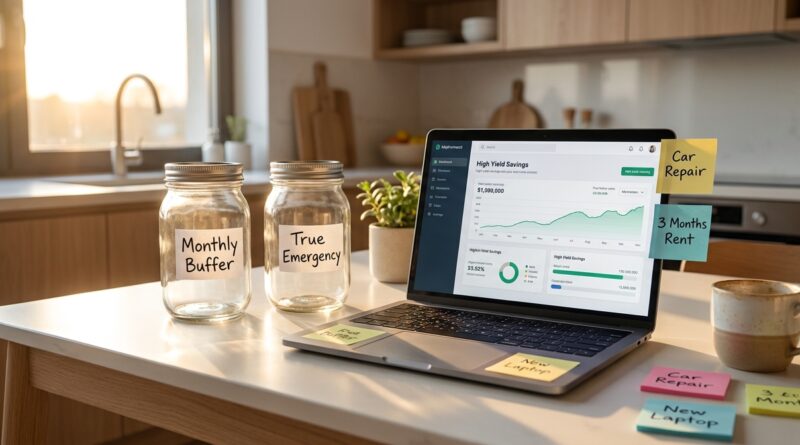
A simple fix is to stop treating your emergency fund like one giant bucket. Instead, split it into two high-yield savings accounts. The first is a rainy-day buffer for annoying but common surprises this month. The second is your true emergency fund for job loss, bigger medical issues, or months of living expenses. If you’ve been searching for how to split emergency fund between high-yield savings accounts, this setup gives you structure without making you track every little purchase. It helps you stay calm, protect your long-term safety net, and avoid panic-charging expenses that should have been covered by savings.
⚡ In a Hurry? Key Takeaways
- Use two HYSAs: one small “rainy-day” buffer for surprise monthly bills, and one larger emergency fund for real crises.
- Start by filling Buffer #1 with one month of essential expenses or a set amount like $1,000 to $3,000, then send extra savings to Buffer #2.
- This setup protects you from draining your full emergency fund too often, while still earning solid interest on both accounts.
Why one savings bucket often fails in real life
On paper, one emergency fund sounds neat and simple. In real life, it gets messy fast.
Maybe you have $8,000 saved. Great. But what happens when your brakes need work, your kid needs a last-minute prescription, and your utility bill spikes in the same month? You dip into savings, then feel guilty. Or worse, you avoid touching savings because it feels too important, and you put the expense on a credit card instead.
That’s the problem. One big pot makes every withdrawal feel dramatic.
A two-buffer system fixes that by giving different jobs to different dollars.
How the rainy-day double buffer works
Buffer #1: Your monthly shock absorber
This is the account for the stuff that is unexpected, but not life-destroying.
Think:
- Car repair
- Vet visit
- Urgent travel for family
- Surprise copay or dental bill
- Home repair that can’t wait
This account keeps one rough month from wrecking your budget.
You are not using it for planned annual bills like insurance premiums or holiday shopping. Those should be sinking funds. This first buffer is for real surprises that pop up during an otherwise normal month.
Buffer #2: Your true emergency fund
This is the bigger, more protected account.
Its job is to sit there quietly and cover serious problems such as:
- Job loss
- Major medical issue
- Large unavoidable repair
- A stretch of reduced income
This is the money you want building toward three to six months of core living expenses.
Because Buffer #1 handles the smaller hits, Buffer #2 gets touched less often. That matters. It means you can actually build a real safety net instead of constantly raiding it.
How to split emergency fund between high-yield savings accounts
Here’s the simplest version.
Step 1: Figure out your “bad month” number
Ask yourself this: if one annoying month went sideways, how much cash would stop me from reaching for a credit card?
For many people, that number lands somewhere between $1,000 and $3,000. If your car, pets, or healthcare costs are higher, your number may be larger.
If you want a more personal target, use one month of essential expenses as your guide.
Step 2: Put that amount in HYSA #1
This becomes your rainy-day buffer.
Name it something obvious, like:
- Monthly Buffer
- Rainy Day
- Do Not Panic Fund
Seriously, the label helps. It reminds you what the money is for when stress hits.
Step 3: Send the rest to HYSA #2
After Buffer #1 is filled, all extra emergency savings goes to Buffer #2.
This is where you build toward three to six months of necessary expenses like housing, groceries, utilities, transportation, insurance, and minimum debt payments.
Step 4: Refill Buffer #1 first after using it
If you use $600 from your rainy-day account for a tire replacement, your next savings goal is to top that account back up.
Only after it’s refilled do you resume building Buffer #2.
That’s the habit. Simple. Repeatable. Low drama.
What this looks like in real numbers
Let’s say you have $7,500 set aside today.
- HYSA #1 Rainy-Day Buffer: $2,000
- HYSA #2 Emergency Fund: $5,500
Now your dog needs a $700 procedure.
Instead of feeling like you’re “breaking into emergency savings,” you pull it from HYSA #1. Buffer #2 stays intact. Your bigger safety net remains untouched. Next month, you focus on restoring that $700.
That mental separation is not just nice. It changes behavior.
Why two HYSAs work better than checking plus savings
A lot of people keep a little extra in checking “just in case.” The problem is that checking earns very little interest, and it’s too easy to blur the line between spending money and safety money.
Using two high-yield savings accounts gives you three benefits:
- Both buckets can earn competitive interest
- Your money has clear jobs
- You reduce the urge to spend what should be saved
If you’re also worried that today’s good savings rate won’t last forever, it’s worth reading The ‘Rate‑Drop Padlock’ Habit: One Pre‑Fed Move That Protects Your HYSA From Falling Yields. It pairs nicely with this setup if you want your cash to stay organized and keep earning as much as possible.
Should the two accounts be at the same bank?
Usually, yes.
If your bank lets you open multiple savings accounts with nicknames, that is often the easiest move. Transfers are simple. You can see both balances in one login. Less friction means you’re more likely to stick with the system.
But there are two reasons to use separate banks:
- You want a little extra friction before touching your true emergency fund
- One bank has a clearly better rate or features
If you know you’re tempted to dip into savings too casually, putting Buffer #2 at a different bank can help. Not impossible to reach. Just less convenient.
Common mistakes to avoid
Making Buffer #1 too small
If you only keep $200 in your rainy-day account, it won’t do much when real life happens. Try to make it big enough to handle your most likely surprise.
Using Buffer #2 for routine overspending
If you blew the grocery budget or booked a weekend trip you couldn’t really afford, that is not an emergency. Your system only works if each account keeps its job.
Mixing planned expenses into the emergency fund
Car insurance every six months is not a surprise. Holiday gifts are not a surprise. Those belong in separate sinking funds, even if they also sit in a HYSA.
Obsessing over perfection
You do not need the exact ideal split on day one. Start with a rough number. Adjust later. A good system you use beats a perfect system you never finish setting up.
Who benefits most from this setup
This approach is especially useful if:
- Your income is steady, but your monthly expenses can get jumpy
- You have kids, pets, an older car, or a house
- You hate budgeting every tiny purchase
- You keep using credit cards for surprise expenses even though you do have savings
It is also great for anxious savers. If every withdrawal makes you feel unsafe, splitting the money can make savings feel usable again.
At a Glance: Comparison
| Feature/Aspect | Details | Verdict |
|---|---|---|
| Single emergency fund account | Simple to open, but every withdrawal comes from the same pot, which can make normal surprises feel like a crisis. | Okay for simplicity, weaker for peace of mind. |
| Two-HYSA buffer system | One account handles surprise monthly bills, while the other grows into a true three-to-six-month safety net. | Best balance of clarity, flexibility, and protection. |
| Extra cash left in checking | Easy access, but usually low interest and easy to spend by accident. | Convenient, but usually the least efficient option. |
Conclusion
You do not need a complicated money system to feel more secure. You just need your savings to be easier to use the right way. Right now rates are still strong on high-yield savings, yet most people either park everything in one pot or leave it scattered across checking and low-interest accounts. A two-buffer habit turns that mess into a clear system: one account keeps your month from derailing when a tire blows or a copay shows up, and the other quietly builds toward three to six months of true expenses. That kind of clarity is exactly what many people want right now. Not fear. Not doom-scrolling. Just a practical setup that helps you feel safer without hoarding every dollar or cutting every small joy from your life.