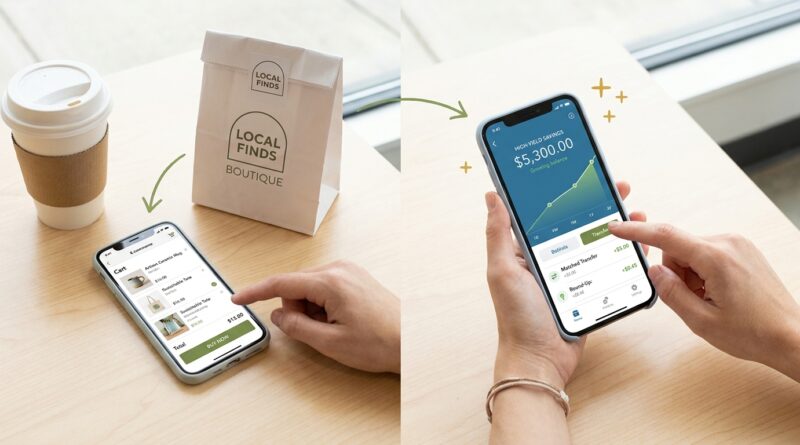
The ‘Match-Your-Splurge’ HYSA Habit: Turn Every Treat Into Double Savings
You know the feeling. You buy the coffee, the quick Target run, the birthday gift from Amazon, and tell yourself it is not a big deal. Then payday comes and your savings account looks exactly the same as it did two weeks ago. That is the frustrating part. Most people are not blowing money on yachts. They are losing it in tiny, harmless-looking treats that never seem big enough to worry about, until they stack up. The good news is you do not need a harsh budget or a guilt trip to fix it. The high yield savings matching habit is simple. Every time you make a non-essential purchase, you move the same amount into your HYSA. Buy a $7 latte, save $7. Spend $28 at Target on stuff you did not need, save $28. You still get the treat, but now your savings grows with it.
⚡ In a Hurry? Key Takeaways
- The high yield savings matching habit means copying every non-essential purchase with an equal transfer into your HYSA.
- Start with one category, like coffee, takeout, or impulse shopping, so the habit feels easy enough to keep.
- This works best with a real high-yield savings account and a spending cap, so you build savings without creating cash-flow stress.
What the high yield savings matching habit actually is
Think of it as a money mirror.
When you spend on a want, not a need, you send that same amount to savings. It is not a punishment. It is a reality check with a reward built in.
People like this habit because it turns vague money advice into something you can do today. “Small purchases add up” is easy to ignore. Matching those purchases with real transfers makes that idea impossible to miss.
If you bought lunch out for $14, your HYSA gets $14. If you grabbed a $40 skin care item you did not plan for, your HYSA gets $40 too. Pretty soon, your account balance starts proving where your money has been going all along.
Why this works better than “just stop spending”
Most all-or-nothing money plans fail for one simple reason. Real life is not all-or-nothing.
You are still going to meet a friend for coffee. You are still going to buy the little birthday extra. You may still wander into Target and come out with candles, socks, and one thing you actually needed.
The matching habit works because it keeps joy in the picture. You do not have to act like every non-essential purchase is moral failure. You just pair it with savings.
That changes the emotional math. Instead of thinking, “I blew $25,” you think, “I spent $25 and saved $25.” You become more aware without feeling deprived.
If this idea sounds familiar, it is close to the approach in The ‘Match-Your-Treat’ HYSA Habit: Turn Every Little Splurge Into Quiet Savings, which explains why people stick with this better than stricter no-fun budgets.
How to start without making it complicated
Pick one spending category first
Do not try to match every dollar you spend right away.
Start with the category that gets you most often. For some people it is coffee. For others it is takeout, beauty buys, books, gaming purchases, or random Amazon orders.
Choosing one category keeps the habit from feeling heavy.
Use a HYSA, not your regular checking account
A high-yield savings account helps in two ways. First, it keeps your matching money separate from spending money. Second, it earns more interest than a basic savings account at many traditional banks.
You are doing the same transfer either way, so it makes sense to park that money where it can work a little harder.
Transfer the money right away
Speed matters here.
If you wait until the end of the month, you will forget purchases or talk yourself out of the transfer. Move the money the same day if possible. Many banking apps make this easy in under a minute.
Set a weekly or monthly limit
This part is important. The goal is to build savings, not create a cash crunch.
You might decide to match up to $100 a month, or only match purchases in one category until you get comfortable. A cap keeps the habit sustainable.
What this habit teaches you fast
It teaches you the true cost of “little” spending.
A $6 coffee is not just $6 anymore. In this system, it is really $12 total leaving your day-to-day cash flow, because $6 goes to the coffee and $6 goes to savings. That sounds intense, but it is exactly why the habit works.
You start asking better questions.
Do I want this enough to match it?
Is this an actual treat or just boredom spending?
Would I rather skip it and keep both amounts?
Those are healthier money questions than “Why am I so bad at saving?”
Who this works best for
This is especially useful for people who:
- struggle with impulse spending
- hate strict budgets
- want to build an emergency fund faster
- need a simple savings rule they can remember
- feel guilty after small splurges
It is also a good fit if your income is steady but your savings never seem to move. Often that is not an income problem. It is a habit problem.
When to be careful with it
If money is already tight
If you are living paycheck to paycheck, full matching may be too aggressive at first. That is okay.
Try a partial version. Match 25 percent or 50 percent of the purchase instead of the full amount. A $20 takeout order could mean a $5 or $10 transfer. You still build awareness and savings without straining your bills.
If you turn it into punishment
This habit should make you more intentional, not miserable.
If every purchase starts feeling loaded with shame, pull back and simplify. The point is to connect spending with saving, not to make yourself anxious over every iced coffee.
If you “match” with money meant for bills
Never pull matching transfers from rent, utilities, groceries, or debt payments. Savings habits only help when your basics are covered first.
A simple example
Let us say in one week you spend:
- $8 on coffee
- $22 on takeout
- $35 on a spontaneous Target run
That is $65 in non-essential spending.
If you match all of it, another $65 goes into your HYSA. In one month, if that pattern repeats weekly, you have saved about $260. That is money you probably would not have set aside otherwise.
And because it sits in a high-yield savings account, it can earn interest while it waits.
Ways to make the habit easier to stick with
Rename your savings account
Call it “Treat Match Fund” or “Impulse Buffer.” A good label makes the account feel purposeful, not abstract.
Use round numbers if exact matching annoys you
If you buy something for $5.75, transfer $6. If you spend $18.20, send $20 if your budget allows. Simple is better than perfect.
Do a nightly or weekly catch-up
If transferring after every purchase feels like too much, pick one time each evening or one set day a week. Just be consistent.
Celebrate the savings, not just the restraint
Check the HYSA balance once a week. Watching it rise is what makes the habit feel real.
At a Glance: Comparison
| Feature/Aspect | Details | Verdict |
|---|---|---|
| Ease of starting | You only need a HYSA and one spending category to begin. | Very beginner-friendly |
| Impact on spending awareness | Matching purchases makes “small leaks” visible fast. | Excellent for curbing impulse buys |
| Budget safety | Works best when paired with a cap or partial match if cash is tight. | Smart and safe when adjusted to your income |
Conclusion
The reason this habit is catching on is simple. It solves two problems at once. You get to enjoy life now without pretending fun spending will disappear, and you finally put real weight behind the idea that small purchases add up. You do not need a big paycheck or a complicated spreadsheet to start. Pick one category, mirror each non-essential dollar into your HYSA, and let the balance show you what is possible. For Savers readers, the high yield savings matching habit is one of the rare money tricks that feels both realistic and effective. It is a bridge between treating yourself and building a real cash cushion at the same time.