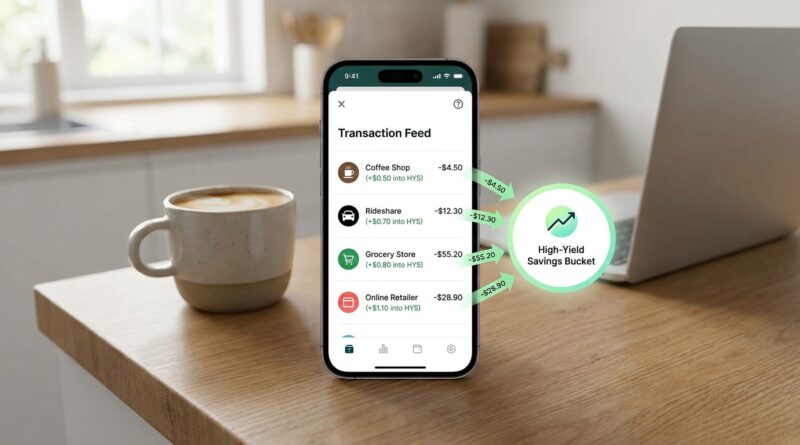
The ‘HYSA Round‑Up Challenge’: Turn Every Swipe Into Automatic High‑Yield Savings
You meant to save this month. Then life happened. A few small Amazon orders, two coffee stops, one late-night takeout run, an Uber when you were tired, and somehow the money you planned to move into savings just stayed in checking. That is the maddening part. You are not being reckless. You are just living. If your high-yield savings account balance keeps growing slower than you hoped, the easiest fix may be to stop depending on perfect timing and start using automation. The high yield savings account round up savings hack is simple: every card purchase gets rounded up to the next dollar, and the spare change moves to savings on autopilot. It is low drama, easy to set up, and it quietly turns normal spending into steady progress. No budgeting spreadsheet required. No monthly guilt trip either. Just small transfers that build a real cushion over time.
⚡ In a Hurry? Key Takeaways
- A round-up system sends the spare change from everyday purchases into your HYSA automatically, which makes saving happen without waiting for willpower.
- You can set this up in under an hour using your bank, a budgeting app, or a manual weekly transfer based on your card activity.
- Keep a checking account buffer so round-ups do not trigger overdrafts, and make sure your savings account still has a competitive rate.
Why this works better than “I’ll transfer money later”
Most people do not fail at saving because they do not care. They fail because saving is usually the last step. Rent comes out first. Groceries happen. Gas happens. Then all the little purchases pile up, and the month ends before the savings transfer does.
Round-ups flip that around. Instead of asking you to make one heroic decision at the end of the month, they turn dozens of tiny purchases into dozens of tiny savings moves.
Buy a coffee for $4.35. Round up to $5. Save $0.65. Order something for $12.20. Save $0.80. Grab lunch for $9.11. Save $0.89.
It feels almost too small to matter, but that is the trick. Small enough not to hurt. Regular enough to add up.
What the high yield savings account round up savings hack actually is
At its core, this hack does one thing. It rounds each debit card or credit card purchase up to the nearest dollar and moves the difference into a savings bucket, ideally a high-yield savings account.
Here are the three common ways people do it
Bank-built round-ups. Some banks and fintech apps already offer this feature. You turn it on, pick the savings account, and the system handles the rest.
App-based round-ups. Budgeting and savings apps can watch your spending and create matching transfers into savings.
DIY round-ups. If your bank does not offer this, you can still fake it with a recurring weekly transfer, like $10, $20, or $35, based on your average card activity.
The sweet spot is sending those round-ups into a HYSA instead of leaving them in basic savings at 0.01%.
How to set it up in under an hour
1. Pick the right HYSA destination
Your round-ups need a home. That should be a high-yield savings account with no monthly fee, easy transfers, and a rate that is still competitive. Rates move around, so it is smart to check whether your current account is still pulling its weight. If you like chasing a better promo rate now and then, The ‘Bonus Sweep’ Habit: Turn Limited-Time HYSA Promos Into Permanent Extra Interest is a useful next step.
2. Check whether your bank already has round-ups
Open your banking app and search for terms like “round up,” “spare change,” “automatic savings,” or “purchase roundup.” If it exists, turn it on and link it to your HYSA.
3. Decide what counts
Some systems round up every debit card purchase. Some include credit card purchases if they are paid from checking. If you overspend on credit cards, be careful here. You do not want a cute savings trick hiding a larger balance problem.
4. Add a checking buffer
This part matters. Keep a little cushion in checking so small auto-transfers do not push you into overdraft territory. For many people, that means leaving an extra $50 to $200 untouched.
5. Start small if money is tight
You do not have to go all in. Some tools let you double round-ups, but plain old nearest-dollar round-ups are enough to start. The point is consistency, not showing off.
How much can this really save?
Let’s keep expectations honest. Round-ups alone probably will not fully fund a six-month emergency stash. But they can build real momentum.
If your average round-up is about $0.50 and you make 40 purchases a month, that is around $20 monthly. If you make 80 purchases, that could be $40. Add HYSA interest, and over 6 to 12 months you have a few hundred dollars you did not have before.
Now stack one more habit on top. Every time your paycheck lands, add a flat transfer of $25 or $50 into the same HYSA. Suddenly your “spare change” system becomes a serious starter emergency fund.
Who this is best for
This works especially well for people who:
- Use debit or credit cards for most daily spending
- Struggle to remember manual savings transfers
- Want a low-effort money habit
- Feel discouraged by slow HYSA growth
- Need a savings system that adjusts to real life spending
It is less useful if you mostly use cash, make very few transactions, or regularly run your checking account close to zero.
Common mistakes to avoid
Thinking round-ups replace budgeting
They do not. This is a savings helper, not a money cure-all. If subscriptions, dining out, or impulse shopping are blowing up your budget, round-ups will not fix that by themselves.
Sending money to a weak savings account
If the money is auto-saving into an old brick-and-mortar account paying almost nothing, you are missing the best part. Put it in a real HYSA so the balance can keep earning.
Ignoring transfer timing
Some banks move round-ups instantly. Others batch them daily or weekly. Learn the timing so you do not get surprised by multiple small transfers landing at once.
Overcomplicating it
You do not need six savings apps, color-coded categories, and a ten-tab spreadsheet. One checking account, one HYSA, one round-up rule. That is enough to start.
A smarter version of the social media micro-savings challenge
The reason this trend has legs is that it fits real life. A lot of “money challenge” content looks good for a week and then fades. Envelope challenges get messy. No-spend months can feel punishing. Random savings games are easy to quit.
Round-ups are different because they are boring in the best possible way. Once set, they keep going whether you feel motivated or not. If this month is expensive, the system saves more because there are more transactions. If this month is quiet, it saves less without making you feel like you failed.
That makes it more sustainable than most viral money tips.
How to make the system grow faster
Pair round-ups with “leftover sweeps”
At the end of each week, transfer whatever is left above your checking buffer into the HYSA. Even $12 here and $18 there helps.
Use one savings goal
Name the account something concrete like “Emergency Buffer” or “Car Repairs.” Vague savings goals are easier to raid.
Review your HYSA rate every few months
Rates drift. That is normal. But if your account slips well below the market, move. A little maintenance can keep your money working harder.
Increase the rule later
Once normal round-ups feel painless, see if your bank lets you round to the nearest $2 or add a fixed match. That is how a tiny habit turns into a bigger one.
At a Glance: Comparison
| Feature/Aspect | Details | Verdict |
|---|---|---|
| Ease of setup | Usually 15 to 60 minutes through your bank app, a savings app, or a simple recurring transfer. | Very beginner-friendly |
| Savings impact | Best for building a starter cushion through many small deposits, especially when paired with HYSA interest. | Slow but steady |
| Risk and downsides | Can cause checking-account stress if you keep too little cash on hand or if transfers batch unexpectedly. | Safe if you keep a buffer |
Conclusion
If your savings plan keeps getting bullied by normal daily spending, this is one of the simplest fixes around. HYSA rates may be drifting and everyday costs may still sting, but a round-up-to-HYSA system gives you something practical you can set up fast and keep running quietly in the background. It scales with your actual life. Spend less this month, save a little. Spend more this month, save more automatically. That is a lot better than waiting for perfect self-control at the end of the month. And unlike one-off social media savings challenges, this can stick. Give it an hour, let it run for 6 to 12 months, and you may be surprised how much “spare change” can turn into a real, interest-earning safety net.