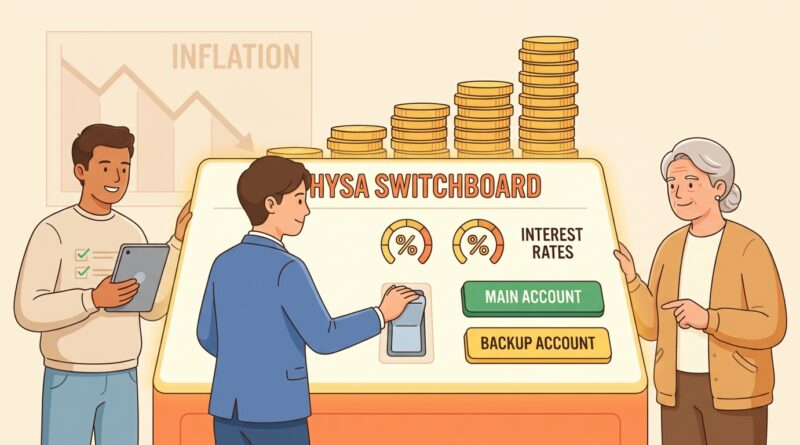
The ‘HYSA Switchboard’ Habit: One 10‑Minute Check That Stops Your Cash Quietly Losing To Inflation
Your savings account can look healthy on the screen while quietly losing ground in real life. That is the frustrating part. You do the responsible thing, keep an emergency fund, avoid risky moves, and still inflation can nibble away at your buying power if your “high yield” rate has slipped. A lot of people know they should shop around, but they do not want a second job managing banks, promo offers, and password resets. Fair enough. The better answer is not constant chasing. It is a simple habit. I call it the HYSA Switchboard. Once a month, spend 10 minutes checking three things: your current savings APY, the best widely available APYs, and the current inflation trend. If your account falls too far behind, you decide whether to switch, split your cash, or stay put on purpose. That small check can stop your cash from slowly shrinking without turning your money into a hobby.
⚡ In a Hurry? Key Takeaways
- The best high yield savings account strategy 2026 inflation is not weekly rate chasing. It is a 10-minute monthly check with clear switch rules.
- Compare your HYSA APY to both top market rates and inflation. If you are trailing badly, make a calm move instead of waiting for months.
- Keep safety first. Use FDIC or NCUA-insured accounts, and do not move emergency cash into risky investments just to beat inflation.
What the HYSA Switchboard habit actually is
Think of it like checking a thermostat, not day trading.
Once a month, on the same day if possible, you look at a tiny dashboard:
- Your current savings account APY
- Two or three competitor APYs from reputable banks or credit unions
- The latest inflation reading, or at least the general trend
- Any fees, minimum balance rules, or transfer limits on your current account
That is the switchboard. You are not trying to grab every last tenth of a percent. You are checking whether your money is still parked in a decent place.
Why this matters in 2026
A lot of savers got used to seeing “high yield” as a guarantee that they were doing well. It is not. “High yield” is a label, not a promise.
If inflation is running above your savings rate, your balance may be growing in dollars while shrinking in buying power. That means the same emergency fund may cover less rent, fewer groceries, or a smaller car repair than it did a year ago.
And with the Fed keeping rates in a fairly tight range, many banks have been slow to stay competitive. Some cut rates quietly. Others rely on the fact that customers do not check.
That is where this habit helps. It gives you a middle path between neglect and obsession.
The three numbers to check each month
1. Your current APY
Log in and write down the actual annual percentage yield, not the headline from when you opened the account two years ago. Banks change rates. Sometimes often.
2. A realistic “best available” APY
Do not compare yourself to some weird promo that lasts six weeks and requires twelve hoops. Look for rates from established, insured institutions that a normal person can open online without drama.
You only need a rough market number. If solid competitors are paying 4.7 percent and you are sitting at 3.8 percent, that gap matters.
3. Inflation
You do not need to become an economist. Just know whether inflation is above, below, or close to your savings rate. If inflation is 3.3 percent and your account earns 4.6 percent, you are at least modestly ahead before taxes. If inflation is 3.5 percent and your account earns 2.9 percent, you are slipping backward.
Your simple switch rules
This is the part that keeps the habit from becoming mental clutter. Make the decision rules before you check.
Here is a practical version:
- If your APY is within 0.25 percentage points of top widely available accounts, stay put.
- If your APY trails by 0.26 to 0.75 points, put the account on watch. Check again next month.
- If your APY trails by more than 0.75 points for two straight checks, switch or move part of the cash.
- If your bank adds fees, balance hoops, or annoying transfer friction, be quicker to leave.
That is it. Clear rules save a lot of energy.
How to switch without making a mess
This is where people get stuck. Not because switching is hard, but because everyone imagines it will be annoying.
Sometimes it is a little annoying. It is rarely terrible.
Use the two-account method
Open the new HYSA first. Keep the old one active until all transfers clear and you have tested withdrawals both ways. Then move most of the money. Leave a small cushion in the old account until you are sure everything works.
Name the account by job
Do not call it “Savings.” Call it “Emergency Fund” or “Home Repair Buffer.” That way, you remember the purpose and are less likely to chase risky returns with money that needs to stay stable.
Save your setup notes
Keep one note with the bank name, customer service number, linked checking account, and any transfer limits. Future you will be grateful.
When not to switch
Not every rate gap is worth your time.
If you have a small balance, the extra return from switching may be tiny. A difference of 0.40 percentage points on $2,000 is not life-changing. On $25,000, it starts to matter more.
Also, if your current bank has excellent service, fast transfers, no hassle, and a rate that is still pretty competitive, staying may be the smarter move. Convenience has value. The point is to make that tradeoff consciously.
A quick example
Let’s say you keep $15,000 in your emergency fund.
Your current HYSA pays 3.6 percent. A strong competitor pays 4.5 percent. That 0.9 point gap is about $135 a year before taxes.
Will $135 make you rich? No.
Will it cover part of a utility bill, a few tanks of gas, or a surprise prescription? Absolutely. More important, the check helps make sure you are not sleepwalking through a slow loss.
What this habit is not
It is not a reason to move your emergency fund into stocks because inflation is annoying.
It is not a reason to jump at every teaser rate.
And it is not a test of whether you are “good with money.”
It is just a maintenance habit. Like checking tire pressure. Boring, useful, and cheap.
Safety rules that matter more than the rate
Before you move money, make sure the account is FDIC-insured, or NCUA-insured if it is a credit union. Stay within coverage limits. Read the transfer timing and withdrawal rules. A great APY is not so great if getting your money in an emergency feels like opening a vault in a spy movie.
Also remember taxes. Interest is usually taxable, so your real return is a bit lower than the APY suggests. That does not mean you should ignore rates. It just means “beating inflation” in practice can be harder than it looks on paper.
The calm middle path
The best high yield savings account strategy 2026 inflation is not perfection. It is consistency.
You do not need six bank accounts and a spreadsheet worthy of a hedge fund. You need one repeatable check that helps you notice drift. That is the whole game.
Set a recurring calendar reminder. First Saturday of the month. Payday. Whatever you will actually do.
Open your note. Compare the three numbers. Follow your rule. Done.
At a Glance: Comparison
| Feature/Aspect | Details | Verdict |
|---|---|---|
| Monthly time needed | About 10 minutes to check your APY, top market rates, and inflation trend | Easy habit for busy people |
| When to switch | Consider moving if your rate trails solid competitors by more than 0.75 percentage points for two checks | Good balance between action and overreacting |
| Safety of your cash | Use FDIC or NCUA-insured accounts and keep emergency money liquid | More important than squeezing out every last rate bump |
Conclusion
If you have felt stuck, you are not alone. A lot of people know inflation is still outpacing many savings rates, and with the Fed holding rates in a narrow range, it can feel like your only options are doing nothing or turning into a full-time rate chaser. The HYSA Switchboard habit is the calmer option. One short monthly check. A few simple rules. A better chance of keeping your emergency fund and short-term savings from quietly eroding. That fits the Savers community perfectly. Small habits, big bank accounts. You stay informed, protect your cash, and keep your life simple. That is a win.