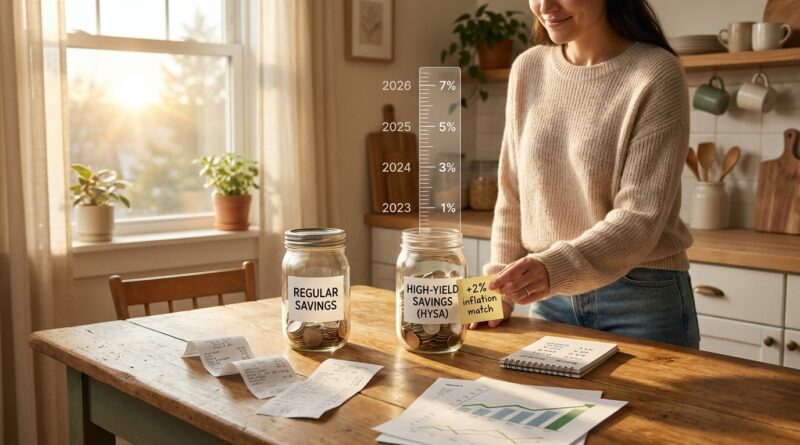
The ‘Inflation‑Match’ HYSA Habit: How To Give Every Dollar A Job So It Stops Quietly Shrinking
You can be doing the “responsible” thing, keeping cash in a high-yield savings account, and still feel like you are losing ground. That feeling is real. If rent is up, groceries are up, insurance is up, and daycare or utilities keep creeping higher, a nice APY alone does not guarantee your money is keeping up with your life. That is the gap a lot of savers miss. They focus on the bank’s rate, but not on their own rising costs. A smarter move is to give every dollar a job by building an Inflation-Match habit. The idea is simple. Figure out your personal cost increase, then raise your monthly HYSA contribution by that same percentage. Not by a huge amount. Just enough to help your safe money hold its buying power. It is one of the most practical high yield savings habits to beat inflation because it is easy to measure, easy to automate, and much less stressful than rate chasing.
⚡ In a Hurry? Key Takeaways
- An Inflation-Match habit means increasing your monthly HYSA deposit by your own realistic cost increases, not just hunting for the highest APY.
- Start by reviewing a few big expenses like rent, food, childcare, and insurance, then raise your automatic savings transfer by that percentage.
- This will not make you rich overnight, but it can help protect purchasing power and keep your emergency or short-term savings from quietly falling behind.
Why a “good” savings rate can still feel disappointing
A high-yield savings account is still a useful tool. It gives your cash a safer place to sit, earns more than a basic savings account, and keeps money available for emergencies or near-term goals.
But there is a catch. Inflation is personal. The government’s inflation number matters, sure, but your household may feel a very different version of it. If your rent jumped 6 percent, groceries 8 percent, and your car insurance 12 percent, your real-world costs may be rising faster than the headline number on the news.
That is why many people feel stuck. They see interest coming in, but their money still buys less than it used to.
What the Inflation-Match habit actually is
The habit is simple. Once a year, or even every six months, estimate how much your own core expenses have gone up. Then increase your monthly transfer into your HYSA by that same percentage.
Think of it like a cost-of-living adjustment for your savings.
If your automatic HYSA transfer is $400 a month and your personal inflation number is 5 percent, your new transfer becomes $420 a month. That is it.
You are not trying to guess the market. You are not moving money around every week. You are simply making sure your savings effort grows along with your life.
How to calculate your personal inflation buffer
Step 1: Pick your biggest repeating expenses
Do not overcomplicate this. You do not need a giant spreadsheet unless you enjoy that sort of thing. Start with the categories that hit hardest:
- Housing or rent
- Groceries
- Childcare or school costs
- Insurance
- Utilities
- Transportation
Step 2: Compare this year to last year
Look at what you paid roughly 12 months ago and what you pay now. If three or four major categories have clearly gone up, you will get a useful estimate fast.
Example:
- Rent: up 4 percent
- Groceries: up 7 percent
- Insurance: up 9 percent
- Utilities: up 3 percent
You do not need perfect math here. A practical buffer might be 5 percent or 6 percent.
Step 3: Raise your HYSA transfer by that amount
If you save $300 a month now and your personal inflation buffer is 5 percent, raise it to $315. If you save $800 a month, make it $840.
Small bump. Meaningful result over time.
Why this works better than chasing every APY headline
Rate chasing is tempting. One bank offers 4.35 percent, another offers 4.50 percent, then another flashes a promo rate. You can spend a lot of time moving money for tiny gains.
Sometimes switching accounts makes sense, especially if your current bank is paying next to nothing. But after you are already in a competitive HYSA, the bigger win often comes from contribution habits, not obsessing over every tenth of a percent.
That is the heart of the Inflation-Match idea. It puts the focus back where it belongs. On your savings behavior.
If you want a simpler system for organizing those savings without a detailed budget, The ‘No-Budget Buckets’ HYSA Habit: How To Save Big Without Tracking Every Dollar pairs nicely with this approach. One habit helps you sort your money by purpose. The other helps you keep contributions growing with real life.
How to automate it so you do not have to think about it
This only works well if it is easy.
Use your bank’s recurring transfer tool
Set a monthly transfer from checking to savings. Then put a reminder on your calendar once or twice a year to increase it.
Anchor it to a raise or annual review
If your income changes once a year, use that moment. Even if your raise is modest, increasing your savings transfer by your inflation buffer can keep you from standing still.
Round up for simplicity
If the math says raise your transfer from $475 to $496, just make it $500. Cleaner numbers are easier to keep.
What this habit is best for
This strategy works especially well for:
- Emergency funds
- Home repair savings
- Insurance deductibles
- Short-term goal money
- Cash you know you will need within a few years
These are the places where safety and access matter. You are not trying to swing for huge returns. You are trying to keep your money useful.
What this habit is not
It is not a magic shield against all inflation. If prices surge hard and rates drop at the same time, cash can still lose ground.
It is also not a replacement for long-term investing. Money you will not need for many years may belong in other places depending on your goals and risk tolerance.
This is a cash-management habit. A good one. But still a cash-management habit.
Common mistakes to avoid
Using the national inflation number as your only guide
That number is a starting point, not the whole story. Your own costs matter more.
Keeping the transfer amount frozen for years
Many people automate savings once, then never touch it again. That is better than nothing, but it can slowly fall behind.
Overreacting to tiny rate changes
If your bank is still competitive and FDIC- or NCUA-insured, your energy may be better spent increasing deposits than hopping banks for a sliver more yield.
Making the increase too aggressive
This should feel sustainable. If 6 percent is realistic, use 6 percent. Do not force a 20 percent jump that wrecks your cash flow.
A quick real-world example
Let’s say Maya keeps her emergency fund and home-repair money in a HYSA. She saves $500 a month. Over the last year, her rent rose 5 percent, groceries rose about 6 percent, and insurance jumped 8 percent. She decides her personal inflation buffer is 6 percent.
Instead of shopping for a new bank every month, she updates her automatic transfer from $500 to $530.
That extra $30 may not look dramatic. But it helps her savings effort keep pace with the fact that emergencies and basic living costs are more expensive now than they were a year ago. That is the point.
At a Glance: Comparison
| Feature/Aspect | Details | Verdict |
|---|---|---|
| Main goal | Raise monthly HYSA contributions in line with your own rising costs | Strong habit for protecting purchasing power |
| Effort required | A quick review of major expenses once or twice a year, then one transfer update | Low effort and easy to automate |
| Best use case | Emergency funds and short-term savings that need safety and flexibility | Very practical for cautious savers |
Conclusion
If your savings account looks healthy on paper but life still feels more expensive every few months, you are not imagining things. That is exactly why the Inflation-Match habit matters. It gives you a simple rule that protects purchasing power better than endlessly chasing the next shiny APY headline. Check your own cost increases, set a realistic inflation buffer, raise your monthly HYSA contribution by that amount, and automate it. Then move on with your life. With rates moving, prices still higher than a few years ago, and plenty of people nervous about another squeeze, this is the kind of calm, durable system that can help your money keep doing its job.