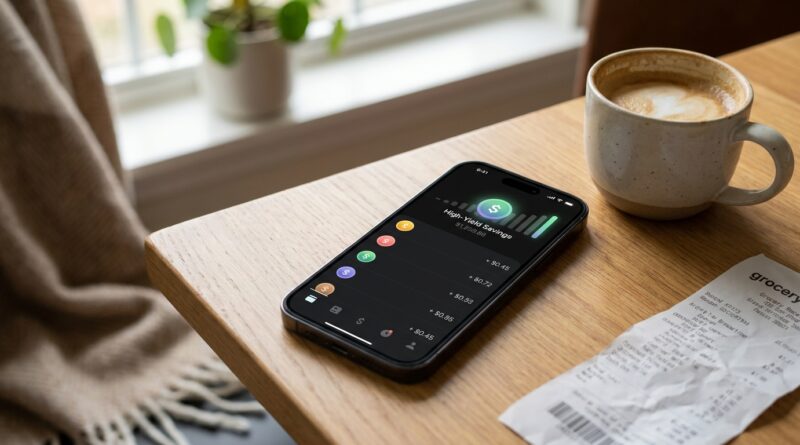
The ‘Micro‑Roundup’ HYSA Habit: Skim Your Spare Change Into A 5% Savings Stream
Trying to save when every expert tells you to “just move $300 a month” can feel absurd. If your paycheck is already busy with rent, groceries, gas, and the occasional little treat that keeps you sane, there may not be a clean extra chunk sitting around. That is exactly why the micro-roundup habit works. Instead of forcing a big transfer, you round up purchases into high yield savings account deposits, usually by moving the spare change from each card swipe into a separate high-yield savings account. Buy something for $7.40, move 60 cents. Spend $23.15, move 85 cents. It is small enough that you barely feel it, but steady enough that it starts building a real cushion over time. And when that money lands in a 5% HYSA, your bank balance is not just sitting there. It is quietly earning while you go about your life.
⚡ In a Hurry? Key Takeaways
- Rounding up purchases into a high-yield savings account is an easy way to save without committing to a large monthly transfer.
- Set a rule to sweep spare change once a day or a few times a week so your checking account stays comfortable.
- This works best with a solid HYSA earning around 5%, but you still need to watch for overdrafts and account fees.
Why this habit clicks when traditional budgeting does not
A lot of savings advice asks for discipline you may not have room for right now. Cut more. Cancel more. Give up more. People are tired of that.
The micro-roundup habit feels different because it does not start with restriction. It starts with the money already moving through your normal life. You are not banning takeout or pretending birthdays and school expenses do not exist. You are simply skimming the loose change created by your own spending and sending it somewhere useful.
That is what makes it realistic during messy seasons. If you spend less one week, less gets moved. If you spend more, a bit more gets scooped up. It bends with real life.
How to round up purchases into high yield savings account deposits
The basic rule
Every time you use your debit card or linked credit card, round the purchase up to the next whole dollar. The difference goes to savings.
Here is the simple version:
- $4.25 becomes $5.00, and 75 cents goes to savings
- $18.90 becomes $19.00, and 10 cents goes to savings
- $52.31 becomes $53.00, and 69 cents goes to savings
If your bank offers automatic roundups, great. Turn it on and direct it to your HYSA if possible. If not, you can still do this manually with a spending app, a weekly transfer, or a separate roundup bucket at your bank.
Where the 5% part matters
The roundup itself is only half the trick. The other half is where that money lives.
If the spare change piles up in regular checking, it is easy to spend it back down. If it goes into a high-yield savings account paying around 5%, it starts earning on top of your deposits. No, the interest will not make you rich overnight. But it does turn a tiny habit into a habit that compounds.
That is the quiet magic here. You save painlessly, then let the account keep helping.
What this can look like in real life
Say you make 40 to 60 card purchases in a month. If your average roundup is 45 cents, you might move about $18 to $27 a month without noticing much.
That may sound small. It is small. That is the point.
But small and automatic beats ambitious and abandoned. And if you want to nudge it up, some apps let you double or triple your roundups. A 45-cent average becomes 90 cents or $1.35. Suddenly your monthly total looks much more interesting.
Add a decent APY, and your “nothing” money starts turning into car repair money, holiday money, or the beginning of an emergency fund.
Best ways to set it up
Option 1: Use your bank’s built-in roundup feature
This is the easiest path if your bank offers it. Look for terms like “round up savings,” “spare change savings,” or “debit card roundup.” Then link it to a savings account, ideally a HYSA.
Just check one important detail. Some banks round up into their standard low-interest savings account, not your outside HYSA. If that is the case, you may want to transfer the balance out weekly or monthly.
Option 2: Use a separate fintech app
Some budgeting and savings apps can track your transactions, calculate your roundups, and move the total automatically. This gives you more flexibility, but you need to read the fine print on fees and transfer timing.
Option 3: Fake it manually
If you do not want another app, you can still make this work. Once a week, scroll through your recent purchases, estimate the roundups, and move a flat amount like $10 or $15 into your HYSA. It is not perfect, but the habit matters more than precision.
How to avoid the one problem that can spoil it
The danger is not the savings habit. The danger is draining checking too tightly.
If your account already runs close to zero before payday, even small automatic sweeps can create stress. So give yourself a cushion.
- Keep a checking buffer, even if it is only $50 to $100
- Start with debit purchases only, not every linked card
- Choose daily or weekly sweeps instead of instant transfers if your app allows it
- Pause the roundup rule during extra-tight weeks
This should feel gentle. If it feels risky, scale it down.
Who this habit works best for
This method is especially useful if you have variable income, irregular bills, or a budget that changes from month to month. A fixed automatic transfer can backfire fast when your cash flow is uneven. Roundups are softer. They rise and fall with your real spending.
It is also great for people who shut down when savings goals feel too big. If moving $250 a month sounds impossible, moving 37 cents at a time might be exactly how you get started.
If you like this “save without guilt” style, you may also like The ‘Cash-Twin’ HYSA Habit: Match Your Fun Swipes With Quiet Savings Instead Of Guilt. It uses the same basic idea of letting everyday spending quietly build savings, without turning your life into a punishment plan.
How to make the habit stronger without making it harder
Try a roundup multiplier
Once the basic version feels easy, consider doubling your roundups. A 52-cent roundup becomes $1.04. Still small. Still manageable. Just faster.
Name the savings bucket
“Savings” is vague. “Emergency car fund” or “December gifts” is motivating. People save better when the money has a job.
Review it once a month
Do not obsess over every transfer. Just check in monthly. If you saved more than expected, great. If it is too aggressive, reduce it. This should support your life, not run it.
At a Glance: Comparison
| Feature/Aspect | Details | Verdict |
|---|---|---|
| Effort required | Usually automatic after setup, with tiny transfers tied to purchases | Excellent for people who struggle with manual saving |
| Impact on budget | Low day-to-day pain because most transfers are just cents | Safer than a large fixed monthly transfer for uneven income |
| Growth potential | Balances build slowly, then earn more in a HYSA paying around 5% | Best as a steady starter habit, not your only savings strategy forever |
Conclusion
If you are worn out by strict budgets but still want proof that you are getting somewhere, this is a smart habit to try. A micro-roundup rule lets you save without cutting every little joy from your week. It catches money you would barely notice, then lets a high-yield savings account do some of the work for you. It is especially useful when life is messy or income is inconsistent, because the transfers move with your real spending instead of forcing a fixed amount that could leave you short. For the Savers crowd, this is the sweet spot. Small habit, low stress, real balance over time, and no complete lifestyle overhaul required.