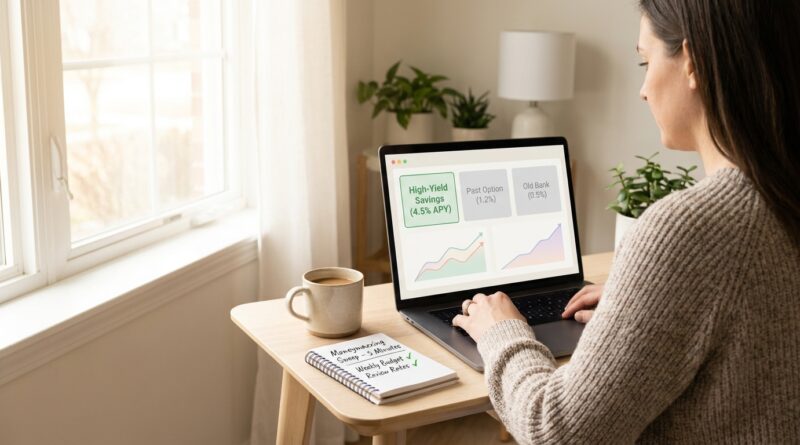
The ‘Moneymaxxing Sweep’ HYSA Habit: Turn One Weekly Check-In Into A Quiet Savings Upgrade
You did the sensible thing. You opened a high-yield savings account, moved your cash out of that sleepy old bank, and felt pretty good about it. Then rates started moving again. Suddenly your “good enough” account does not look quite so good, and every other video on your feed is shouting about moneymaxxing like you need a spreadsheet and six backup banks to keep up. That is exhausting. Most people do not need a full savings makeover. They need a simple habit. A weekly HYSA sweep is exactly that. It is a five-minute check-in where you look at your truly idle cash, confirm what money needs to stay put for bills or short-term goals, and move only the extra into the best safe home you already trust. It is not about chasing every shiny promo. It is about staying current without making saving feel like a second job.
⚡ In a Hurry? Key Takeaways
- A moneymaxxing high yield savings habit works best when you do one short weekly sweep of idle cash instead of constantly chasing every new rate.
- Keep bill money and near-term spending separate, then move only true extras to the highest solid HYSA you already feel comfortable using.
- Safety still comes first. Stick with FDIC- or NCUA-insured accounts, and do not move money just to grab a tiny rate bump that adds hassle.
Why this little habit matters more than people think
Here is the trap. Once people open their first decent HYSA, they stop paying attention. That makes sense. Life gets busy. The problem is that rates do not stand still. An account that was competitive six months ago can quietly drift into the middle of the pack.
That does not mean you need to turn into a rate-chasing maniac. It means you need a rhythm. A calm, repeatable one.
This is the sweet spot for a moneymaxxing high yield savings habit. Not daily tinkering. Not five apps. Just one weekly sweep.
What the “weekly sweep” actually is
Think of it like clearing crumbs off the kitchen counter. You are not remodeling the house. You are just making sure money that has no job is not sitting around earning less than it could.
Step 1: Check your upcoming week
Before moving a penny, look at what is coming up in the next one to three weeks. Rent. Credit card autopay. Utilities. Childcare. Anything boring and predictable belongs in your checking buffer, not in motion.
Step 2: Find your truly idle cash
This is the money that is just sitting there because payday hit, a bill came in lower than expected, or you have built a little cushion beyond your normal checking float.
That is the money to sweep.
Step 3: Compare your HYSA with the current market
You do not need a 40-tab browser session. Just ask one question. Is my current account still close enough to the better rates out there?
If the answer is yes, keep it simple. Sweep the money in and move on.
If the answer is no, and the gap is meaningful, then you can decide whether it is worth shifting future savings to a better account.
Step 4: Move only what makes sense
Do not strip your checking account bare. The whole point is to earn more without creating overdraft stress or forcing yourself to transfer money back three days later.
A good weekly sweep should feel almost boring. That is a good sign.
How much rate difference is worth caring about?
This is where people lose the plot. If one HYSA pays 4.40% and another pays 4.50%, that difference may not be worth opening a whole new account unless your balance is large and the new bank is genuinely easier or better.
But if your old account has quietly slid to 3.80% while several solid options are still much higher, now we are talking.
The goal is not perfection. The goal is to avoid being obviously behind.
A quick rule of thumb
If the rate gap is tiny, keep your life simple.
If the rate gap is noticeable and likely to stick around, consider shifting new savings first.
If your current bank adds hoops, low caps, or promo games, be extra cautious.
Do not “moneymaxx” money you actually need soon
This part matters. Your savings account is not a game.
If money is already assigned to next week’s bills, a planned car repair, holiday travel, or a near-term insurance payment, leave it alone. The weekly sweep is for extra cash, not for playing transfer ping-pong with money that has a job.
People get into trouble when they confuse “available” with “idle.” Your banking app may show a balance. That does not mean all of it is free to move.
The easiest version of this habit
If you want the simplest setup, keep three buckets in mind.
Bucket 1: Checking buffer
Enough for bills, groceries, autopays, and a little breathing room.
Bucket 2: HYSA for near-term goals and emergency cash
This is where your weekly sweep usually goes. It stays accessible, earns a better rate, and is still plain old cash.
Bucket 3: Longer-term money decisions
If cash is piling up beyond your emergency fund and short-term goals, that is a separate conversation. A HYSA is great for safe, liquid money. It is not the answer for every long-term dollar.
If you want a broader starter routine, The ‘Moneymaxx Minute’ HYSA Habit: Turn One Hour A Week Into All‑Year High‑Yield Wins lays out a similar approach in a way that keeps the whole process manageable.
What to ignore during your weekly check-in
Ignore the noise that makes saving feel harder than it is.
Flashy intro promos
If the rate lasts three months and then drops, it may not be worth the setup unless you are moving a large amount and are willing to track the end date.
Complicated account rules
If an account demands debit card swipes, direct deposits, or balance gymnastics just to earn the headline APY, ask yourself whether that still counts as “easy.” Usually, it does not.
Tiny differences that steal your time
Your time has value. So does your peace of mind.
What a five-minute Sunday routine can look like
Here is a realistic version.
Open checking. Check the next 14 days of bills.
Leave your normal buffer untouched.
See if extra cash built up this week.
Open your HYSA and glance at the current APY.
Do a quick market check once a week or even once every other week.
If your account is still competitive, move the extra and close the app.
Done.
That is the whole habit. Quiet. Useful. Sustainable.
Safety checks before you move anything
A better rate is nice. A safe rate is better.
Look for deposit insurance
Use accounts with FDIC insurance for banks or NCUA insurance for credit unions, within the standard limits.
Know transfer timing
Some transfers are fast. Some are not. If you might need the cash tomorrow, do not move it tonight just because the rate is slightly higher.
Keep your login setup clean
Use strong passwords, turn on two-factor authentication, and make sure linked accounts are really yours and up to date.
When it is worth opening a new HYSA
Sometimes the answer is yes.
Open a new account if your current one has fallen well behind, if the new account is simple and insured, and if you are likely to keep using it without adding stress to your life.
Do not open a new one just because someone online called it a “hack.” If the process feels annoying now, it will feel even more annoying three months from now.
At a Glance: Comparison
| Feature/Aspect | Details | Verdict |
|---|---|---|
| Weekly HYSA sweep | Move only truly idle cash after checking bills and short-term needs. | Best balance of better yield and low effort. |
| Constant rate chasing | Frequent account openings and transfers for every small APY change. | Usually too much hassle for most savers. |
| Leaving cash in “good enough” mode | No regular review, so your account may slowly drift below market rates. | Easy, but often costs you over time. |
Conclusion
Rates on high-yield savings are moving faster again, and most people never adjust after they open their first “good enough” account. That is how you slowly fall behind while thinking you are already optimized. A tiny weekly sweep fixes that without turning saving into a part-time job. Focus on truly idle cash. Respect upcoming bills and short-term goals. Let your savings drift toward better safe returns instead of gathering dust. In a world full of loud trends and complicated hacks, this is the kind of moneymaxxing high yield savings habit that actually fits real life. Five calm minutes can do a lot.