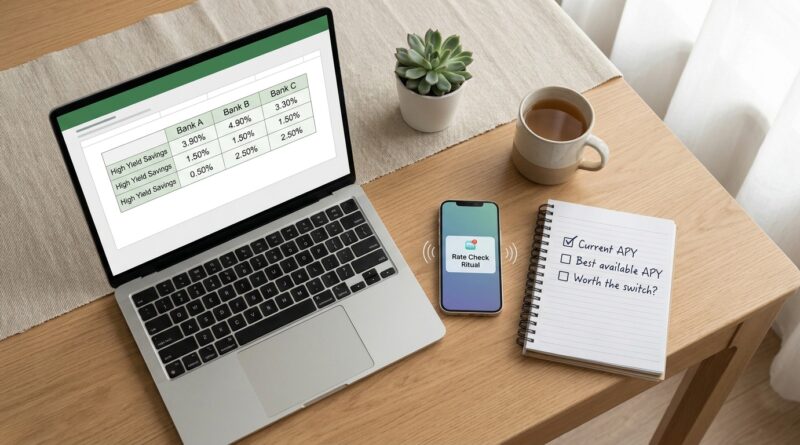
The ‘Rate Check Reminder’ Habit: A 10‑Minute Monthly Ritual To Keep Your High‑Yield Savings From Quietly Falling Behind
You did the responsible thing. You opened a high-yield savings account, parked your cash there, and figured the hard part was over. Then life got busy. Months passed. Now you are left wondering whether your “high-yield” account is still actually high-yield, or whether your bank quietly let your rate slide while advertising better deals to new customers. That is a real frustration, and it can cost more than people think. A small drop in APY may not look dramatic on a screen, but over time it means less growth on money that is supposed to be working for you. The fix is not obsessing over rates every day. It is a simple 10-minute monthly ritual. Check your current APY, compare it with a few top options, and decide whether to stay put or make a move. That one habit can keep your savings from slowly drifting into the slow lane.
⚡ In a Hurry? Key Takeaways
- How often should I check my high yield savings account rate? Once a month is a smart baseline, with an extra check after major Fed rate news or if your bank emails updated terms.
- Set a recurring 10-minute calendar reminder to log in, note your APY, and compare it with 2 to 3 well-known competitors.
- Do not switch for every tiny difference. A move usually makes sense when the gap is meaningful, your balance is large enough, and the new account is safe and FDIC or NCUA insured.
Why this tiny habit matters right now
High-yield savings rates are still strong compared with the near-zero years many people got used to. That is the good news.
The bad news is that rates move fast. Banks raise them, lower them, and sometimes reserve the flashiest offers for new customers. If you are not checking, you may be earning less than you think for months at a time.
This is not about squeezing pennies. On a decent emergency fund or house down payment stash, a rate gap of even half a percentage point can mean noticeable money over a year.
And there is another problem. Most people do not actually know their current APY. They know where their money is. They do not know what it is earning.
That is why a monthly rate check works so well. It is small enough to stick with, but frequent enough to catch drift before it quietly becomes expensive.
The 10-minute monthly rate check reminder
Here is the whole ritual. Keep it simple.
Minute 1 to 2: Log in and find your current APY
Open your savings account and look for the annual percentage yield, or APY. Not interest rate. APY. That is the number that reflects compounding and gives you the clearest apples-to-apples comparison.
Write it down in your notes app, spreadsheet, or budget tracker. Also note your current balance.
Minute 3 to 6: Compare with 2 to 3 solid alternatives
Check a few reputable banks or credit unions offering high-yield savings. You are not trying to scan the whole internet. You are just trying to answer one question: Is my current account still competitive?
A good rule of thumb is to compare your rate with:
- Your current bank’s advertised rate for new customers
- One large well-known online bank
- One or two other established high-yield savings options
Minute 7 to 8: Do the quick math
If another account pays more, estimate the difference in dollars. That matters more than getting emotionally attached to a tiny APY gap.
For example, if you keep $20,000 in savings:
- At 4.00% APY, you earn about $800 a year
- At 4.75% APY, you earn about $950 a year
That is roughly a $150 yearly difference before taxes. Worth noticing. Maybe worth switching.
But if the gap is only 0.10% on a small balance, the extra money may barely buy lunch. In that case, staying put may be the better move.
Minute 9 to 10: Decide and move on
You only need one of three decisions:
- Stay. My rate is close enough, and the simplicity is worth it.
- Ask. My bank may match or explain whether I am in an older, lower-paying account.
- Switch. The gap is big enough that moving is worth the effort.
Then you are done until next month.
How often should I check my high yield savings account rate?
For most people, once a month is the sweet spot.
Weekly is too much unless you genuinely enjoy tracking rates. Yearly is too little, especially when rates are changing and banks are competing hard for deposits.
A monthly reminder strikes the right balance. It keeps you aware without turning your savings account into a side hobby.
You may also want to do an extra check when:
- The Federal Reserve announces a major rate change
- Your bank emails new account terms or rate updates
- Your balance grows a lot, making even small APY differences more valuable
- You are parking money for a near-term goal, like a home purchase or tax payment
When a rate difference is worth acting on
Not every better rate deserves a full account switch. This is where people either get too lazy or too twitchy.
Here is a practical way to think about it.
Probably not worth moving
- The rate gap is tiny, like 0.10% to 0.20%
- Your balance is modest
- You love your current bank’s app, speed, or account setup
- The new bank has annoying limits, long transfer holds, or weak customer service
Probably worth a closer look
- The gap is 0.50% or more
- You keep a large emergency fund or sinking fund there
- Your current bank has clearly fallen behind the market
- The alternative bank is established, insured, and easy to use
The goal is not to chase every headline rate. The goal is to avoid getting stuck in a clearly inferior account out of habit.
Watch for these common gotchas
Teaser rates
Some banks promote eye-catching APYs that may be temporary or tied to account conditions. Read the details before moving money.
Different rates for different savings products
Your bank may offer several savings accounts. The one you opened two years ago may not be the same one advertised on the homepage now.
Slow transfers
If your emergency fund is spread across accounts, make sure you understand transfer times and limits. A slightly better rate is not worth creating stress when you actually need the money.
Insurance limits
Stick with FDIC-insured banks or NCUA-insured credit unions, and know the coverage limits. Safety comes first.
A simple template you can reuse every month
If you like checklists, use this one:
- Check my current APY
- Check my savings balance
- Compare with 2 to 3 competitors
- Estimate yearly dollar difference
- Decide: stay, ask, or switch
- Set next month’s reminder
That is it. No giant spreadsheet required.
Why this works better than “set it and forget it”
“Set it and forget it” is great for some things. Retirement contributions, for example. But savings rates are not fixed rewards for loyalty. They are moving targets.
Banks know many customers will not notice a slow decline. That is why a tiny reminder matters. It breaks the autopilot spell.
It also helps you build judgment. Over time, you learn when to ignore noise, when to ask better questions, and when a small change is worth your energy.
That same mindset can help with your saving habits overall. If you want to give new money a better chance of actually sticking, this pairs nicely with The ‘Windfall Capture’ Habit: Turn Every Surprise Dollar Into High‑Yield Savings Before It Disappears. More money going in and a better rate on top is a nice one-two punch.
At a Glance: Comparison
| Feature/Aspect | Details | Verdict |
|---|---|---|
| Check frequency | Once a month is usually enough, with extra checks after big rate news. | Best balance of awareness and sanity |
| When to switch banks | Consider it when the APY gap is meaningful, your balance is large, and the new bank is easy and insured. | Worth it for bigger gaps, not every tiny bump |
| Main risk to avoid | Ignoring your current APY and assuming “high-yield” still means top-tier. | A monthly reminder solves most of this |
Conclusion
Right now, high-yield savings rates are unusually strong, but they change quickly, and banks have every reason to let existing customers drift while the best-looking offers go to new ones. That is why this small monthly habit matters. Most people do not know what they are earning, so they quietly give up months or even years of growth they could have kept with one or two smart moves a year. A 10-minute reminder to check your APY, compare it with the market, and decide whether the difference is worth action helps you get more from money you already saved. No extra shifts. No guilt about coffee. Just better awareness and better choices. And maybe the best part is this: it teaches a useful wealth skill. Not just how to chase a better number, but how to weigh convenience against return and choose what actually fits your life. That is the kind of steady, sustainable habit that builds a stronger bank balance over time.