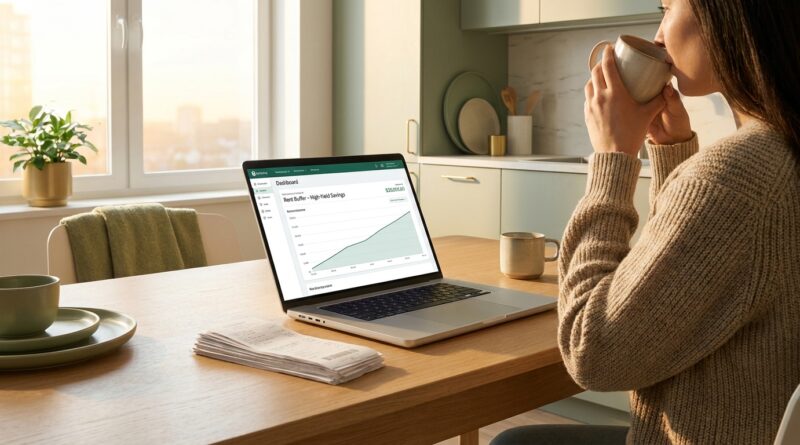
The ‘Rent Buffer’ HYSA Habit: Park One Month Of Peace So Your Money Finally Breathes
Rent day can feel like getting hit by the same truck every month. The money comes in, the housing payment goes out, and suddenly everything else has to squeeze into what is left. If you are living close to zero, one car repair, one medical bill, or one weird utility spike can shove you straight into overdraft fees or credit card debt. That is why the high yield savings account rent buffer habit works so well. The idea is simple. Keep one full month of rent or mortgage in a separate high-yield savings account, and use that account as your housing holding tank. You are still paying the same bill. You are just changing where that money waits. That small shift gives you breathing room, makes your cash flow less chaotic, and lets your buffer earn interest while it sits there instead of gathering dust in a low-paying checking account.
⚡ In a Hurry? Key Takeaways
- A high yield savings account rent buffer habit means keeping one month of rent or mortgage in a separate HYSA so housing stops wrecking your monthly cash flow.
- Start by building one month of housing costs, then refill that buffer every payday or right after each housing payment clears.
- This is a low-stress money move that can cut overdraft risk, reduce credit card dependence, and earn more interest than a typical savings account.
What the rent buffer habit actually is
Think of it as a parking spot for next month’s housing payment.
Instead of letting rent or mortgage money sit mixed in with grocery money, gas money, and whatever else is in checking, you move one full month of housing costs into a dedicated high-yield savings account. Then, when payment time comes, you transfer the money over and pay the bill.
That is the whole habit.
You are not trying to become a budgeting robot. You are creating one layer of separation between your biggest monthly bill and the rest of your life.
Why this feels so different from regular saving
A lot of savings goals feel abstract. Retirement is important, of course, but it can feel far away. Even a general emergency fund can feel vague when money is tight.
A rent buffer is different because you feel the benefit almost immediately.
When one month of housing is already set aside, your next paycheck is no longer racing to beat the first of the month. You get margin. You get a little calm. You stop treating every calendar flip like a mini financial emergency.
It fixes a timing problem, not just a money problem
Many people do not only have a savings shortage. They have a cash flow timing problem. Bills are due before the next paycheck, or a surprise expense lands right when rent is about to hit.
The buffer smooths that out. It gives you one month of distance between your income and your biggest bill.
Why use a high-yield savings account for this
Because if the money is going to sit somewhere anyway, it might as well earn something.
Many traditional savings accounts still pay next to nothing. A good high-yield savings account can pay several times more. No, the interest on one month of rent will not make you rich. But that is not really the point.
The point is that your buffer stays liquid, easy to reach, and a little more productive.
It is a simple upgrade. Same money. Better parking spot.
What to look for in the account
Keep it boring. That is a compliment.
- FDIC or NCUA insurance
- No monthly maintenance fees
- Easy transfers to and from checking
- A competitive APY
- No weird hoops just to earn the top rate
You want safe and easy, not clever.
How the high yield savings account rent buffer habit works in real life
Let’s say your rent is $1,800.
Your first goal is to build a dedicated $1,800 cushion in a HYSA. Once it is there, that money becomes next month’s rent. After you pay rent, you rebuild the account with income from the current month so it is ready again.
From then on, you are operating one month ahead on housing.
That means if your car needs tires this month, you are less likely to steal from rent money because rent is already parked elsewhere.
That one change can stop a lot of bad chain reactions.
How to build the first month if money is tight
This is the part that sounds hard, because it is the hard part. But it is still doable in chunks.
Option 1: Build it piece by piece
Set a target and chip away at it weekly. If one full month feels impossible, start with 10 percent, then 25 percent, then half.
Even a partial rent buffer helps.
Option 2: Use windfalls
Tax refunds, bonuses, gift money, side hustle cash, or a utility rebate can all give this habit a jump start.
This is one of the best uses for irregular money because it creates stability that lasts.
Option 3: Trim one repeat expense and redirect it
If you need a clean place to start, cut one thing you barely notice but pay for constantly. That is why small habit changes can matter. If eating out is your leak, this pairs well with The ‘Skip-One-Meal-Out’ HYSA Habit: Turn A Single Weekly Trade-Off Into $3,000+ In Quiet Savings. You do not need a total life reset. You just need a steady stream feeding the buffer.
Where people mess this up
The biggest mistake is treating the rent buffer like general savings.
If the account becomes your go-to stash for random spending, the system falls apart. Label the account clearly. Call it “Next Month Rent” or “Housing Buffer.” Make its job obvious.
The second mistake is keeping it in checking. If it sits in the same bucket as everyday spending, it is too easy to nibble away at it.
The third mistake is waiting for the “perfect” time to start. There usually is no perfect time. Start small and let the habit grow.
Is this the same as an emergency fund?
Not exactly.
A rent buffer is more like a targeted cash-flow tool. An emergency fund is there for bigger surprises like job loss, medical bills, or urgent repairs.
That said, a rent buffer can keep small emergencies from becoming bigger ones. If rent is already covered, a surprise bill is less likely to push you into late fees, overdrafts, or credit card interest.
It is a first layer of protection.
Who benefits most from this habit
This works especially well if:
- You feel wiped out right after paying rent or mortgage
- Your income and bills do not line up cleanly
- You have dipped into savings to cover housing before
- You tend to use credit cards to bridge the gap between paychecks
- You want less financial stress without a super strict budget
If any of that sounds familiar, this habit is worth trying.
At a Glance: Comparison
| Feature/Aspect | Details | Verdict |
|---|---|---|
| Main purpose | Holds one month of rent or mortgage in a separate HYSA so housing is funded ahead of time | Excellent for reducing month-to-month money stress |
| Best account type | FDIC- or NCUA-insured high-yield savings account with easy transfers and no monthly fees | Best mix of safety, access, and interest |
| Biggest benefit | Cuts overdraft risk, lowers the odds of using credit cards for housing-related shortfalls, and adds breathing room | High value for relatively low effort |
Conclusion
If your housing payment keeps knocking the wind out of your budget, the high yield savings account rent buffer habit is one of the simplest ways to get some control back. Today’s top high-yield savings accounts are paying several times more than the average bank, so every dollar in a dedicated rent buffer is pulling extra weight instead of sitting idle. For the Savers community this is a low-stress move. You are not cutting lattes or living like a monk. You are simply shifting where one month of an expense you already pay lives. That one change can lower overdraft risk, keep emergencies off high-interest cards, and turn housing from a monthly panic into a predictable, interest-earning system.