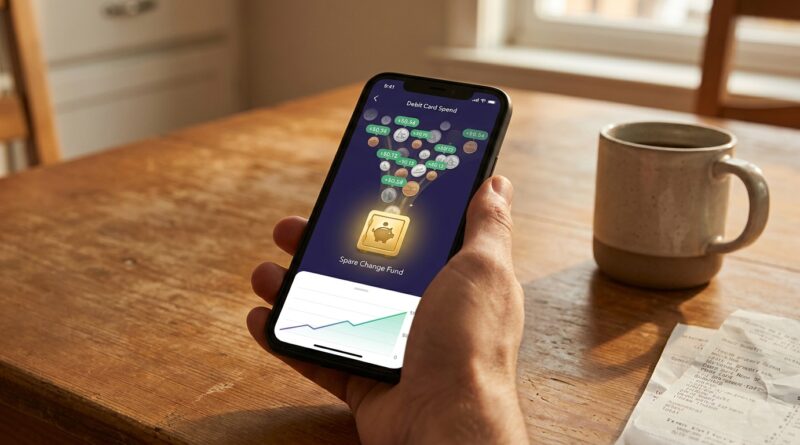
The ‘Round‑Up HYSA Sweep’ Habit: Turn Spare Change Into Real Interest
You are not imagining it. Saving feels harder when your money leaks out in tiny, forgettable taps all week long. A $4 coffee, a $12 lunch, a $9 late-night app order. None of it looks serious on its own, so nothing gets cut. Then the month ends, and somehow there is still not much landing in savings. That is exactly why the round up savings high yield savings account habit works so well. It catches the money you barely notice spending and sends the difference into a high-yield savings account automatically. No guilt. No full budget overhaul. Just a simple sweep that turns everyday card swipes into real deposits that can actually earn interest. If you have been meaning to save more but never seem to get around to moving money, this is one of the easiest habits to start, and one of the least painful to keep.
⚡ In a Hurry? Key Takeaways
- A round-up rule linked to a no-fee HYSA quietly turns small purchases into automatic savings.
- Start with round-ups to the next dollar, then add a weekly “safe-to-save” sweep if your cash flow is stable.
- Only use accounts with no monthly fees and FDIC or NCUA protection, so your extra savings are not getting eaten up.
Why this habit works better than “I’ll save what’s left”
Most people do not fail at saving because they do not care. They fail because saving usually asks for effort at the exact wrong time. You have to log in, choose an amount, and move money after bills and life have already happened.
Round-ups flip that around. The saving happens first, in tiny amounts, at the same moment you spend. Buy something for $7.40, and 60 cents gets swept to savings. Spend $18.15, and 85 cents follows it. One purchase does not change much. Fifty purchases in a month can.
That is why this habit is so useful in 2026. Frictionless spending is everywhere now. Tap-to-pay makes spending fast and painless. Your savings system should be just as fast and painless.
What the round up savings high yield savings account habit actually is
At its simplest, this habit has two parts.
1. A round-up rule
Your bank, fintech app, or budgeting tool rounds each debit card purchase up to the nearest dollar and sets aside the spare change.
2. A high-yield savings account
Instead of leaving that spare change in checking, it goes into a HYSA where it earns a much better rate than a traditional savings account.
That second part matters. If your round-ups are piling into an old savings account earning next to nothing, you are missing the point. The automation is good. The interest boost is what makes it smarter.
If you have not checked your rate lately, it is worth reading The ‘Fed-Hike HYSA Shuffle’ Habit: Give Yourself An Instant Raise Without Earning A Dollar More. It is a good reminder that the account itself matters, not just the saving habit.
How much can this really save?
More than people think, though it is not magic.
Say you make 45 card purchases a month and the average round-up is 52 cents. That is about $23.40 a month, or roughly $280 a year, before interest. If you add a small weekly “safe-to-save” sweep of $10 on top of that, you add another $520 a year. Now you are at about $800, and that money is sitting in a HYSA earning actual interest.
No, that will not buy a house. But it can build an emergency cushion, cover a holiday bill, or stop you from reaching for a credit card the next time life gets expensive.
How to set it up in about 15 minutes
Pick the right HYSA first
Look for these basics:
- No monthly maintenance fee
- No minimum balance you cannot realistically keep
- Competitive APY
- FDIC-insured bank or NCUA-insured credit union
- Easy transfers to and from checking
You do not need the flashiest app. You need an account that is simple, safe, and pays well.
Turn on round-ups
Some banks build this in directly. Some neobanks call it spare change savings. Some budgeting apps connect your checking account and handle the sweep for you. If your main bank does not offer it, you can still create a close version by setting an automatic transfer of $5 to $10 a few times a week.
Send the money to a dedicated savings bucket
If your HYSA lets you create buckets or goals, label one “Round-Ups” or “Everyday Buffer.” That matters more than it sounds. People stick with habits better when the money has a clear job.
Add a weekly five-minute check-in
This is the part that keeps the habit from drifting. Once a week, glance at:
- Your checking balance
- How much got swept
- Any pending bills
- Whether you need to pause or lower the sweep temporarily
Five minutes is enough. You are not doing a full money meeting. You are just making sure the automation still fits your real life.
Round-ups vs “safe-to-save” sweeps
These are cousins, not twins.
Round-ups
Best for beginners. They are predictable, small, and easy to tolerate. You hardly notice them.
Safe-to-save sweeps
These tools scan your cash flow and move small amounts they think you can afford. They can save faster, but they also need a little more monitoring, especially if your income or bills bounce around.
For a lot of people, the sweet spot is both. Start with round-ups. Then, once you know your checking buffer is healthy, add a modest safe-to-save sweep.
Who this habit is best for
This works especially well if:
- You use your debit card often
- You struggle to remember manual transfers
- You want to save without feeling deprived
- You are rebuilding savings after overspending
- You need a low-stress way to start an emergency fund
It is less ideal if your checking account regularly runs very close to zero. In that case, build a tiny checking cushion first, even $100 to $200, so round-ups do not cause overdraft stress.
Common mistakes to avoid
Using a HYSA with fees
This defeats the purpose fast. Small automated savings should not be paying rent just to exist.
Forgetting transfer timing
Some round-up programs move money instantly. Others batch transfers later. Know which one you are using, so you do not accidentally spend against money that is about to leave checking.
Going too aggressive too soon
If your app lets you double or triple round-ups, that can be great later. At the start, keep it boring. A habit you can stick with beats a habit you turn off after two weeks.
Never reviewing the APY
Rates change. A good HYSA today may be average next year. Check it every few months so your money keeps working.
A simple starter plan
If you want the easiest version, do this:
- Open a no-fee HYSA.
- Turn on round-ups to the nearest dollar.
- Name the savings bucket “Micro-Savings.”
- Set a five-minute Sunday check-in.
- After 30 days, decide whether to add a small weekly sweep of $10 to $20.
That is it. No spending freeze. No long spreadsheet. No promise that you will “just be better” next month.
At a Glance: Comparison
| Feature/Aspect | Details | Verdict |
|---|---|---|
| Round-up automation | Moves spare change from everyday purchases into savings automatically. | Great for people who forget manual transfers. |
| HYSA interest | Lets those tiny deposits earn a better rate than a standard savings account. | Worth it, as long as the account has no fees and a solid APY. |
| Weekly check-in | A quick review helps avoid overdrafts and keeps the habit aligned with your bills. | Important if your cash flow changes month to month. |
Conclusion
The beauty of this habit is that it plugs the exact leak hurting savers most in 2026. Small, frictionless spending that never feels serious enough to fix, yet quietly wrecks your savings rate. A round-up rule tied to a high-yield savings account turns those forgettable micro-purchases into automatic deposits that earn real interest. You do not need to rewrite your whole budget or give up every little treat. You just need one smart setting and a quick weekly glance to keep it on track. For many people, that is the easiest saving win available right now. Small moves count, especially when they happen over and over without asking you to think about them.