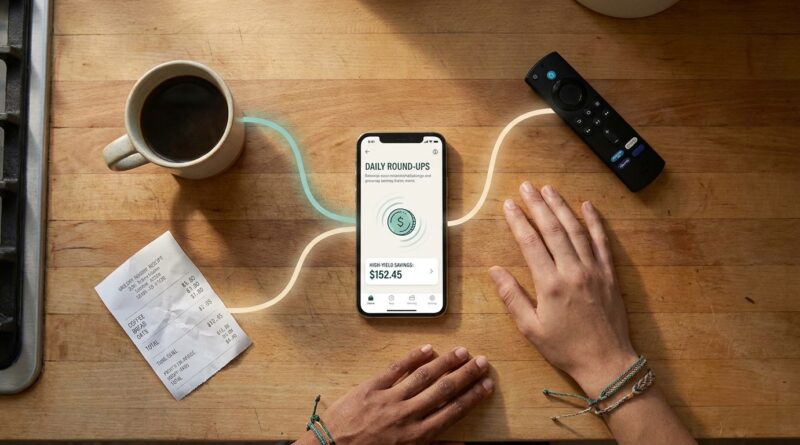
The ‘Round‑Up & Reroute’ Habit: Turn Every Swipe Into Automatic High‑Yield Savings
Trying to save by cutting every little treat is exhausting. You skip the coffee, say no to dinner out, and then one rough week later you blow past your budget anyway because you are tired of feeling punished. I get it. Most people do not fail at saving because they are careless. They fail because the plan asks for too much willpower, too often. Meanwhile, your checking account keeps leaking money in tiny amounts. A snack here. A $12 subscription there. A quick pharmacy stop. None of it looks dramatic, which is exactly why it slips by.
That is where the round up savings high yield account habit can help. Instead of trying to become a different person overnight, you set up a system that skims tiny amounts from everyday spending and reroutes them into a high-yield savings account. You usually will not miss the money, but over time you will notice the balance. Better yet, that money can earn interest while it sits there. It is not flashy. It is just steady, realistic progress.
⚡ In a Hurry? Key Takeaways
- A round-up habit moves spare change from everyday purchases into savings automatically, which makes saving easier without major budget cuts.
- For best results, reroute those round-ups into a high-yield savings account so the money also earns a stronger rate.
- Keep a small checking buffer and start with limits if needed, so automation helps you instead of causing overdrafts.
What the “round-up & reroute” habit actually is
Think of it like digital pocket change.
When you buy something for $3.40, the app or bank rounds it up to $4.00. The extra 60 cents gets moved into savings. If you spend $18.25, it rounds to $19.00 and saves 75 cents.
On its own, that sounds almost too small to matter. But that is the point. Tiny moves are easier to live with than heroic ones.
The reroute part is what makes this habit smarter. Instead of letting those round-ups sit in a low-interest account, you send them to a high-yield savings account. That way your spare change is not just piling up. It is also earning.
Why this works better than “just cut back”
A lot of saving advice sounds good on paper and awful in real life.
Stop all takeout. Cancel everything fun. Track every penny. Cook every meal. For some people, that works. For a lot of people, it turns money into a daily stress test.
The round up savings high yield account habit works because it lowers friction. You do not have to make a fresh saving decision every day. The system handles it in the background.
It also avoids the deprivation trap. You are not banning small pleasures. You are simply collecting a little money from the normal flow of spending and putting it somewhere useful.
How much can round-ups really save?
More than most people expect, though probably not enough to replace a full emergency fund by itself.
Let’s say you make 35 card purchases a month and your average round-up is 55 cents. That is about $19.25 a month. Over a year, that is $231 before interest.
If you are a heavier card user, the number can be higher. If you also add a small matching transfer, like an extra $5 or $10 a week, the habit gets stronger fast.
No, it is not magic. But $200 to $400 a year from money you barely noticed is still real money. And for many people, seeing that first few hundred dollars show up is what finally makes saving feel possible.
Why the high-yield account part matters
If your round-ups land in a basic savings account paying almost nothing, you are only getting half the benefit.
A high-yield savings account usually pays much more interest than a traditional savings account at a big brick-and-mortar bank. Rates change, of course, but the gap is often big enough to matter.
That means your small transfers get two jobs. First, they protect money from being spent. Second, they earn while they wait.
If you already have a cash cushion and want to make it work a little harder, you might also like The ‘Bonus Parking’ Habit: Turn Bank Sign‑Up Deals Into A High‑Yield Savings Booster. It is another low-drama way to help idle cash do more.
How to set this up without making your life complicated
1. Pick where the money will go
Choose a high-yield savings account with no monthly fee, easy transfers, and a rate that is competitive right now. You do not need perfection. You need something simple enough that you will actually use it.
2. Turn on round-ups through your bank or app
Many banks, neobanks, and budgeting apps offer a round-up feature. Some send money to savings automatically. Others hold the round-ups and transfer them on a schedule.
Read the settings. This part matters.
You want to know:
- When the transfer happens
- Whether there is a daily or weekly cap
- Whether it pulls from debit card purchases only or also credit card payments
- Whether it moves to an internal savings bucket or an outside account
3. Add a “reroute” rule
If the tool only sends round-ups to your checking-linked savings pocket, create a second automatic transfer from there into your high-yield savings account once a week or once a month.
This is the key move. It keeps your savings from getting stranded in the wrong place.
4. Leave a checking buffer
This habit should feel invisible, not risky. Keep a little extra in checking so a week of groceries, gas, and round-ups does not put you too close to zero.
If your checking account already runs tight, start with a capped version or wait until payday to sweep the round-up total over.
Who this habit is best for
This works especially well if you:
- Use your debit card or credit card often
- Struggle to stick to big fixed savings transfers
- Get discouraged by all-or-nothing budgeting advice
- Want a low-effort way to start building momentum
It is less useful if you mostly spend in cash, rarely use cards, or are so close to the edge that any extra transfer could trigger an overdraft.
Common mistakes to avoid
Using round-ups as your only savings plan
Round-ups are a starting habit, not the whole game. Once you build confidence, pair them with even a tiny recurring transfer, like $10 every payday.
Ignoring fees and account rules
A high rate means less if the account has annoying limits, slow transfers, or hidden fees. Simple wins here.
Forgetting to check your cash flow
Automation is great until it runs without supervision. Peek at your checking account regularly, especially in the first month.
Making it too hard to access your own savings
You want enough separation to avoid impulse spending, but not so much that moving money back becomes a major project in a real emergency.
A simple way to make the habit stronger
If you want faster results, try a mini boost.
Match your weekly round-ups with a fixed amount. For example, if your app saves $6.80 in round-ups this week, add another $5 manually or automatically. You are still keeping the system easy, but now you are speeding it up.
Another option is to sweep in “found money.” Refunds, rebate payments, cash-back rewards, and small sale proceeds can all go into the same high-yield account. That gives your savings one clear home and makes progress easier to see.
At a Glance: Comparison
| Feature/Aspect | Details | Verdict |
|---|---|---|
| Effort required | Mostly automatic once set up. No daily tracking needed. | Excellent for people with low attention and busy schedules. |
| Savings impact | Small amounts add up slowly, and earn more when moved into a high-yield savings account. | Best as a starter habit or a side boost, not your only savings method. |
| Risk and downside | Can strain a tight checking balance if you do not keep a buffer or set limits. | Safe and useful if you watch cash flow and avoid overdrafts. |
Conclusion
You do not need a total budget makeover to start saving again. And you definitely do not need to make yourself miserable over every coffee or convenience purchase. The round up savings high yield account habit works because it is realistic. It grabs money you are unlikely to miss, moves it out of spending range, and lets it earn while it sits. In a time when prices are still high and everybody feels mentally stretched thin, that kind of low-friction system matters. Start small, keep it automatic, and let the habit do the heavy lifting. Real progress counts, even when it begins with spare change.