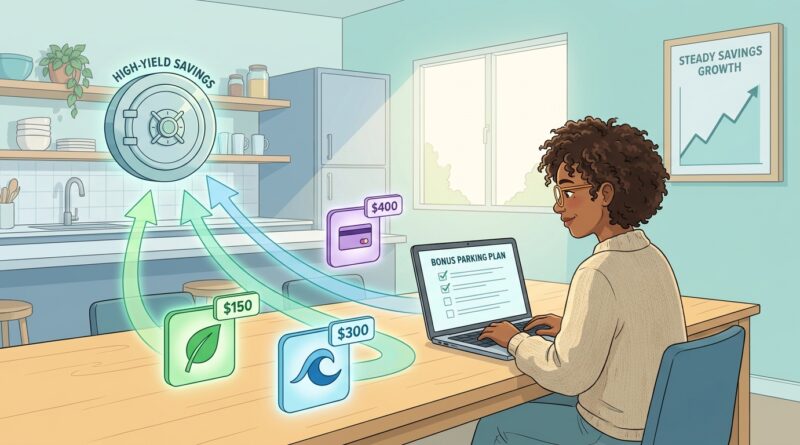
The ‘Bonus Parking’ Habit: Turn Bank Sign‑Up Deals Into A High‑Yield Savings Booster
Your savings account is doing its job, but I get why it still feels a little disappointing. You finally built a decent cash cushion, you picked a high-yield account like the responsible adult you are, and now the rate that once looked great feels… fine. Meanwhile, every other ad seems to promise $200, $300, even $500 just for opening a bank account. It sounds easy until you read the tiny rules about direct deposits, minimum balances, monthly fees, and taxes. That is where a simple “Bonus Parking” habit can help. Instead of moving all your money around nonstop, you set aside a small, safe chunk of cash and use it to qualify for carefully chosen bank bonuses. Done right, this can act like a temporary yield booster on money you were already keeping in cash anyway. The trick is to be picky, organized, and boring about it. Boring is good here.
⚡ In a Hurry? Key Takeaways
- A smart bank account bonus strategy for high yield savings can boost your effective return if you only use extra cash and follow the rules exactly.
- Focus on offers with simple requirements, no monthly fees, and a clear timeline for funding, holding the money, and getting paid.
- Bank bonuses are usually taxable, so count the after-tax value before deciding whether a deal is worth the hassle.
What “Bonus Parking” actually means
Think of it like this. Your emergency fund stays where it is. Your everyday checking stays put too. But if you have extra cash beyond that, maybe money for a future car repair, home project, or next year’s insurance bill, you “park” part of it in a new bank account long enough to earn a sign-up bonus.
You are not investing it. You are not gambling it. You are not trying to outsmart the market. You are simply renting out your cash for a short period in exchange for a bonus.
That is the core idea behind a good bank account bonus strategy for high yield savings. You use the bonus as a temporary yield booster, then move the money back to your regular savings setup when the deal is done.
Why this can beat rate-chasing
Rate-chasing gets old fast. One bank drops its APY by a quarter point, another raises it by a little, and suddenly you are moving money for tiny differences that may not even matter after a few months.
A bonus can change the math.
Say a bank offers $300 for parking $10,000 for 90 days. Ignore taxes for a moment. That is a 3 percent return on that chunk of money in just three months. Annualized, that looks much stronger than a standard savings rate, even if you would not want to repeat the move every single month.
This is not a replacement for a good high-yield savings account. It is a booster. That is an important difference.
Start with the right pile of money
The biggest mistake people make is using the wrong cash.
Use “stable but not needed tomorrow” money
The best money for Bonus Parking is cash you will not need for at least a few months, but that still belongs in a safe place. Examples include:
- A portion of your emergency fund above your true minimum comfort level
- Sinking funds for annual bills
- Cash for a planned purchase that is still months away
- Extra savings sitting above your regular checking buffer
Do not use money tied to a near-term bill
If your rent, mortgage, tuition payment, or insurance premium is due soon, leave that money alone. The bonus is never worth a late fee, bounced payment, or stress spiral.
If you are still trying to make your savings more automatic before adding bonuses, this pairs well with The ‘Payday Boost’ Habit: Turn Direct Deposit Tweaks Into Automatic High‑Yield Savings. Automation first. Bonus hunting second.
How to tell if a bank bonus is actually worth it
Some offers are easy money. Some are a headache wearing a cash costume.
Look at the bonus amount versus the money required
A $200 bonus for keeping $15,000 in an account for four months may be less attractive than a $300 bonus on $5,000 for two months. Bigger headline numbers do not always mean better value.
Check the time requirement
How long does the money need to stay there? Thirty days? Ninety days? Six months? The longer the hold, the more careful you should be.
Read the fee rules
This one matters a lot. A good bonus can get eaten by monthly maintenance fees if you miss one small waiver requirement. If the account charges $15 a month unless you keep a certain balance or have direct deposit, that needs to be part of your math.
Watch for direct deposit requirements
Some of the best bonuses require direct deposit, which can be easy or annoying depending on your payroll setup. Others only require a certain balance. If changing payroll feels like too much friction, skip those deals.
Count taxes
Most bank bonuses are taxable as ordinary income. The bank may send you a 1099-INT or 1099-MISC, depending on how they classify it. Either way, the IRS wants its share. So that $300 bonus may feel more like $225 or $240 after taxes, depending on your bracket.
That does not make it bad. It just means you should compare the after-tax bonus, not the shiny advertised amount.
A simple step-by-step Bonus Parking system
You do not need a spreadsheet with fourteen tabs. A basic repeatable system is enough.
Step 1: Pick one target amount
Choose a set amount of cash you are comfortable parking. Maybe $3,000. Maybe $10,000. Keep it simple. This becomes your Bonus Parking fund.
Step 2: Choose only easy offers
For most people, that means:
- No monthly fee, or an easy fee waiver
- Clear deposit and balance requirements
- A realistic timeline under six months
- FDIC- or NCUA-insured institution
- No requirement to keep the account forever
Step 3: Write down the rules before you apply
Create a note with:
- Date opened
- Required deposit amount
- Deadline to fund the account
- How long the money must stay
- Any debit card or direct deposit requirement
- Date the bonus should post
- Earliest safe close date
This one habit saves people from the classic “Wait, was I supposed to keep $5,000 there until the statement closes?” problem.
Step 4: Move the money once, then leave it alone
Do not fuss with the account unless the terms require something extra. Constant transfers increase the chance of messing up the balance requirement.
Step 5: Get the bonus, then move back to home base
Once the bonus posts and any required holding period ends, transfer the money back to your regular high-yield savings account. If the account has no use after that, close it cleanly.
Rules of thumb that keep this safe
This is where Bonus Parking stays helpful instead of turning into a side hobby you resent.
Rule 1: Never move your whole emergency fund
Keep your core safety net in your main high-yield savings account, where you know the app works, transfers are familiar, and the money is easy to reach.
Rule 2: One bonus at a time is plenty
You do not need five open promos at once. One or two carefully managed offers can add meaningful extra return without creating account chaos.
Rule 3: If the rules are confusing, skip it
There will always be another offer. Confusion is a cost. If you cannot explain the requirements in one sentence, it is probably not a good fit.
Rule 4: Compare the bonus to what your cash would have earned anyway
If your normal savings account would have earned $40 over that period and the bonus nets you $220 after tax, your real gain is about $180. That is still solid. Just use the honest number.
Rule 5: Set a calendar reminder for everything
Open date. Funding deadline. Required hold date. Expected bonus date. Close date. Let your phone be the adult in the room.
Common traps that make “easy money” annoying
Monthly service fees
These are the silent killers. Always know how the fee is waived.
Early account closure penalties
Some banks claw back the bonus or charge a fee if you close the account too soon. Check the fine print before you hit apply.
Too many direct deposit changes
If every new bonus means begging HR to update payroll, you may decide the extra money is not worth the hassle. Balance-based bonuses are often easier.
Forgetting tax season exists
If you do a few bonuses in a year, you may get several tax forms. Keep a folder in your email or downloads for bank bonus documents.
Opening accounts right before a major loan application
New accounts can create extra paperwork during mortgage or other loan underwriting. If you are about to buy a house or refinance, keep your banking life boring for a while.
Who should use this strategy, and who should skip it
Good fit for:
- People with a solid cash cushion
- Savers who like checklists
- Anyone comfortable tracking a few deadlines
- People who want a better return without market risk
Probably not worth it for:
- Anyone living paycheck to paycheck
- People who often overdraft or miss due dates
- Savers who hate admin tasks
- Anyone needing every dollar instantly available
What a realistic year might look like
Let us say you have a $7,500 Bonus Parking fund. Over a year, you complete two or three clean, simple bonus offers worth a combined $600 before tax. Maybe that lands closer to $450 after tax.
That is not life-changing money. But it is also not nothing.
On cash that was going to sit in savings anyway, an extra few hundred dollars can cover a utility bill, holiday spending, a car registration, or a nice bump to next year’s emergency fund. And unlike risky shortcuts, this one is built on insured deposit accounts and patience.
At a Glance: Comparison
| Feature/Aspect | Details | Verdict |
|---|---|---|
| Traditional high-yield savings | Simple, liquid, low effort, but rates may only be moderately better than average. | Best home base for emergency cash. |
| Bank bonus parking | Can produce a strong short-term effective return if you meet funding, timing, and fee requirements. | Great as a booster for extra cash, not as your whole system. |
| Aggressive account hopping | Higher admin burden, more chances to miss terms, more tax forms, more stress. | Usually not worth it for most savers. |
Conclusion
If your savings rate feels decent but not exciting, you are not imagining it. Right now, high-yield savings accounts are still useful, just not thrilling. That is why a careful bank account bonus strategy for high yield savings can make sense. The goal is not to turn your cash into a hobby. It is to squeeze a little more value from money you already plan to keep safe. Done well, Bonus Parking helps you collect a few extra hundred dollars a year without gambling, constant account hopping, or putting your true emergency fund at risk. The key is to stay selective, read the rules, track the dates, and always count the after-tax value. That way, you are not chasing every shiny offer. You are using a repeatable habit that can quietly boost your returns in a year when every extra percent still counts.