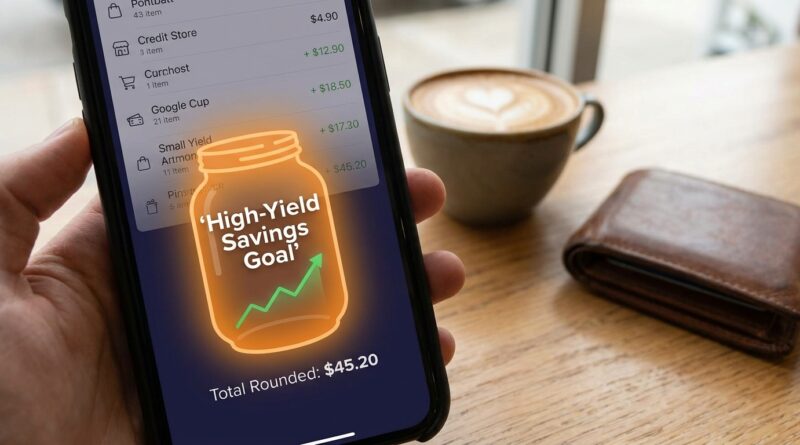
The ‘Round-Up To HYSA’ Habit: Turn Every Purchase Into Automatic High-Yield Savings
You know the feeling. You tap your card for coffee, groceries, takeout, a random Target run, then look at your checking account and think, where did the week go? Meanwhile, your high-yield savings account is sitting there, barely moving, because waiting for the “right time” to transfer money rarely works in real life. If you do not want a full spreadsheet budget or another money app you will ignore by Thursday, there is a simpler fix. Start using round up savings to high-yield account automation. Every purchase gets rounded to the next dollar, and the spare change moves into savings without you having to think about it. It is small enough not to hurt, steady enough to add up, and automatic enough to keep going even when life gets busy. For a lot of people, that is the sweet spot between doing nothing and trying to become a personal finance robot overnight.
⚡ In a Hurry? Key Takeaways
- Round-up savings automatically moves spare change from everyday purchases into a high-yield savings account, so saving happens without extra effort.
- Start with debit card purchases or a low weekly cap if you are worried about cash flow, then increase it once you see how little you miss.
- This works best when your HYSA has a competitive rate, no monthly fee, and easy transfer rules you understand.
Why this habit is catching on again
A lot of savings advice assumes you have extra money just sitting around. Most people do not. They have bills, groceries, gas, and a dozen tiny purchases that quietly eat the week.
That is why round-ups are having a moment again. They fit real life. Instead of trying to move $200 at once and feeling the pinch, you move 23 cents here, 61 cents there, $1.14 on a lunch order. It is less dramatic, but often more consistent.
And consistency is the whole game. A saver who transfers a little every day often gets further than the person who keeps waiting for a perfect payday surplus that never quite appears.
Some newer savings tools and reward programs are also nudging this behavior along. Products inspired by Spending Club style rewards and LevelUp savings features are putting more value on frequent micro-deposits, not just a giant balance. That is good news if you feel stretched but still want momentum.
What “round up savings to high-yield account” actually means
Here is the plain-English version.
If you buy something for $4.40, your bank or savings app rounds it up to $5.00. The extra 60 cents gets swept into savings. If you buy something for $12.10, then 90 cents goes over. Do this across dozens of purchases, and your account starts building in the background.
The key twist is where that money lands. If it goes into a regular savings account paying next to nothing, this habit is nice but limited. If it goes into a high-yield savings account, those tiny deposits also earn meaningful interest. That is where the habit gets more powerful.
Why this works better than “I’ll save what’s left at the end of the month”
Because there usually is not much left at the end of the month.
Round-ups beat that pattern by moving money before it gets absorbed into everything else. You are not relying on discipline. You are changing the path of your money by default.
It removes timing
You do not need to remember to transfer money on payday. You do not need to wait for motivation. Saving happens as you spend.
It feels painless
Most people do not notice 37 cents leaving their checking account. They absolutely notice a manual transfer of $100.
It creates visible progress
When you check your HYSA and see a growing balance, even from tiny amounts, you get a little win. That win matters. It makes you more likely to keep going.
How much can round-ups really add up to?
More than people expect, though not overnight miracle money.
Let’s say you make 35 card purchases a week and your average round-up is 52 cents. That is about $18 a week, or roughly $75 a month. Over six months, that is around $450 before interest. In a solid HYSA, you also earn interest on those deposits as they build.
No, this will not replace a full emergency fund on its own. But it can absolutely create one faster than doing nothing. It can also fund holiday spending, a travel stash, a car repair buffer, or the first few hundred dollars of a true rainy-day account.
How to set it up without making your life complicated
This should take one short session, not a whole weekend.
1. Pick a HYSA that is actually worth using
Look for a competitive APY, no monthly fee, and easy transfers. If you have not checked your rate in a while, it is worth reading The 10-Minute ‘Rate Check Sunday’ Habit: Stop Leaving HYSA Interest On The Table. A round-up habit works best when the destination account is pulling its weight.
2. See whether your bank already offers round-ups
Some banks and fintech apps have this built in. Others let you connect checking and savings so the spare change moves automatically after transactions settle.
3. Start with one card, not every account you own
If your spending is unpredictable, begin with your main debit card or the card you use for everyday basics. You can always expand later.
4. Add a safety rail
If your provider allows it, use a weekly cap or low-balance threshold. That way round-ups pause if your checking account gets too close to your comfort line.
5. Leave it alone for a month
This is important. Do not keep turning it on and off. Give it time to work, then review the total after 30 days.
Who this habit is best for
Round-ups are especially good for people who:
- struggle to remember manual transfers
- feel intimidated by strict budgeting
- spend regularly on a card already
- want to build savings without feeling deprived
- like small systems that run quietly in the background
It is a very “set it and forget it” habit, which is exactly why it sticks.
When round-ups are not enough by themselves
There is one honest caveat here. If your spending is very low, or you mostly pay with cash, round-ups will grow slowly. Helpful, yes. Magical, no.
Also, if your checking account is already close to the edge each week, even tiny extra transfers can cause stress. In that case, you may be better off starting with a fixed auto-transfer of $5 or $10 after payday, then adding round-ups later.
The goal is progress, not overdraft fees.
Smart ways to boost the habit without feeling it
Once basic round-ups are running smoothly, you can make them work a little harder.
Use a multiplier if available
Some apps let you round up by 2x or 3x. That means a 50-cent round-up becomes $1 or $1.50. Nice upgrade, but only if your cash flow can handle it.
Stack it with direct deposit savings
Even a tiny recurring transfer like $25 per paycheck pairs well with round-ups. One builds in bursts. The other builds in drips.
Keep the savings out of sight
If your HYSA is at a separate bank from your checking account, you are less tempted to pull money back out for impulse spending.
Common mistakes to avoid
A few simple ones can make this habit less useful.
Sending round-ups to a low-interest account
If the money is going into a sleepy old savings account, you are missing part of the benefit. The whole point is to pair automation with better yield.
Ignoring transfer timing
Some providers transfer each round-up instantly. Others batch them. Know the difference so you are not surprised by your available balance.
Thinking this replaces all other saving
It is a starter habit and a support habit. It can become meaningful, but it is even better as part of a simple savings setup.
At a Glance: Comparison
| Feature/Aspect | Details | Verdict |
|---|---|---|
| Ease of use | Set up once, then savings happen automatically with each eligible purchase. | Excellent for people who hate manual budgeting. |
| Savings impact | Small deposits add up steadily, especially when paired with a high-yield savings account. | Best for building momentum, not instant large balances. |
| Risk or downside | Can feel tight if your checking balance runs low or if transfers are not clearly timed. | Use low-balance alerts or caps to keep it safe. |
Conclusion
If saving always seems to happen “later,” round-up automation is a simple way to make it happen now. That is why this habit is trending again. Savers are realizing they leave free progress on the table when they only transfer money on payday. Frequent micro-deposits are getting more attention, and in some cases more rewards, because they match how real people actually live and spend. You do not need to stop buying coffee or overhaul your whole budget. You just need to route the spare change somewhere smarter. When you tie everyday swipes to a solid HYSA, tiny amounts start compounding into real money over time. It is low-friction, practical, and surprisingly motivating. Small habits, big bank accounts. That is not just a catchy line. With the right setup, it is exactly how this works.