The ‘Split‑Rate Shield’ Habit: Protect Your High‑Yield Savings From Sudden Rate Drops
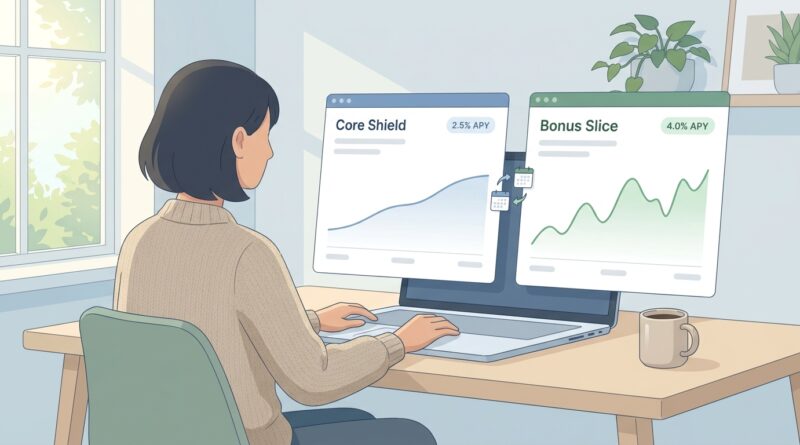
Few money annoyances feel as sneaky as opening your savings account and realizing the interest payout is smaller again. You picked a high-yield account. You moved your cash. You did the responsible thing. Then your bank quietly trims the rate and suddenly your “safe” parking spot is earning less than you expected. That is exactly why it helps to build a simple habit instead of relying on one account to stay generous forever. I call it the Split-Rate Shield. The idea is simple. Keep most of your cash in a dependable, easy-access home, then set aside a smaller piece as your “rate-sensitive” slice. That second piece is the one you move if rates elsewhere look meaningfully better. This gives you a practical answer for how to protect high yield savings from falling interest rates without turning into someone who checks bank offers every lunch break.
⚡ In a Hurry? Key Takeaways
- Do not keep 100 percent of your cash strategy dependent on one high-yield savings rate. Split it into a stable core and a smaller movable slice.
- A good starting rule is 80 to 90 percent in your main account and 10 to 20 percent in an experimental account you can switch if rates drop.
- Stick with FDIC- or NCUA-insured accounts and review quarterly so you stay flexible without constantly chasing tiny rate changes.
What the Split-Rate Shield habit actually is
The habit is less fancy than the name sounds. You divide your savings into two jobs.
1. The stable core
This is the bulk of your money. For many people, that means 80 to 90 percent. It stays in a solid, insured savings account you trust, ideally one with a decent rate, good app, fast transfers, and no weird hoops.
2. The experimental slice
This is the smaller piece, usually 10 to 20 percent. Its job is not to hold your whole emergency fund. Its job is to give you options. If your bank cuts rates and another insured account is clearly better, this is the piece you move first.
That split matters because it lowers the pain of rate drops. You are not forced into an all-or-nothing decision every time a bank sends one of those “we’ve updated your annual percentage yield” emails.
Why this works when rates start drifting down
When rates are rising, almost everyone feels smart. Even lazy savers get rewarded. When rates flatten or fall, the cracks show.
Banks do not all move at the same speed. Some cut quickly. Some hold higher rates a little longer. Some lure new customers with promotional rates while longtime customers sit still and earn less.
If all your savings sit in one place, you absorb every cut immediately. If you use a split system, you keep life simple while preserving some flexibility.
That is the whole point. Not perfection. Not chasing every last decimal point. Just not being fully exposed to one bank’s mood swings.
How to set your percentages
There is no magical number, but there is a practical one.
A simple starting rule
Use this if you want an easy framework:
- 80 percent in your main high-yield savings account
- 20 percent in a second insured account with a competitive rate
If your savings balance is large, or if you hate moving money around, go more conservative:
- 90 percent core
- 10 percent experimental
If you are comfortable opening accounts and comparing rates once in a while, 75/25 can work too. But for most people, 80/20 is the sweet spot. It protects most of your money from constant fiddling while still giving you enough on the side to make switching worthwhile.
What belongs in the stable core
Think emergency fund, near-term bills, tax money, home repair cash, or any money you may need without drama. This money should prioritize access, reliability, and insurance coverage over squeezing out the absolute top rate.
What belongs in the experimental slice
This is cash you still want safe and accessible, but you are willing to move if the math is good enough. It is your “test lane.” If a new bank looks better, you move this chunk first, not your whole financial life.
How big a rate difference should trigger action?
This is where people get stuck. They either ignore everything or become full-time rate stalkers.
A good rule is to move only when the difference is meaningful, not microscopic.
A practical trigger
Consider action if:
- Your current account drops by about 0.50 percentage points or more
- Another insured account offers at least 0.50 to 0.75 percentage points more
- The new account has no monthly fees, no balance traps, and easy transfers
If the gap is tiny, the payoff may not be worth the hassle. Saving habits should help your life feel calmer, not turn into another unpaid part-time job.
How often to review your savings setup
Quarterly is enough for most people. That means every three months.
This timing is useful because rate changes tend to feel less random when you check on a schedule. You are less likely to panic over one email, and less likely to sleep through a long slow decline.
If you want a lighter-touch system, pair this habit with a calendar reminder. The piece that makes this easier is having a set day to look, compare, and decide. If you want help creating that routine, The ‘Rate-Reset Reminder’ Habit: Capture Every High-Yield Bump Without Chasing Banks All Day fits perfectly here.
Your 10-minute quarterly check
- Look up your current APY
- Compare it with two or three reputable competitors
- Check whether your core account is still “good enough”
- Decide whether the experimental slice should stay put or move
That is it. Ten minutes, four times a year, is very different from obsessing every week.
How to protect high yield savings from falling interest rates without taking more risk
This part matters. A falling rate can tempt people into reaching for products that are not really savings substitutes.
If your goal is safety and liquidity, stay in the safety lane.
Good places for the Split-Rate Shield
- FDIC-insured high-yield savings accounts
- NCUA-insured credit union savings accounts
- Money market deposit accounts with insurance and clear terms
Be careful with these if you need quick access
- Brokerage cash products with different protections
- Promotional accounts with short teaser rates
- Anything that locks your money longer than your comfort level
The goal is not to dodge lower rates by taking stock-market-like risk. The goal is to limit the damage from bank rate cuts while keeping your money boring and safe.
Common mistakes that make savers feel stuck
Keeping everything in one “good enough” account forever
This is the big one. “Good enough” quietly becomes below average, and because the drop happens in small steps, it is easy to miss.
Moving for tiny differences
A difference of 0.10 percentage points may look exciting on a comparison chart, but on smaller balances it often barely matters. Save your energy for bigger gaps.
Ignoring account quality
A top rate is not worth much if transfers are slow, customer service is a mess, or the app makes basic tasks painful. Your core account should be easy to live with.
Forgetting insurance limits
If your balances are high, check FDIC or NCUA coverage rules. Protecting yield is good. Protecting principal is better.
A quick example
Say you have $20,000 in savings.
- $16,000 goes into your stable core account
- $4,000 goes into your experimental slice
Your main bank cuts its APY from 4.50% to 3.90%. You find another insured account paying 4.60% with no nonsense attached.
Instead of moving the whole $20,000 right away, you move the $4,000 experimental slice first. You see how the new bank works. You test transfer times. You decide whether it feels worth expanding later.
That lowers friction. More important, it lowers regret. You are not gambling on a brand-new setup with your entire cash pile.
At a Glance: Comparison
| Feature/Aspect | Details | Verdict |
|---|---|---|
| Stable core | Usually 80 to 90 percent of savings, kept in a reliable insured account with easy access | Best for emergency cash and money you do not want to babysit |
| Experimental slice | Usually 10 to 20 percent, moved only when another insured account offers a clearly better rate | Best for staying flexible without moving everything |
| Review schedule | Check every three months and act only on meaningful rate gaps | Best balance between awareness and sanity |
Conclusion
Rates are starting to drift down from the recent highs, and plenty of savers are just now seeing how exposed they are to every quiet tweak their bank makes. The good news is you do not need a complicated system to respond. The Split-Rate Shield gives you a clear rule: keep most of your savings in a stable home, keep a smaller slice movable, and review it on a simple schedule. That way, you stay flexible without becoming a full-time rate watcher. It is a small, repeatable habit, which is exactly why it works. You protect more of your money with less stress, and then you get on with your life.