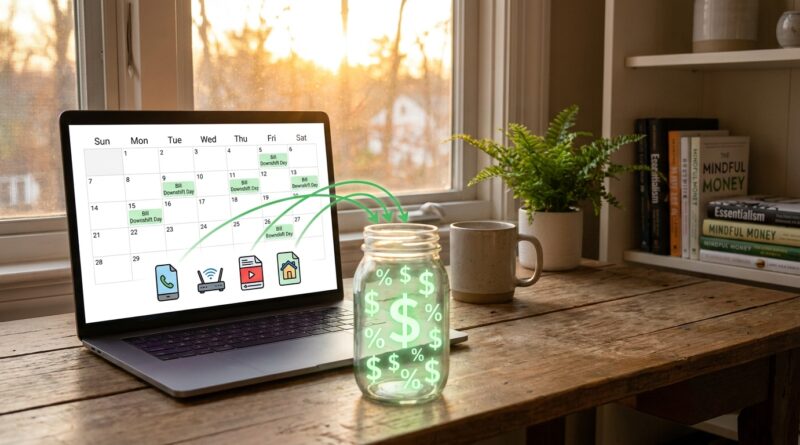
The ‘Zero-Task HYSA Rule’: One Tiny Setup That Makes Every Bill Lower Next Year
You are not lazy if you cannot keep up with every rate increase, trial ending, or “limited-time savings” trick. Most people are tired. Bills creep up a dollar here, five dollars there, and somehow your checking account feels tighter even when nothing big changed. That is what makes the Zero-Task HYSA Rule so useful. It is one small setup that turns those annoying little bill cuts into automatic savings, without asking you to become a spreadsheet person.
The rule is simple. Any time you lower a recurring bill, even by a tiny amount, you send that exact difference straight into your high-yield savings account with an automatic transfer. Cancel a $12 add-on, move $12 a month to savings. Negotiate your phone bill down by $8, send $8 to savings. You never “feel” the money because you were already paying it. But now it starts earning for you instead of disappearing into price creep. That is the whole point of high yield savings habits to lower bills automatically. Less tracking. More quiet progress.
⚡ In a Hurry? Key Takeaways
- The Zero-Task HYSA Rule means every time a monthly bill drops, you set the savings amount to auto-transfer into your high-yield savings account.
- Start with 3 to 5 recurring bills like streaming, phone, internet, and software. Then match each bill cut with the same monthly transfer.
- This works because it avoids lifestyle pain, cuts decision fatigue, and helps cash earn more instead of sitting in a low-interest checking account.
What the Zero-Task HYSA Rule actually is
Think of it as a money redirect, not a budget overhaul.
You are not trying to slash every expense. You are not checking rates every weekend. You are not building a giant personal finance system you will quit in two weeks.
You are doing one thing. When a fixed monthly bill gets cheaper, you create or raise an automatic transfer to your HYSA by that same amount.
That is why I call it “zero-task” after setup. The work happens once. The benefit keeps going.
A quick example
Let’s say your monthly bills look like this:
- Streaming bundle goes from $31 to $22 after you drop one service
- Phone plan drops from $65 to $55 after switching plans
- Password manager annual cost works out to $2 less per month after a promo
You just freed up $21 a month.
Instead of letting that money get absorbed by takeout, random app renewals, or higher grocery prices, you set an automatic $21 transfer into your HYSA every month.
That is $252 a year, plus interest. And you did not “find” extra money. You simply kept a bill reduction from vanishing.
Why this works so well for busy people
A lot of savings advice quietly assumes you have time to monitor everything. Most people do not.
What usually happens is this. You get a bill lowered. You feel good for a day. Then life moves on, and the savings just blends into the mess of your account.
The Zero-Task HYSA Rule fixes that exact problem.
It works because it removes three common pain points:
1. It cuts decision fatigue
You do not have to ask, “Should I save this or spend it?” The answer is already set.
2. It avoids the pain of “cutting back”
You are not giving up money you are used to spending. You are redirecting money you were already losing to a bill.
3. It makes small wins matter
A $6 reduction sounds tiny. But six dollars a month, stacked with a few others, grows. In a decent HYSA, it grows a little faster.
How to set it up in about 15 minutes
Step 1: Pick one good HYSA
If your extra cash is sitting in checking earning almost nothing, inflation is doing quiet damage. A high-yield savings account gives those bill savings somewhere useful to go.
You do not need to chase every top rate in America. You just need a solid account with a competitive yield, easy transfers, and no nonsense fees.
Step 2: List your recurring bills
Keep it simple. Start with bills that often change or can be trimmed:
- Streaming services
- Phone plan
- Internet
- Music or cloud storage
- Software subscriptions
- Gym membership
You are not auditing your whole life. You are just identifying the repeat charges.
Step 3: Lower one bill
Pick the easiest win first. Cancel the least-used streamer. Switch to the cheaper phone tier. Ask for the promo rate. Move from monthly billing to annual if it truly saves money and fits your cash flow.
The goal is not perfection. The goal is one drop.
Step 4: Match the savings with an automatic transfer
If the bill drops by $9 a month, create a recurring $9 transfer from checking to HYSA. Schedule it for a day or two after payday or right after the bill usually clears.
This is the key move. Without it, the “saved” money often disappears.
Step 5: Increase the transfer only when another bill falls
That is what keeps this sustainable. You do not keep adjusting things weekly. You only touch it when you create a new reduction.
That is why the system stays light.
The best bills to use with this habit
Some bills are better than others for this rule.
Best fit: subscriptions and plans you can control
- Streaming services
- Mobile phone plans
- Internet packages
- Digital storage
- Apps and software
These are ideal because changes are usually easy to measure. If the bill falls by $7, you know exactly what to move.
Okay fit: annual renewals broken into monthly value
If you switch an annual plan from $120 to $84, that is a $36 yearly difference. Divide by 12 and transfer $3 a month to your HYSA.
It is not fancy. It works.
Less ideal: variable expenses
Groceries, gas, and electricity can change month to month. You can still save from those categories, but they are not as clean for this specific habit.
The Zero-Task HYSA Rule works best when the number is stable and automatic.
How this pairs with other simple savings habits
This habit is especially good when combined with automatic saving from income. If you like systems that do not rely on motivation, it fits nicely with The ‘Paycheck Skim’ Habit: How To Build A Hidden High‑Yield Safety Net Without Touching Your Lifestyle.
That approach helps you save from the top of your paycheck. The Zero-Task HYSA Rule helps you save from the bottom of your bills. Together, they create a nice little pincer move on waste.
One catches money before you spend it. The other rescues money when your monthly costs shrink.
Common mistakes to avoid
Do not move the “maybe” savings
Only count real bill reductions. Not hoped-for cuts. Not one-time coupon luck. Not “I think I spent less this month.”
Use actual recurring savings.
Do not overcomplicate the math
If your bill drops by $8.73, you can transfer $8 or $9. This is not a tax filing. Round it if needed.
Do not keep the transfer in checking
If you leave it in checking, it becomes snack money. Move it to the HYSA so it has a job.
Do not chase every HYSA rate change
Yes, rates matter. But constantly moving your money for tiny differences can become its own part-time job. A strong, reputable HYSA is usually enough.
What this can look like after one year
Here is a realistic example for someone with a handful of subscriptions and service bills:
- Streaming cuts save $14 per month
- Phone plan saves $10 per month
- Cloud storage downgrade saves $3 per month
- Internet promo saves $15 per month
Total redirected to HYSA: $42 per month.
That is $504 a year before interest. Add HYSA interest, and it starts to feel like a small system that is finally on your side.
No heroic budget month. No guilt spiral. Just less money leaking out.
Why this matters more right now
Price creep is sneaky. Companies know most people will not cancel over a one-dollar hike. But stack enough of those increases together and your monthly cash flow gets slowly squeezed.
At the same time, money sitting in a low-interest account is not doing much for you.
That is why high yield savings habits to lower bills automatically matter right now. They help on both fronts. You reduce waste, and you give the rescued money a better place to sit.
It is practical. And more importantly, it is realistic.
At a Glance: Comparison
| Feature/Aspect | Details | Verdict |
|---|---|---|
| Setup effort | One HYSA, one bill cut, one matching auto-transfer | Easy for most people |
| Ongoing maintenance | Only update the transfer when another recurring bill gets cheaper | Very low effort |
| Financial upside | Turns forgotten bill savings into compounding cash in a high-yield account | Small gains can add up fast |
Conclusion
If you are tired of being nickel-and-dimed by subscriptions and too busy to play full-time savings detective, this is the kind of habit worth keeping. The Zero-Task HYSA Rule gives you a low-friction way to turn lower bills into something useful instead of letting those dollars disappear back into everyday spending. That matters right now. People are getting squeezed by subscription creep on one side and decision fatigue on the other, while inflation keeps eating away at cash that is parked in the wrong place. This setup helps you fight back without adding another chore to your week. Every tiny bill cut becomes a built-in savings engine, and in a strong HYSA, those small transfers can grow into real progress over the year. Quietly. Automatically. Exactly the way good money habits should work.