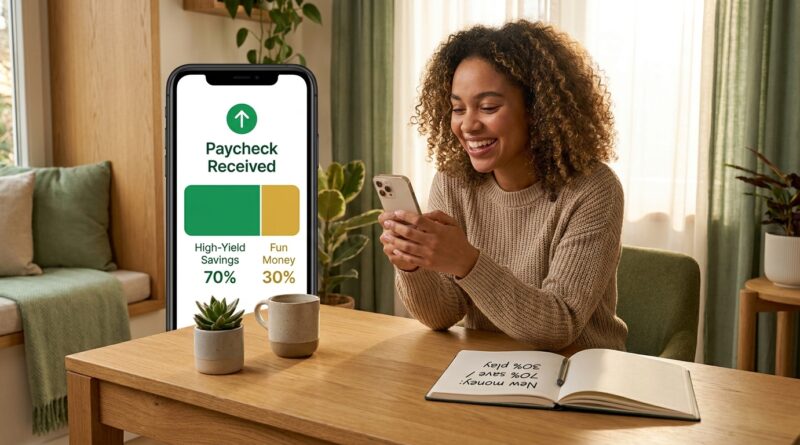
The ‘Pay Yourself First Split’ Habit: Route Every Raise And Refund Into High‑Yield Savings Before You See It
You get a raise, a tax refund lands, or a side-gig payment hits your account, and for about five minutes it feels like you are finally getting ahead. Then real life happens. A few dinners out. A “needed” upgrade. One weekend trip. Suddenly that extra money is gone, and your high-yield savings balance still looks like it is standing still. That is frustrating, especially when you are doing the hard part already by earning more.
The fix is simple. Start a pay yourself first high yield savings habit by splitting every windfall before you ever see it as spending money. Route most of each raise, refund, bonus, or freelance deposit straight into high-yield savings, and send a small slice to checking for guilt-free fun. You are not banning joy. You are just making sure your future gets paid first. With savings rates still better than they were not long ago, this one rule helps fresh dollars start earning right away instead of quietly disappearing.
⚡ In a Hurry? Key Takeaways
- Send raises, refunds, bonuses, and side-gig money to high-yield savings first, before it blends into everyday spending.
- Use a simple split, like 80 percent to savings and 20 percent to fun, so the habit feels realistic and easy to keep.
- Keep the money in an FDIC- or NCUA-insured account, and compare rates now since many banks and credit unions are quietly raising yields.
Why extra money disappears so fast
Most people do not waste money because they are careless. They lose it because extra money is slippery.
Your regular paycheck already has a job. Rent. Groceries. Gas. Childcare. Bills. But a raise or refund feels different. It shows up without a clear assignment, so it gets absorbed into whatever seems reasonable in the moment.
That is how “I deserve this” spending sneaks in. Not with one huge bad decision, but with a dozen small ones that barely register.
This is exactly why the pay yourself first high yield savings habit works. It removes the need for perfect self-control. The money gets a job before temptation gets a vote.
What the “Pay Yourself First Split” habit looks like
The rule is easy. Every time extra income shows up, split it immediately.
A simple starting formula
Try this:
- 70 to 90 percent into high-yield savings
- 10 to 30 percent into checking for fun or flexibility
That is it. No complicated budget category list. No guilt spiral.
If you get a $2,000 tax refund, maybe $1,600 goes to savings and $400 stays available for something enjoyable or useful. If your pay goes up by $200 a month, route $150 of that increase to savings automatically and leave $50 in checking.
You still feel the win. You just stop letting the whole win leak away.
Why this works better than “I will save what is left”
Because there usually is not much left.
When savings comes last, spending expands to fill the gap. It happens quietly. A nicer streaming bundle. More delivery. Better seats. Extra Amazon orders. None of it looks huge alone.
Paying yourself first flips that script. Saving becomes the default. Spending becomes the smaller, intentional piece.
It also works well with a companion habit like The ‘Freeze & Fill’ Habit: One Tiny Pause That Turns Every Swipe Into High‑Yield Savings, which helps catch little leaks from everyday purchases after your bigger windfalls are already protected.
How to set it up without making your life complicated
For pay raises
This is the cleanest version. If your employer lets you split direct deposit, send the raise amount straight to a separate high-yield savings account.
Example:
- Old take-home pay lands in checking as usual
- The extra amount from the raise goes straight into savings
If payroll cannot do that, set up an automatic transfer for payday. Schedule it for the same day your paycheck lands so the money moves before you mentally claim it.
For tax refunds
When you file taxes, many tax software platforms and preparers let you split the refund between accounts. Use that feature if you can.
If not, the moment the refund arrives, transfer your savings portion out that day. Do not wait until the weekend. Waiting is where plans go to die.
For side-gig income
Side-gig money is extra vulnerable because it feels flexible. Open a dedicated savings account just for side income if needed. Every deposit gets split the same way, every time.
You want the rule to be boring. Boring is good. Boring builds balances.
How much should go to high-yield savings?
Enough that it matters, but not so much that you rebel against your own system.
Here is a quick guide:
- Very cautious: 60 percent savings, 40 percent checking
- Balanced: 80 percent savings, 20 percent checking
- Aggressive: 90 percent savings, 10 percent checking
If your emergency fund is thin, go heavier on savings. If you have a solid cash cushion and you are using a refund for a planned purchase, a looser split can still work.
The best ratio is the one you will actually keep using.
Where the money should go
For short-term goals and emergency cash, use a high-yield savings account. Right now, many banks and credit unions are offering better yields than they were a year ago, so fresh dollars can start earning faster.
For money you know you will not need for a few months, a short-term CD may be worth a look too, especially if the rate beats your savings account and you are comfortable leaving the money alone until maturity.
Just make sure the account is FDIC-insured at a bank or NCUA-insured at a credit union. Safety matters as much as the rate.
What this habit is really protecting you from
Not just spending. Lifestyle creep.
Raises are supposed to improve your life. The problem is that they often improve your monthly spending first. Better restaurants. Nicer subscriptions. More casual yeses.
That can feel harmless until you realize your cost of living rose with your income, and now the next raise is already spoken for too.
The split habit keeps some of your upside from becoming permanent overhead.
Good uses for the savings bucket
This money does not need to sit there without a purpose. Give it a mission.
- Emergency fund
- Travel fund
- Home repair cushion
- Insurance deductibles
- Next car down payment
- Quarterly taxes for freelance work
Labeling the account can help. “Buffer,” “Freedom Fund,” or “Next Move” is a lot more motivating than plain old “Savings.”
Common mistakes to avoid
Making the fun slice too big
If every windfall becomes half spending, you are still likely to wonder where the money went. Keep the fun part intentional, not accidental.
Using the same checking account for everything
If savings and spending money mix together, you lose the benefit of friction. Separate accounts help.
Chasing a tiny rate difference while ignoring behavior
Yes, compare APYs. But a slightly better rate will not matter much if the money never stays put. Your system matters more than squeezing out every last decimal point.
Forgetting taxes on side income
If you freelance or do gig work, part of that money may already belong to the IRS or your state. Build that into your split so you do not mistake tax money for free cash.
At a Glance: Comparison
| Feature/Aspect | Details | Verdict |
|---|---|---|
| Best use case | Raises, tax refunds, bonuses, and side-gig deposits that tend to vanish into everyday spending | Excellent for people who save inconsistently but earn occasional extra money |
| Setup effort | One-time direct deposit split or automatic transfer to a high-yield savings account | Low effort once set up, high payoff over time |
| Long-term value | Builds savings without feeling deprived, while higher APYs help each new dollar earn more | Strong habit for balancing progress and enjoyment |
Conclusion
If your extra money keeps disappearing, the answer is not more guilt. It is a better default. The pay yourself first high yield savings habit gives every raise, refund, and side-gig deposit a simple rule. Most goes where it can grow. A small piece stays available for real life and a little fun. That matters right now, because many banks and credit unions are quietly bumping up yields on high-yield savings and short-term CDs, so each fresh dollar you trap in savings can work harder than it did a year ago. And with social feeds constantly pushing “treat yourself” spending, this habit helps you stop feeling like you must choose between enjoying your money and building security. You can do both. Just make sure your future gets paid first.