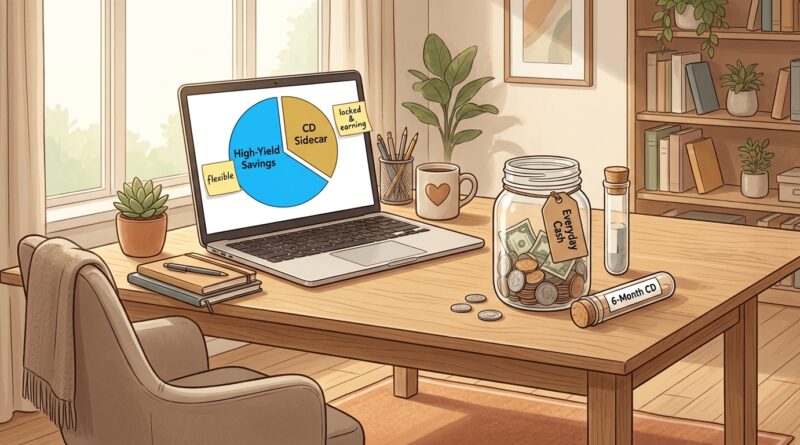
The ‘CD Sidecar’ Habit: Use One Mini Certificate To Turbocharge Your High-Yield Savings
You did the smart thing and moved your cash into a high-yield savings account. Then the headlines started. Rates may fall. Savings yields are drifting lower. Suddenly, the account that felt like a win starts to feel shaky. That anxiety is real, especially if you do not want to lock up all your money in a CD just to protect a decent rate.
A simple fix is what I think of as the CD sidecar habit. Keep most of your cash in your HYSA so it stays easy to reach. Then move a smaller slice, only money you know you will not need for 6 to 12 months, into one short CD. That gives you a clearer CD vs high yield savings strategy without turning your savings into a puzzle. You keep flexibility for bills, surprises, and everyday peace of mind, while locking in a steady return on part of your cash before rates slide further. It is a small move, but for nervous savers, it can make a big difference.
⚡ In a Hurry? Key Takeaways
- Use a split approach. Keep most cash in a HYSA, and put a smaller amount into one short CD.
- Start with money you will not need for 6 to 12 months, not your full emergency fund.
- This can help you keep flexibility while protecting part of your savings from falling rates.
Why savers feel stuck right now
A year or two ago, the answer felt easy. Put cash in a high-yield savings account and enjoy the rate. Now it is a little messier. HYSA rates are still good, but many are slipping down from their peak. At the same time, CD rates are no longer wildly better than savings, which makes people wonder if locking up money is even worth it.
That is where people freeze. They start comparing CDs, Treasury bills, money market funds, online banks, local banks, and brokered products. Too many choices can make you do nothing at all.
If that sounds familiar, the goal is not to build the perfect cash system. The goal is to make one solid move that lowers your stress.
The CD sidecar habit, explained simply
Think of your HYSA as the main vehicle. It holds your everyday cash buffer, your emergency fund, and any money you may need soon. The CD is the sidecar. Smaller, useful, and attached to the main plan without taking it over.
Here is how it works:
Step 1: Leave your flexible money alone
Keep the bulk of your cash in high-yield savings. This is the money that covers surprises, near-term bills, and the stuff life throws at you.
Step 2: Pick one short CD
Choose a CD with a term of about 6 to 12 months. That is long enough to lock in today’s rate, but short enough that you are not stuck for years.
Step 3: Use only money you will not touch
This is the most important part. Do not move rent money. Do not move your full emergency fund. Use a smaller amount that can sit untouched until the CD matures.
If you want a deeper version of this idea, The ‘CD Sidecar’ Habit: Lock In Today’s High Yields While Keeping Your HYSA Flexible lays out why this middle-ground approach feels so practical right now.
Why this CD vs high yield savings strategy works
A lot of financial advice acts like you have to pick one winner. CD or HYSA. Fixed or flexible. But real life does not work that neatly.
The sidecar approach works because it respects two truths at once.
You want access to your money
A HYSA is still one of the best places for cash you may need soon. You can transfer money out, cover emergencies, and avoid early withdrawal penalties.
You do not want your whole yield to drift lower
A CD lets you hold onto today’s rate for a set period. If savings rates keep falling, at least part of your cash is protected.
That makes this a strong CD vs high yield savings strategy for cautious savers. You are not making a big bet. You are simply dividing jobs. Savings for access. CD for rate stability.
How much should go into the CD?
There is no magic number, which is actually good news. You do not need a perfect formula. You just need a sensible one.
A few easy ways to decide:
Option 1: One month of expenses
If you have a healthy emergency fund already, you might move an amount equal to one month of spending into a short CD.
Option 2: New cash you recently saved
If you have extra cash sitting in your HYSA beyond your normal target, that extra chunk could be your CD sidecar.
Option 3: A percentage of your cash
Some people like to use 10 to 25 percent of their cash savings. That keeps the majority liquid while still locking in part of the balance.
If you are nervous, start smaller. You can always do more later. The point is to build a habit, not to make a giant move all at once.
What to look for in a short CD
Not all CDs are worth the hassle. Keep it simple and check these basics:
Competitive rate
Compare the APY to your HYSA. If the CD rate is only barely better, that can still be fine if you expect savings rates to fall. But if it is much lower than your HYSA, skip it.
Term length
For most people, 6 to 12 months is the sweet spot right now. It is enough time to lock in a rate without losing too much flexibility.
Early withdrawal penalty
This matters more than people think. If there is a chance you might need the money, a lighter penalty is better. Read the fine print before you click.
FDIC or NCUA coverage
Stick with insured accounts at banks or credit unions, within the coverage limits. This is savings money. Boring and safe is the goal.
When this strategy makes the most sense
This approach is especially useful if:
- You already have an emergency fund.
- You feel uneasy about falling HYSA rates.
- You do not want to build a full CD ladder.
- You want one clear next step instead of comparing ten products.
It makes less sense if your cash is very tight, if you may need every dollar soon, or if the CD rate is not meaningfully attractive.
Common mistakes to avoid
Locking up too much
The sidecar should stay small enough that you do not worry about it. If moving money into a CD makes you feel cash-poor, you moved too much.
Chasing tiny rate differences
Do not spend six hours opening a new account to earn a few extra dollars a year. Good enough is good enough here.
Ignoring maturity dates
Set a reminder for when the CD ends. Some CDs renew automatically, and you may miss the short window to move your money if you are not paying attention.
Forgetting the job of each account
Your HYSA is for flexibility. Your CD is for a fixed slice of money. When you mix up those jobs, things get confusing fast.
At a Glance: Comparison
| Feature/Aspect | Details | Verdict |
|---|---|---|
| Access to cash | HYSAs let you move money easily. CDs may charge a penalty if you withdraw early. | HYSA wins for flexibility |
| Rate protection | HYSA rates can change anytime. CDs lock your rate for the full term. | CD wins for stability |
| Best overall use | A split approach keeps most money liquid while giving some money a fixed return. | Best choice for many savers right now |
Conclusion
You do not need to solve every cash question at once. Right now, high-yield savings rates are still attractive, but they are drifting down from their highs, and CD offers are getting closer to HYSA yields. That is exactly why the CD sidecar habit is useful. Instead of getting stuck between savings accounts, CDs, Treasurys, and money market funds, you can take one clear step. Pick a single short CD with money you will not need for 6 to 12 months, and leave the rest in your flexible high-yield savings account. It is a small adjustment, not a dramatic overhaul. But it can help you lock in a reliable return on part of your cash while keeping the rest easy to reach, which is often the sweet spot anxious savers need in a rate-cut environment.