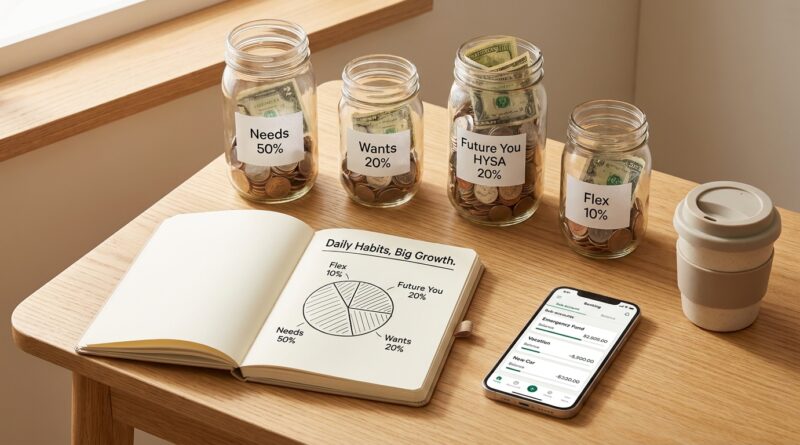
The ‘50/20/20/10 Bucket’ Habit: A Summer-Proof High-Yield Savings Plan That Actually Fits Real Life
If the 50/30/20 rule makes you feel broke, lazy, or bad at money, you are not the problem. A lot of people try it, plug in real rent, real groceries, real insurance, and laugh because the math just does not work. When half your pay disappears into housing before you even buy toothpaste, “save 20 percent” can sound like advice from another planet. That is why a better fit for 2026 is the 50/20/20/10 bucket habit. It keeps the useful part of the old rule, which is structure, but swaps out the fantasy. You still cover needs first. You still save hard. But now you build in room for irregular costs and everyday fun, instead of pretending those things do not exist. Best of all, this system works especially well with a high-yield savings account, so the money you are setting aside is actually earning something while you get your life in order.
⚡ In a Hurry? Key Takeaways
- The 50/20/20/10 bucket system is a more realistic high yield savings habits 50 30 20 rule alternative for people dealing with high rent and uneven monthly costs.
- Split your pay into four jobs: 50% fixed needs, 20% high-yield savings, 20% flexible spending, and 10% irregular or annual expenses.
- Automating the savings bucket into an FDIC- or NCUA-insured high-yield account helps you save consistently without relying on willpower.
Why the old 50/30/20 rule keeps falling apart
The classic version sounds clean. Fifty percent for needs. Thirty for wants. Twenty for savings. Nice idea. The trouble is that in many cities, rent alone can eat up 35 to 45 percent of take-home pay. Add utilities, transit, insurance, and groceries, and the “needs” category is suddenly way over 50 percent.
That leaves people feeling like they failed a basic money test. But a budget rule is supposed to help you. If it breaks the minute it meets your actual life, the rule is the issue.
The better approach is to stop forcing your spending into categories that ignore modern costs. Instead, give your money jobs that match real life.
What the 50/20/20/10 bucket habit looks like
Here is the simple version:
- 50% Fixed needs: Rent, utilities, minimum debt payments, insurance, phone, basic groceries, transit.
- 20% High-yield savings: Emergency fund, short-term goals, future big expenses.
- 20% Flexible spending: Dining out, streaming, hobbies, clothing, fun money, the stuff that keeps you from feeling punished.
- 10% Irregular expenses: Car repairs, gifts, medical co-pays, annual subscriptions, travel, pet surprises, all the “oops, I forgot that was coming” costs.
This is what makes it work. The extra 10 percent bucket protects your savings from getting raided every time life happens. That one change can be the difference between a system that lasts three weeks and one that lasts three years.
Why the high-yield savings piece matters so much
If you are going to work this hard to save 20 percent, do not send it to an account paying basically nothing. A high-yield savings account gives your cash at least a chance to keep up better than a standard bank savings account.
No, the interest will not make you rich overnight. But it does reward the habit. And habits are where the real progress happens.
A good setup is to use one high-yield savings account with separate labeled buckets if your bank offers that feature, or multiple savings accounts if it does not. You might label them:
- Emergency Fund
- Irregular Bills
- Travel or Holiday Spending
- Next Big Goal
Once you have the habit running, check the rate every month or so. Banks change rates quietly. This is where The ‘Rate Check Reminder’ Habit: A 10‑Minute Monthly Ritual To Keep Your High‑Yield Savings From Quietly Falling Behind is worth a look. It is a simple way to make sure your money does not start underperforming while you are busy living your life.
How to set it up in under an hour
1. Use your take-home pay, not your gross salary
This system should be based on the money that actually lands in your checking account after taxes, health insurance, and retirement deductions.
If your monthly take-home pay is $4,000, your buckets would look like this:
- $2,000: Fixed needs
- $800: High-yield savings
- $800: Flexible spending
- $400: Irregular expenses
If your numbers are tight and your needs are a little above 50 percent right now, do not quit. Start by getting close. The goal is a system you can repeat, not a perfect chart on day one.
2. Open or use a high-yield savings account
Look for an account with no monthly fee, easy transfers, and strong insurance protection. For banks, that usually means FDIC insurance. For credit unions, NCUA insurance.
If your bank lets you create sub-accounts or savings buckets, great. If not, one main HYSA and a simple spreadsheet or notes app can still do the job.
3. Automate the 20% savings transfer first
This is the heart of the habit. Set the transfer to happen the same day your paycheck lands, or the morning after. Do not wait to “see what is left.” There will always be less left than you hoped.
Even if 20 percent feels aggressive, start with the full target in your setup and adjust only if needed after a month of real testing.
4. Automate the 10% irregular bucket too
This is the secret weapon. Put that 10 percent into savings as well, ideally in a separate labeled bucket. It is still your money. It is just assigned to future-you, who will definitely need it.
Think of it as a bill that has not arrived yet.
5. Let the 20% flexible spending be guilt-free
This part matters more than people think. If every budget feels like punishment, you stop using it. Giving yourself a reasonable “live your life” bucket keeps the plan humane.
Coffee with a friend. A movie. Takeout on a rough Thursday. Those things do not ruin budgets. Having no plan does.
What if your needs are already above 50 percent?
This is common. Especially in high-cost cities. If your fixed costs are closer to 60 percent, do this instead:
- Keep the 20% high-yield savings target if you can.
- Trim the flexible bucket before you trim the irregular bucket.
- Treat the 50 percent number as a direction, not a moral rule.
For example, a temporary 60/20/10/10 version may fit your life better than pretending 50/30/20 works when it clearly does not. The point is to build a repeatable saving system, not cosplay a textbook.
Where most people accidentally sabotage this plan
They keep everything in checking
If your savings sits beside your debit card money, it is too easy to blur the lines. Separate accounts create healthy friction.
They use savings for predictable non-emergencies
Holiday gifts are not emergencies. Annual insurance bills are not emergencies. Birthdays are not emergencies. That is exactly why the 10 percent irregular bucket exists.
They never review their account rate
A high-yield account is only useful if the yield stays competitive enough to matter. Set a calendar reminder once a month. It takes minutes.
They aim for perfect instead of automatic
You do not need to categorize every snack. You need your core transfers to happen without debate.
A simple example from real life
Say Maya brings home $3,600 a month. Her rent and fixed bills are brutal, about $1,950. Under the old rule, she would feel behind right away. Under the 50/20/20/10 bucket habit, she can set up:
- $1,950 for fixed needs
- $720 to high-yield savings
- $570 for flexible spending
- $360 for irregular expenses
Her needs are slightly above 50 percent. Fine. The system still works because she protected savings and future surprise costs first. When her car needs tires or a wedding invite shows up, she is not blowing up her emergency fund or swiping a credit card out of panic.
Why this feels better than traditional budgeting
Because it respects reality.
It assumes life includes random costs. It assumes your rent may be unfairly high. It assumes you still want some room to enjoy your money. And it gives your savings a real place to grow instead of leaving it stranded in a near-zero account.
That is why this is such a useful high yield savings habits 50 30 20 rule alternative. It turns budgeting from a guilt exercise into a repeatable system.
At a Glance: Comparison
| Feature/Aspect | Details | Verdict |
|---|---|---|
| Classic 50/30/20 rule | Simple on paper, but often breaks when rent and fixed bills are unusually high. | Useful as a starting idea, not always realistic in 2026. |
| 50/20/20/10 bucket habit | Adds a separate bucket for irregular expenses while preserving a strong savings target. | Best fit for real-world cash flow and fewer budget blowups. |
| High-yield savings setup | Automates savings into an account that earns more than a standard savings account, with insurance protection. | Strong move for emergency funds and short-term goals. |
Conclusion
If trending budget advice keeps making you feel like you are bad at money, take a breath. A lot of classic rules quietly fall apart in high-rent, high-inflation places, and that is not a character flaw. It is bad fit. The 50/20/20/10 bucket habit is a practical fix. It respects housing costs, gives irregular expenses their own lane, and still pushes at least 20 percent into high-yield savings every month when set up well. Better yet, you can build the whole thing in under an hour and let automation do the heavy lifting after that. That is the real win. You move from “I should save more” to a system that saves for you, while leaving room for the little joys that make life feel livable.