The ‘Freeze & Fill’ Habit: One Tiny Pause That Turns Every Swipe Into High‑Yield Savings
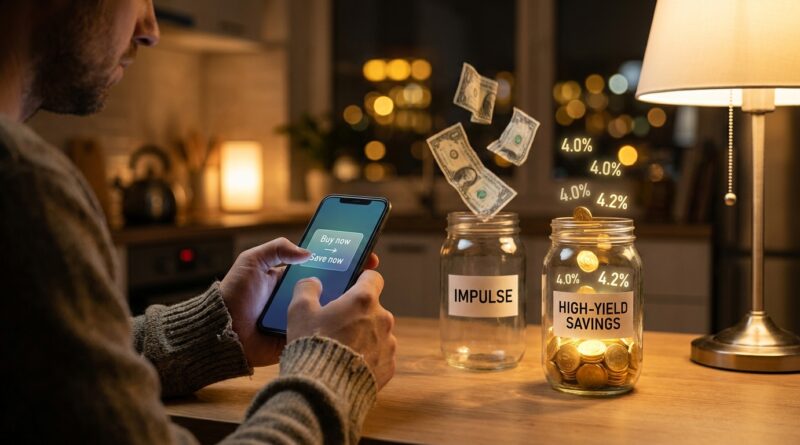
You already know the advice. Open a high yield savings account, move money there, let it earn more. The annoying part is not knowing what to do. It is doing it when you are hungry, tired, bored, or one tap away from buying something you did not plan for. That is where most budgets fall apart. Not on spreadsheets. On Tuesday night, with the food app open and your brain asking for an easy win. The good news is you do not need perfect discipline. You need a tiny pause you can actually use in real life. The Freeze & Fill habit is exactly that. You freeze for a few seconds before an impulse buy, then if you skip it, you send part of that almost-spend into your high yield savings account right away. It turns a near-miss purchase into a real deposit, which is a much more useful high yield savings habit than waiting for your “better” future self to magically spend less.
⚡ In a Hurry? Key Takeaways
- The Freeze & Fill method is a simple high yield savings habit: pause before an impulse buy, then transfer 20 to 50 percent of that skipped spend into your HYSA.
- Start small with a script and one transfer amount, like “If I skip takeout, I move $10 or $15 to savings right now.”
- This works best when your HYSA is easy to reach from your bank app and you keep enough in checking to avoid overdrafts or late bill payments.
What the Freeze & Fill habit actually is
Think of it as a two-step ritual.
Step one, freeze. You pause for 10 to 20 seconds before an unplanned purchase.
Step two, fill. If you decide not to buy, you move a slice of that money into your high yield savings account.
That slice can be a percentage or a flat amount. Many people do well with 20 to 50 percent of the almost-purchase. So if you nearly spend $40 on takeout, you move $10 to $20 into savings. Not someday. Right then.
This matters because your brain still gets a reward. You did not just “miss out.” You turned that moment into progress.
Why this high yield savings habit works better than “just spend less”
“Spend less” is not wrong. It is just too vague to help in the moment.
Freeze & Fill works because it meets you at the exact second money is about to leave your account. That is where the battle usually is. Not when you set goals on a Sunday afternoon. It is when you are standing in line, scrolling late at night, or talking yourself into one more convenience purchase.
It also removes the all-or-nothing trap. You do not have to become a no-fun robot. You are simply creating a rule for the purchases you almost made but decided against.
A tiny script helps
Use a short phrase so you do not have to think too hard.
Try one of these:
- “Do I want this, or do I want the cushion more?”
- “If I skip it, part of it goes to savings.”
- “Pause first. Then decide.”
That may sound small, but small is the point. A good habit should still work when you are not at your best.
How to set it up in five minutes
1. Pick your transfer rule
Do not overcomplicate this. Choose one rule:
- 20 percent of any skipped impulse buy
- 50 percent if the purchase is over $25
- A flat $5, $10, or $15 for every near-buy you avoid
If you are brand new, a flat amount is easiest. It removes math from the moment.
2. Make your HYSA easy to reach
Your high yield savings account should already be linked to your checking account. If it takes too many steps to transfer money, you will not do it consistently.
Open your bank app and check this now:
- Can you move money to savings in under 30 seconds?
- Can you rename the account something motivating, like “Cushion” or “No Panic Fund”?
- Can you save the transfer amount as a quick option?
3. Decide your trigger categories
Most people have a few repeat trouble spots. Start there:
- Takeout and coffee runs
- Late-night shopping
- Ride shares when public transit or walking would work
- Flash sales and social media finds
If social apps are your weak spot, this pairs nicely with The ‘24‑Hour Wishlist’ Habit: How To Turn Impulse Scrolls Into High‑Yield Savings Wins. That habit slows down the urge. Freeze & Fill gives the money a job afterward.
Real-life examples
The takeout example
You are about to place a $32 order. You pause. You realize there is food at home. You skip the order and transfer $10 to your HYSA.
You still saved more than $10 overall, of course. But the key is that some of the money became visible progress instead of quietly disappearing into general checking.
The impulse cart example
You have $58 of “little treats” in an online cart. You freeze for 20 seconds. You close the tab. You move $15 or $20 to savings.
That turns a vague good decision into a measurable one.
The convenience spending example
You almost call a $24 ride for a trip you could walk in 15 minutes. You choose to walk and move $5 to savings.
Again, this is about creating a repeatable high yield savings habit, not winning a medal for suffering.
How much can this really add up to?
More than most people expect.
Say you do Freeze & Fill three times a week and move just $10 each time. That is $30 a week, around $120 a month, and roughly $1,560 a year before interest.
If your HYSA is earning a strong rate, that extra yield helps. It will not make you rich overnight, but it does something more important. It builds a cash cushion from decisions you are already making in everyday life.
That is especially useful in 2026, when rates are still attractive but not moving in a perfectly predictable line. Chasing every top APY matters less than building the steady habit of getting money into the account in the first place.
Common mistakes to avoid
Making the rule too ambitious
If you say you will transfer 100 percent of every skipped purchase, you may quit fast. Start with an amount that feels almost easy.
Using it for essentials
This is for impulse spending, convenience spending, and near-buys. It is not for groceries, medicine, or necessary bills.
Forgetting cash flow
If your checking account runs tight before payday, set a lower transfer amount. Savings habits should help you feel safer, not trigger overdrafts.
Turning it into guilt
You are not punishing yourself for wanting things. You are giving yourself a better default for those moments when the purchase was not that important in the first place.
Make it easier with a simple routine
Here is a beginner version that works well:
- Pause for 15 seconds before any unplanned purchase over $15.
- Ask, “Do I want this right now, or do I want more breathing room later?”
- If you skip it, transfer $10 to your HYSA immediately.
That is it. No complicated budget categories. No giant reset. Just one repeatable move.
At a Glance: Comparison
| Feature/Aspect | Details | Verdict |
|---|---|---|
| Ease of starting | Works with your existing checking account and HYSA. No new app or full budget overhaul needed. | Very beginner-friendly |
| Impact on savings | Small transfers from skipped impulse buys can add up fast, especially when repeated weekly and left to earn interest. | Strong over time |
| Willpower required | Uses a short pause and a preset rule, so you rely less on motivation and more on routine. | Lower stress than traditional “just spend less” advice |
Conclusion
Most people do not need another lecture about finding the highest APY. They need a way to actually use their high yield savings account when real life happens. That is why the Freeze & Fill habit is so useful. It plugs into the moment of swipe with a tiny pause and a simple transfer rule, like sending 20 to 50 percent of an almost-impulse into savings. Your account grows from your actual choices, not from some imaginary month where you never get tempted. In 2026, with solid but uneven rates and constant spend triggers on every feed, that kind of low-friction system matters. Start small, use the bank app you already have, and let those near-buys turn into a real cash cushion.