The ‘Tax-Refund Turbocharge’ HYSA Habit: Turn One Windfall Into Three Years Of Extra Interest
You know the feeling. Your tax refund lands, or your annual bonus shows up, and for about one afternoon you feel financially responsible. You tell yourself this money is different. It is going to stay put. It is going to boost your savings. Then life gets noisy. A weekend trip, a few bigger grocery runs, one overdue home purchase, a couple of “why not” meals out, and three months later that windfall is gone. Worse, you cannot point to anything lasting it did for you. That is frustrating, especially because this is one of the easiest chances you get all year to move your money forward without cutting your normal spending. If you want to know how to use tax refund for high yield savings, the answer is not finding some magical account. It is building one simple habit so the money gets a job before your emotions get a vote.
⚡ In a Hurry? Key Takeaways
- Use your tax refund or bonus by moving a preset chunk into your high-yield savings account the same day it arrives.
- Create a “windfall rule,” such as sending 70 percent to savings, 20 percent to debt, and 10 percent to fun, so the whole amount does not slowly leak away.
- A good HYSA is safe for short-term savings if it is FDIC- or NCUA-insured, and the real win comes from the habit, not just chasing the very highest APY.
The real problem is not the refund. It is the gap between intention and action
Most people do not waste a windfall on purpose. They just treat it differently from their paycheck.
Paychecks usually have a system. Bills get paid. Transfers happen. Maybe some money goes to savings automatically. But refunds and bonuses feel like bonus rounds. That is where lifestyle creep sneaks in.
So if you are wondering how to use tax refund for high yield savings, think less about discipline and more about setup. A habit beats a promise almost every time.
The “Tax-Refund Turbocharge” habit
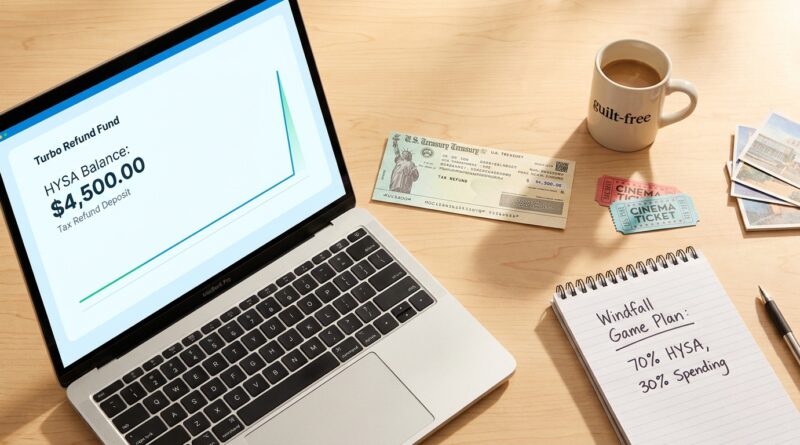
Here is the whole idea. Before your refund or bonus hits, decide exactly what percentage goes straight into your HYSA. Then move it immediately.
A simple version that works
Try this rule:
- 70 percent to your high-yield savings account
- 20 percent to one practical goal, like paying down a credit card or building your checking cushion
- 10 percent for guilt-free fun
This works because it respects real life. You are not telling yourself you must be perfect. You are making sure most of the money sticks.
If your refund is $2,400, that means $1,680 goes to savings right away. Even if the remaining $720 gets used quickly, you still made real progress.
Why this beats APY shopping alone
People spend a lot of time comparing savings rates down to the decimal point. That is fine. Yields matter. But the bigger difference often comes from whether the money makes it into the account at all.
If one person earns a slightly lower rate but consistently moves windfalls into savings, and another person keeps hunting for the best advertised APY while spending half their refund first, the first person usually comes out ahead.
That is the quiet truth. The habit creates the balance. The rate helps it grow.
How one windfall can create three years of extra interest
This is where the turbocharge idea gets interesting. A single refund does not just earn interest once. It can sit there and keep earning for years, and it can also help you build the reflex to repeat the move next year.
Let’s use a rough example
Say you get a $3,000 refund and move $2,100 into a HYSA at 4.25% APY.
If you leave it alone for one year, you earn roughly $89 in interest. Leave that balance in place for three years, and with compounding, you earn more without adding another dime.
Now add the real-world part. Once you have a successful “send the windfall first” habit, next year’s refund or bonus is more likely to join it. That is where the extra interest starts stacking in a way that feels almost unfair, in a good way.
The first deposit matters. The repeated ritual matters even more.
Set up the transfer before the money arrives
This is the step people skip.
Do not wait until your refund lands and then decide what to do. By then, your brain has already started spending it.
Do this instead
Before refund season or bonus season, take 10 minutes and:
- Pick your percentage or dollar amount
- Make sure your HYSA is open and linked
- Name the savings goal something specific, like “Emergency Buffer” or “Next Car Fund”
- Set a calendar reminder for the week you expect the money
- If possible, split the deposit automatically
The less thinking required in the moment, the better.
What if you also have debt or bills?
You do not have to choose between being responsible and building savings.
If you are carrying very high-interest credit card debt, it may make sense to send a good chunk there. But many people do better with a split approach because savings keeps you from running the card balance back up after one surprise expense.
That is why the 70-20-10 model works for so many households. It gives your money more than one job.
A flexible version
- If you have no emergency savings, make HYSA the top priority
- If your credit card APR is brutal, increase the debt slice
- If you are already in good shape, send even more of the refund to savings
The exact percentages can change. The habit should not.
How to pick the right HYSA for this strategy
You do not need the fanciest account on earth. You need one you will actually use.
Look for these basics
- Competitive APY
- No monthly maintenance fee
- FDIC or NCUA insurance
- Easy transfers to and from checking
- A clean app or website you will not hate using
If opening a separate HYSA keeps your refund out of sight, that can help a lot. A little friction is sometimes your friend.
Make windfalls part of your larger savings system
Once this works with a tax refund, use the same move for bonuses, side-gig payments, rebate checks, and cash gifts. Windfalls are where a lot of hidden savings potential lives.
And if your income goes up later, pair this with The ‘Hidden-Raise Auto‑Split’ Habit: Give Your HYSA A Pay Bump Every Time Your Income Jumps. That is the next-level version of the same idea. More money comes in, and a chunk gets routed before lifestyle creep can grab it.
Common mistakes that quietly undo the plan
1. Waiting to “see what is left”
This almost never works. Leftover money is a myth for most people.
2. Sending all of it to checking first
If the full amount lands where you normally spend, it starts blending into daily life immediately.
3. Making the savings goal too vague
“Save more” is weak. “Build a $5,000 emergency cushion” is much easier to protect.
4. Treating one good move like permission to spend the rest carelessly
Celebrate a little if you want. Just decide the fun slice ahead of time.
A small ritual that makes this stick
When the transfer goes through, take a screenshot or write down the new balance. That sounds minor, but it gives your brain proof that the money did something real.
People repeat behaviors that feel visible. Watching your HYSA jump by $1,500 or $2,000 is motivating in a way that “I was probably more responsible this year” is not.
At a Glance: Comparison
| Feature/Aspect | Details | Verdict |
|---|---|---|
| Move timing | Transfer part of the refund to your HYSA the same day it arrives, or automate the split if possible. | Best way to stop drift and impulse spending. |
| Savings rule | Use a simple formula like 70 percent savings, 20 percent practical use, 10 percent fun. | Realistic and easy to repeat every year. |
| APY focus | A competitive HYSA matters, but getting the windfall into the account matters more than squeezing out a tiny extra rate. | Habit first, yield second. |
Conclusion
The smartest answer to how to use tax refund for high yield savings is surprisingly simple. Decide the rule before the money arrives, send a set chunk to your HYSA immediately, and let the habit do the heavy lifting. Right now, savers are being told to hunt for the highest advertised APY, but a lot of the real upside gets lost because windfalls are handled emotionally instead of by routine. Most people expect extra cash like refunds or bonuses, yet only a small group actually moves that money into higher-yield accounts where it can keep growing. That means you can quietly pull ahead by doing one practical thing at the exact right moment. Give the money a job as soon as it hits. You do not need to stop enjoying small treats or become a totally different person with money. You just need one repeatable ritual that helps more of your windfall finally stick.