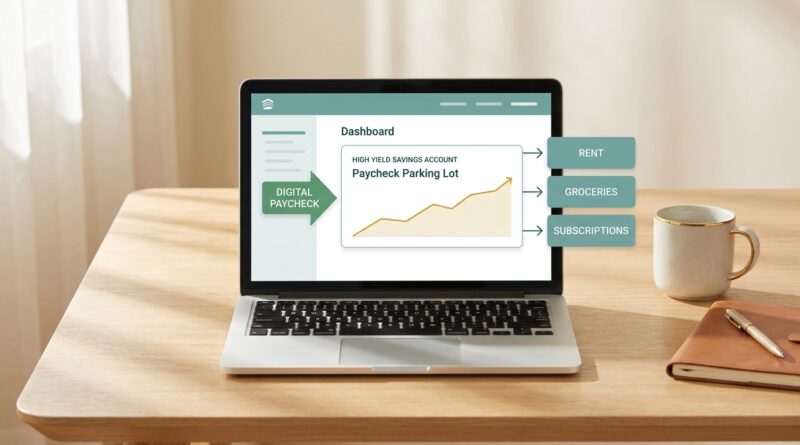
The ‘Paycheck Parking Lot’ HYSA Habit: Earn Interest On Money You Were Going To Spend Anyway
You know this feeling. Payday hits, you feel briefly ahead, and then your money just camps out in checking while rent, utilities, subscriptions, and card payments slowly pull it away. It is frustrating because you did the hard part already. You earned the money. But while it waits to be spent, it earns next to nothing. That is where a simple high yield savings paycheck strategy can help. Instead of letting each paycheck sit idle in checking, you move the portion meant for upcoming bills into your high yield savings account, then transfer it back only when needed. You are not investing it. You are not changing your bills. You are just giving your money a better parking spot for a few extra days or weeks. If you already have an emergency fund and a HYSA, this is one of the easiest ways to squeeze a little more value out of money you were going to spend anyway.
⚡ In a Hurry? Key Takeaways
- Use your HYSA as a short-term parking lot for paycheck money that will not be needed for several days.
- Keep a small checking buffer, move the rest to HYSA on payday, and transfer money back a few days before bills hit.
- This works best if your emergency fund is already set and you watch transfer timing so you do not trigger overdrafts or late payments.
What the “paycheck parking lot” habit actually is
This is not a budget overhaul. It is more like a routing tweak.
On payday, you leave enough in checking to cover near-term spending and a safety cushion. Then you move the rest, including money for bills due later in the month, into your high yield savings account. As due dates get closer, you send that money back to checking.
The goal is simple. Let your cash earn interest during the days it would otherwise be doing nothing.
For people using a high yield savings paycheck strategy, the win is not magic. It is just better timing.
Why this works better now
When savings rates are low, the difference between checking and a HYSA can feel too small to bother with. Right now, many HYSAs still pay several times more than standard checking.
That means the “float time” between payday and bill day has real value. Maybe not retire-early value, but real money over a year.
If your paycheck lands on the 1st and your mortgage is not due until the 10th, that money has about a week where it could be earning something instead of nothing. Multiply that by every bill, every month, and it adds up.
Who this habit is best for
This approach is a good fit if:
- You already have a high yield savings account
- You already keep at least a basic emergency fund
- Your bills are fairly predictable
- You are comfortable checking account balances once or twice a week
It is probably not the best first move if you are often close to overdrafting, your income is irregular, or your bill dates are chaotic.
How to set it up without making your life harder
1. Keep a checking buffer
This is the boring but important part. Do not drain checking down to the dollar.
Leave a buffer that covers random card holds, a forgotten subscription, or a bill that posts a day early. For some people that is $200. For others it is $1,000. The right number is the one that helps you sleep at night.
2. Map your bill timing
Look at when your biggest bills actually leave your account, not when the statement arrives. Rent, mortgage, utilities, insurance, credit cards, streaming, phone bill. Write down the real withdrawal dates.
This gives you a clear picture of how long your money can stay parked in HYSA.
3. Move “not needed yet” money on payday
Once the paycheck clears, transfer the amount that will not be used for several days into your HYSA. You can do this manually or with an automatic rule if your bank supports it.
Some people send over everything except their checking buffer and weekly spending money. Others only move bill money. Either can work.
4. Transfer money back before bills post
Do not wait until the morning a payment is due. ACH transfers can take time. A safer habit is to move money back two to three business days early, especially for large bills.
That gives you room for weekends, bank cutoffs, and processing delays.
A simple example
Let’s say you are paid $3,000 twice a month.
On the 1st, your paycheck lands. You know your rent is due on the 8th, your car insurance on the 14th, and your credit card on the 18th. You keep $700 in checking for groceries, gas, and a buffer. You move $2,300 to your HYSA.
On the 5th, you transfer rent money back. On the 11th, you transfer back insurance money. On the 15th, you transfer back the credit card payment.
Nothing about your bills changed. But now that money earned interest while it waited.
Common mistakes to avoid
Moving too much out of checking
This is the biggest one. If you leave checking too lean, one surprise charge can ruin the whole system.
Ignoring transfer times
Not every transfer is instant. Some banks are quick. Some are not. Test your setup with a small amount first so you know the real timeline.
Using the HYSA like a spending account
The account is a parking lot, not a debit card substitute. Keep your actual spending in checking so you do not create a messy shuffle every other day.
Forgetting rate changes
HYSA rates can move. This habit is still useful even if rates dip, but it is smart to check once in a while that your account is still competitive.
How much can you really earn?
Probably not a fortune. Let’s be honest.
But if you regularly keep a few thousand dollars parked for one to three weeks at a time, the extra interest over a year can be noticeable. It may cover a utility bill, part of a holiday budget, or just pad your savings a little faster.
The bigger point is this. It is earned on money you were already going to have sitting around. No side hustle required.
Make it easier with one extra habit
If this strategy clicks for you, pair it with automatic increases to savings whenever income rises. That way your system gets stronger over time, not just smarter between paydays. A good next read is The ‘Hidden-Raise Auto‑Split’ Habit: Give Your HYSA A Pay Bump Every Time Your Income Jumps.
At a Glance: Comparison
| Feature/Aspect | Details | Verdict |
|---|---|---|
| Effort required | A few transfers per month, plus a one-time setup of your bill calendar and checking buffer. | Low-friction once you build the routine. |
| Potential payoff | Extra interest on money that would otherwise sit in checking earning little or nothing. | Worth it for organized savers, even if the gains are modest. |
| Risk to watch | Mistiming transfers can lead to overdrafts, stress, or late payments if your checking cushion is too small. | Safe if you keep a buffer and transfer early. |
Conclusion
If your paycheck usually lands in checking and then slowly leaks out through the month, this is a smart fix. Right now, with many high yield savings accounts paying several times more than standard checking, unused days in checking are basically lost yield. Turning your HYSA into a short-term parking lot for each paycheck lets you earn interest on money that used to lie idle, without changing your lifestyle or bill due dates. It is a realistic, low-friction upgrade for people who already have an emergency fund and a HYSA but feel like they are not squeezing everything they can out of current rates. Small habit, better parking spot, extra money.