The ‘Two-Home Cash Split’ Habit: Stop Parking All Your Savings In The Wrong Place
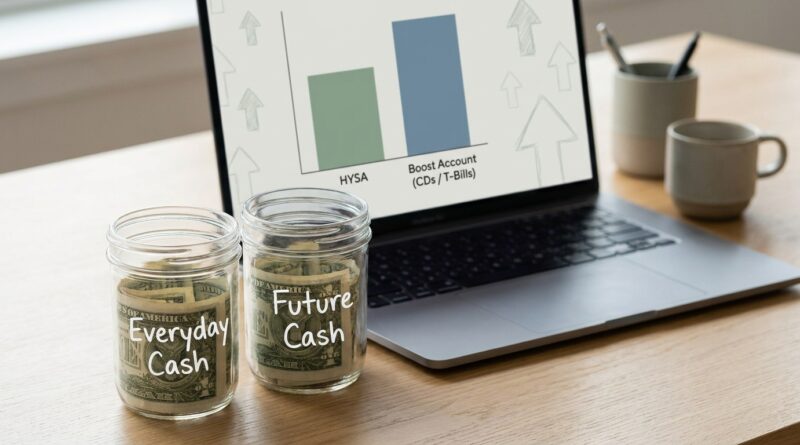
If you finally have a decent cash cushion, this question gets weirdly stressful fast. You want your money safe. You want it easy to reach. But you also do not want to watch it sit in the wrong account while better rates pop up somewhere else. That is why so many people get stuck on the “where to park cash high yield savings vs cd” debate. The good news is you do not need one perfect account. You need two jobs for your cash. Think of it as a two-home split. Keep one chunk in an everyday high-yield savings account for fast access. Park the rest in a higher-yield second home, usually a CD, Treasury bill, or money market fund, depending on when you might need it. That simple split helps you stay liquid, earn more, and stop second-guessing every Fed headline.
⚡ In a Hurry? Key Takeaways
- Do not park all your cash in one place. Keep emergency money in a HYSA and move extra cash to a higher-yield second home like a CD or T-bill.
- A simple rule works well: keep 1 to 2 months of core expenses in your everyday HYSA, then send the rest of your cash reserve to the best safe option for your timeline.
- Safety still matters more than squeezing out every last fraction of a percent. Stick with FDIC-insured banks, NCUA-insured credit unions, or U.S. Treasurys.
Why this feels harder than it should
Cash used to be simple. You had a savings account. End of story.
Now you are seeing high-yield savings accounts, CDs, money market accounts, money market funds, Treasury bills, and endless “best rates today” lists. One week a HYSA looks great. Then a CD jumps ahead. Then the Fed hints at cuts and suddenly locking a rate sounds smart. It is enough to make people freeze.
The trap is thinking you must pick one winner. Most savers do better with a split.
The two-home cash split habit
Here is the habit.
Home #1: Your everyday cash home
This is your high-yield savings account. It holds the money you may need soon or without warning.
Examples:
- Your emergency fund base
- This month’s big bills
- Car repair money
- Insurance deductibles
- Anything that needs quick transfer access
This account is about access first, yield second.
Home #2: Your higher-yield second home
This holds cash you probably will not need tomorrow, but still want to keep safe.
Good options include:
- CDs if you can leave the money alone for a set term
- Treasury bills if you want government-backed safety and often strong short-term yields
- A competitive money market fund if you are comfortable using a brokerage account
This account is about earning more without taking stock market risk.
So, where should you park cash: high yield savings vs CD?
Here is the plain-English answer.
If you might need the money anytime, use a high-yield savings account.
If you know you will not need the money for a few months or longer, a CD can make sense, especially if its rate is better than your HYSA and you want to lock it in before rates slide.
That is the heart of the high yield savings vs CD question. It is less about which product is “best” and more about matching the product to the job.
Choose a HYSA when:
- You need fast access
- You are still building your emergency fund
- You hate withdrawal penalties
- You want flexibility if life changes suddenly
Choose a CD when:
- You have extra cash beyond your immediate emergency buffer
- The CD rate beats your HYSA by enough to matter
- You can leave the money untouched until the term ends
- You think rates may drop and want to lock in today’s yield
A simple split that works for most people
You do not need a spreadsheet masterpiece.
Try this:
- Keep 1 to 2 months of essential expenses in your HYSA
- Keep any near-term sinking funds there too
- Move the rest of your cash reserve to a second home with a better yield
Example:
If your essential monthly expenses are $3,000 and you have $18,000 in cash savings, you might keep $6,000 in your HYSA for quick access. The remaining $12,000 could go into a short CD, T-bill, or another safe option with a stronger rate.
That way, you are not locking up your full emergency fund. But you are also not letting all $18,000 sit in the most basic setup just because it feels easier.
How to pick the best second home
This depends on your timeline.
If you may need the money in under 3 months
Stay mostly in a HYSA or use a very short Treasury bill. Flexibility matters more than squeezing out a tiny extra return.
If you likely will not need it for 3 to 12 months
This is solid CD or T-bill territory. Compare rates and check the fine print.
If you want less rate-chasing drama
Short-term CDs or a simple ladder can help. If that idea sounds useful, read The 24-Hour ‘Lazy Ladder’ Habit: How To Lock In Today’s Best HYSA Rate Without Rate-Chasing Burnout. It is a good next step if you are tired of opening twenty tabs every time rates move.
Common mistakes people make
1. Keeping every dollar in checking
This is the most expensive version of “playing it safe.” Your money stays convenient, but it quietly earns next to nothing.
2. Locking up too much in a CD
Yes, CDs can pay well. But if you lock up all your cash and then need it, the penalty wipes out some of the benefit. Keep your first home funded first.
3. Chasing the absolute top rate every week
This burns people out. A very good setup that you actually maintain beats the perfect rate that requires constant account hopping.
4. Ignoring safety
If it is cash savings, make sure you know what protection you have. FDIC insurance for banks. NCUA insurance for credit unions. Treasurys are backed by the U.S. government. With money market funds, understand that they are investments held at brokerages, not bank accounts.
What about money market accounts and money market funds?
This is where the names get annoying.
Money market account
This is usually a bank or credit union product. Think of it as a cousin to a savings account. It may offer a decent rate and limited check-writing.
Money market fund
This is an investment product in a brokerage account. It often holds very safe short-term debt and can offer competitive yields, but it is not the same as an FDIC-insured savings account.
For many non-techie, non-finance people, a HYSA plus a CD or Treasury bill is the cleaner setup. Fewer moving parts. Less confusion.
When Treasury bills beat both
T-bills deserve a quick mention because they often get left out of the basic HYSA vs CD conversation.
They can be especially attractive if:
- You want short-term parking spots like 4, 8, 13, or 26 weeks
- You want to lock in a yield without bank shopping
- You like that Treasury interest is exempt from state and local income taxes
The downside is convenience. Buying and managing T-bills is a little less plug-and-play than opening a savings account. Not hard, just less familiar.
The low-drama rule to remember
Cash has two jobs. Protect you, and pay you.
If all your money is fully liquid, you may be underpaid.
If all your money is locked up, you may be overcommitted.
The sweet spot is a split.
At a Glance: Comparison
| Feature/Aspect | Details | Verdict |
|---|---|---|
| High-yield savings account | Easy access, variable rate, ideal for emergency cash and short-term needs | Best first home for cash you may need anytime |
| CD | Fixed rate for a set term, early withdrawal penalty if you need the money too soon | Best second home for extra cash you can leave alone |
| Treasury bill or money market option | Can offer strong short-term yields, but may be slightly less familiar or less simple than a bank savings account | Good alternative if you want safety and a competitive yield beyond your HYSA |
Conclusion
The big win here is not finding a magical perfect account. It is building a repeatable habit. Keep your everyday cash in a solid HYSA. Give the rest of your savings a second home where it can earn a little harder, whether that is a CD, a Treasury bill, or another safe option that fits your timeline. That simple move cuts through all the noise around rates, Fed moves, and product comparisons. It helps you stay ready for real life while still getting paid better on money that would otherwise sit still. For savers who finally have meaningful balances, that is a quiet but powerful upgrade. Small habit. Low drama. Real payoff.