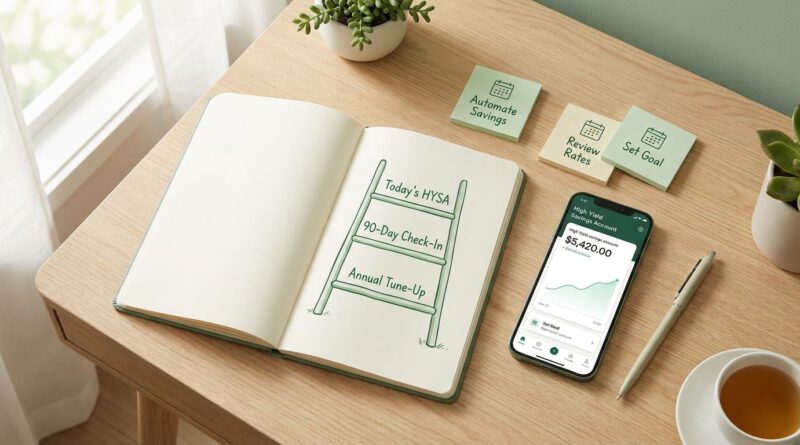
The 24-Hour ‘Lazy Ladder’ Habit: How To Lock In Today’s Best HYSA Rate Without Rate-Chasing Burnout
You know the drill. You open one tab to compare high-yield savings accounts, then five more. One bank has a great rate but weird transfer limits. Another has a bonus that looks good until you read the fine print. A third is 0.10% higher, but now you are wondering if rates will change next week and make your choice look dumb. So you do nothing. That is the real problem. Not picking a decent HYSA is usually worse than picking one that is merely very good.
If you are trying to figure out how to choose the best high yield savings account without rate chasing, the answer is simpler than most comparison pages make it seem. Pick one strong account today using a short checklist, move your cash, then schedule just two review dates over the next 12 months. I call it the 24-Hour Lazy Ladder. It helps you earn a top-tier rate now without turning savings into a part-time job.
⚡ In a Hurry? Key Takeaways
- Choose a HYSA by using a short filter: competitive APY, FDIC or NCUA insurance, no monthly fee, easy transfers, and no annoying balance rules.
- Give yourself 24 hours to pick one good account, fund it, and set two calendar check-ins instead of watching rates every week.
- When HYSAs, money market accounts, and short CDs are paying similar returns, convenience and access often matter more than squeezing out the last tiny fraction of a percent.
The real enemy is not a bad rate. It is decision fatigue.
Most people are not avoiding a HYSA because they do not care. They are avoiding it because the choices all look almost the same, and the differences are buried in details that are easy to overthink.
That is especially true right now. High-yield savings accounts, money market accounts, and short-term CDs are often clustered pretty close together. That makes the hunt for the absolute best deal feel important, even when the real-world difference may be small.
If one account pays 4.40% and another pays 4.55%, that gap matters less than the fact that your current bank might still be paying 0.01% or 0.10%.
So the goal is not perfection. The goal is getting your cash into a strong account quickly and with as little mental drag as possible.
What the 24-Hour Lazy Ladder habit looks like
This is a behavior system, not a spreadsheet contest.
Step 1: Give yourself one day, not one month
Set a 24-hour deadline. By tomorrow, you will choose one account and start the transfer.
This matters because open-ended research expands forever. A short deadline forces you to focus on what actually counts.
Step 2: Use a five-point filter
When comparing accounts, ignore most of the noise and check only these five things:
- Competitive APY. It does not have to be the number-one rate in America. It should simply be in the top tier right now.
- FDIC or NCUA insurance. This is non-negotiable. Your deposits should be protected up to the standard limits.
- No monthly maintenance fee. A fee can wipe out the benefit of a slightly better rate.
- Easy transfers. Make sure linking your regular checking account and moving money in or out is straightforward.
- No frustrating rules. Watch for minimum balances, transaction hassles, or hoops to earn the advertised rate.
If an account checks all five boxes, it is a contender. If it misses one or two, move on.
Step 3: Pick the best fit, not the highest number
If two or three accounts look good, choose the one from the bank or credit union that feels easiest to live with.
That can mean a cleaner app, faster transfers, better customer service hours, or fewer restrictions. This is your cash cushion, not a game show. Smooth access matters.
Step 4: Move the money now
Once you choose, fund the account right away. Even if you start with part of your savings today and move the rest after a test transfer, do something before the day ends.
The biggest return jump comes from leaving a near-zero savings rate behind.
Step 5: Schedule two review dates
This is the lazy ladder part. Put two reminders on your calendar right after you open the account:
- Review #1 in 6 months
- Review #2 in 12 months
That is enough for most savers. You stay aware without becoming obsessed. If rates move a lot, you will catch it. If they do not, you save yourself hours of pointless checking.
How to choose the best high yield savings account without rate chasing
Here is the short answer. Choose a top-tier HYSA that is insured, fee-free, and easy to use. Then stop shopping.
That last part is important. Rate chasing sounds smart, but for many people it creates three problems:
- You delay opening anything at all.
- You keep moving money for tiny gains.
- You burn time and attention that are worth more than the extra dollars.
If you are moving a very large cash balance, tiny APY differences may be worth a closer look. But for many households, the convenience cost can outweigh the benefit.
For example, a 0.15% APY gap on $10,000 is about $15 a year before taxes. That is real money, but it is not enough to justify endless account hopping for most people.
When a money market account or short CD might make sense instead
Sometimes a HYSA is not the only good answer.
Choose a money market account if you want flexibility
Money market accounts can offer rates similar to HYSAs while sometimes adding limited check-writing or debit access. If you want a bit more access without moving back to a low-rate bank account, it can be a decent middle ground.
Choose a short CD if you know you will not need the cash
If part of your savings is truly hands-off for a few months, a short CD can make sense. Just remember that CDs trade flexibility for certainty. If rates rise after you lock in, you may feel stuck. If you need the money early, penalties can apply.
That is why many people are happiest using a HYSA for their emergency fund and only using CDs for money with a clear no-touch timeline.
A simple way to split your cash if you are still unsure
You do not have to make one giant all-or-nothing decision.
Try this:
- Keep your monthly spending money in checking.
- Put your emergency fund in a HYSA.
- If you have extra cash beyond that and will not need it soon, consider a short CD for a portion.
This approach lowers the pressure. You are not trying to crown one perfect account for every purpose. You are just giving each pile of money a job.
And once your HYSA is open, a small habit can help you earn more without much effort. The 10-10-10 ‘HYSA Boost’ Habit: One Tiny Rule That Quietly Doubles Your High-Yield Gains is a good next step if you want an easy way to keep feeding the account after you open it.
Red flags that are actually worth your attention
You do not need to read every line of legal text. But you should watch for a few common problems.
- Promotional rates that expire quickly
- Requirements to keep a large minimum balance
- Monthly fees or inactivity fees
- Hard-to-find transfer limits
- Long transfer times that make access annoying
- Accounts that are not clearly FDIC or NCUA insured
If you spot any of these and they feel like a hassle, move on. There are too many solid options to settle for one that makes saving harder.
What if rates fall right after you open the account?
This is the fear that keeps people stuck.
Here is the good news. If rates fall, they usually fall across many banks, not just yours. You did not make a bad choice. You made a smart choice based on the information available when your money was sitting idle.
The same goes if another bank pops up with a slightly better rate next week. That does not mean you failed. It means the market moved, which is exactly why you set review dates instead of trying to guess every twist in advance.
Your savings account is a tool. It does not need to be perfect every day. It needs to work well for you most of the time.
At a Glance: Comparison
| Feature/Aspect | Details | Verdict |
|---|---|---|
| Top APY vs good APY | The highest advertised rate may beat a solid competitor by only a tiny margin. | Pick a top-tier rate, not necessarily the absolute highest one. |
| HYSA vs money market | Both can pay strong yields. Money market accounts may offer a little more access. | Choose based on convenience and access needs. |
| HYSA vs short CD | Short CDs can lock in a rate, but your money is less flexible and early withdrawal can cost you. | Use CDs only for cash you truly will not need soon. |
Conclusion
If your cash is still parked in a low-paying account, the best move is usually not more research. It is action. Right now high-yield savings, money market accounts and even short CDs are paying unusually similar returns, which makes the choice feel harder than it needs to be. The 24-Hour Lazy Ladder cuts through that. Pick one strong HYSA today using a short checklist, move your money, and set two easy review dates for later. That way you stop losing interest while waiting for some perfect account that probably never shows up. A good account opened now beats a great account you never get around to choosing.