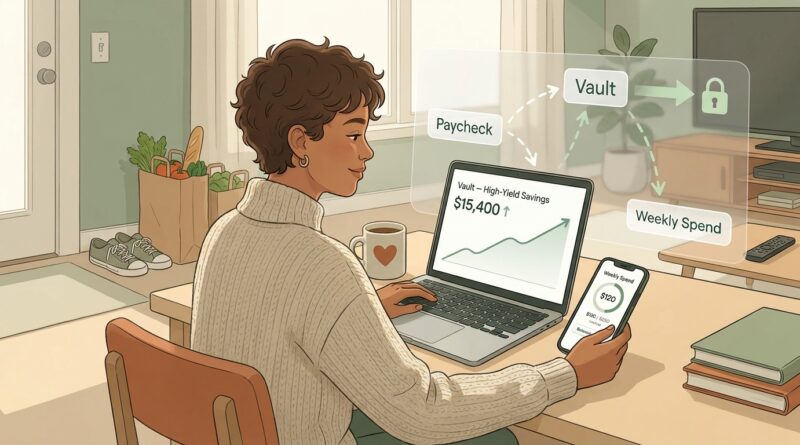
The ‘Two-Account Speed Bump’ Habit: Make Spending Slightly Hard So Your High-Yield Savings Grows On Autopilot
You are not bad with money because your checking account keeps emptying out. A lot of people do the same thing. They get paid, feel a little breathing room, then a dinner out, a flash sale, a few taps on a phone, and the extra cash is gone. That is frustrating, especially when you really do want to save more. The good news is you do not need a perfect budget or a color-coded spreadsheet to fix it. One of the best high yield savings habits to stop overspending is simply creating a small amount of friction between your spending money and your savings money. I call it the two-account speed bump. Your checking account handles bills and fun money. Your high-yield savings account holds the rest. Because moving money back takes a little effort and a little time, you spend less on impulse and save more without thinking about it all day.
⚡ In a Hurry? Key Takeaways
- The two-account speed bump works by keeping only a planned amount in checking and moving the rest to a high-yield savings account automatically.
- Set one automatic transfer right after payday, then use your checking account as your spending limit for the week or month.
- This habit is simple, low-stress, and helps curb impulse spending while your savings earns more interest in the background.
Why this works better than “just have more discipline”
Discipline is great until real life shows up.
You are busy. You are tired. Your friends want to go out. Your favorite store sends a discount code. None of that means you are reckless. It means you are human.
The problem with keeping all your extra cash in checking is that checking accounts are designed for movement. Money flows in. Money flows out. If your full financial life sits in one easy-to-reach place, overspending gets too easy.
The fix is not to stare at a budget app all day. The fix is to change the route your money takes.
What the two-account speed bump habit actually is
This habit is simple.
You use two main accounts:
- A checking account for bills, groceries, weekend plans, and everyday spending
- A high-yield savings account for the money you want to keep and grow
Then you set up an automatic transfer so that soon after payday, most of your extra money moves out of checking and into savings.
That leaves your checking account with a set amount. Not zero. Not deprivation. Just a clear limit.
If you want to spend beyond that amount, you have to manually move money back from savings. That extra step is the speed bump. It is not a wall. It is just enough friction to make you pause and ask, “Do I really want this?”
Why a high-yield savings account matters here
A regular savings account can hold your money. A high-yield savings account lets that money work a little harder while it sits there.
That matters because the goal is not only to stop overspending. It is also to reward yourself for not spending.
When your savings is parked in a high-yield account, you are more likely to leave it alone because it feels separate and purposeful. It is not just idle cash. It is money earning something while it waits.
If you are still figuring out how to keep that account useful without treating it like an everyday cash machine, this guide on The ‘ATM-Proof’ Habit: How To Use A High-Yield Savings Account Without Getting Slapped With Fees is a smart next read.
How to set this up in real life
Step 1: Keep your checking account boring
Your checking account should have a job description. It is there to pay monthly bills and cover normal spending.
That is it.
It should not also be your long-term savings pile, your vacation fund, your emergency fund, and your “I might need this later” stash.
Step 2: Pick your checking cushion
Decide how much money you want sitting in checking between paychecks.
For some people, that is one week of spending money. For others, it is their monthly bills plus a comfortable buffer. The right number is the one that keeps you from overdrafting but does not leave so much extra cash lying around that every impulse purchase feels harmless.
Step 3: Move the rest automatically
As soon as your paycheck lands, schedule an automatic transfer into your high-yield savings account.
The timing matters. If you wait to “see what is left over,” there usually is not much left over.
Saving first is what makes this habit run on autopilot.
Step 4: Let checking be the limit
Once the transfer happens, your checking balance becomes your built-in spending boundary.
You can still go out. You can still buy the occasional treat. You can still enjoy your life. You are just doing it inside a lane that protects your bigger goals.
Step 5: Make savings slightly annoying to access
Not impossible. Slightly annoying.
That means no debit card tied to savings, no instant mental habit of moving money back every other day, and no treating it like backup spending cash.
If buying something requires a transfer and a waiting period, you will naturally skip a surprising number of nonessential purchases.
What this looks like with real numbers
Let’s say you bring home $3,000 a month.
You decide your bills and normal spending need $2,200 in checking. You also want a $300 cushion there so life feels manageable.
That leaves $500.
Instead of hoping you “do better” this month, you automatically move that $500 to your high-yield savings account after each paycheck or once per month, depending on how you get paid.
Now the money is out of your daily line of sight. Your checking account tells you what is available. Your savings starts growing in the background.
You have not tracked every coffee. You have not built a 17-category budget. You have just made overspending harder.
Common mistakes that make this habit fail
Leaving too much in checking
If checking still feels flush all month, the speed bump is too small. Trim the amount until it gives you a useful boundary.
Making savings your second checking account
If you transfer money back every weekend, the system is not protecting you. That usually means your checking cushion is unrealistic or your fun money needs a better limit.
Setting the transfer too late
If savings happens at the end of the month, spending usually gets first dibs. Move money right after payday.
Using guilt instead of design
This habit works because it changes your setup, not because it makes you feel bad. The point is to reduce temptation, not judge yourself every time you want takeout.
Who this habit is best for
This works especially well if you:
- Keep dipping into savings for random spending
- Feel overwhelmed by strict budgeting
- Earn enough to save, but somehow never see the savings pile grow
- Want a system that feels low-maintenance
- Still want room for dinners out, small treats, and normal life
It is a practical middle ground. Not extreme. Not perfect. Just smart.
Why this feels easier than a full budgeting overhaul
A lot of money advice makes people feel like they need to become part-time accountants.
Track every purchase. Review every category. Cut every pleasure. Optimize every detail.
That is exhausting. It is also why many people quit.
The two-account speed bump habit is lighter. It asks one big question instead of a hundred small ones: how much money should stay easy to spend?
Once you answer that, the system does the heavy lifting.
At a Glance: Comparison
| Feature/Aspect | Details | Verdict |
|---|---|---|
| Setup effort | Requires one checking account, one high-yield savings account, and an automatic transfer after payday. | Easy to start and easy to maintain. |
| Impact on overspending | Reduces impulse spending by keeping extra cash out of your main spending account. | Very effective for people who spend what they can see. |
| Lifestyle flexibility | Still allows fun spending, but inside a clear limit that protects long-term savings. | Best for people who want balance, not a money lockdown. |
Conclusion
You do not need to become a budgeting superhero to save more. If all the “optimize everything” advice has made you want to give up, this is a better place to start. The two-account speed bump habit works because it does not ask you to track every dollar or obsess over every purchase. It simply changes the path your money takes so saving happens first and spending happens within a limit. That is why it is one of the most useful high yield savings habits to stop overspending. You still get to enjoy dinners out, little treats, and a life that feels like yours. You just stop letting every extra dollar sit in the easiest possible place to disappear. Small friction can create big results, and your high-yield savings account gets the benefit quietly, month after month.