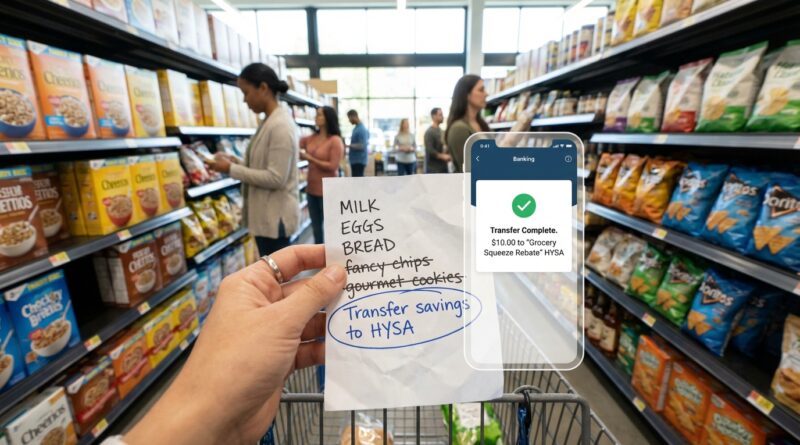
The ‘Grocery Shrinkflation To HYSA’ Habit: Turn Sneaky Price Hikes Into Automatic High-Yield Savings
You are not imagining it. The cereal box feels lighter, the snack bag looks puffier than it should, and somehow your usual grocery run now costs $20 more. That is the nasty mix of shrinkflation, price creep, and impulse buying doing its work. It is frustrating because it makes you feel careless, when really the store is full of tiny traps. The good news is you do not need to swear off your favorite foods or become the person comparing bean prices for an hour. A smarter move is to turn those small grocery “saves” into something visible. If you skip the marked-up brand, catch a smaller package pretending to be the same deal, or leave the random checkout treat behind, transfer that difference into a high-yield savings account right away. Give it a name like “Grocery Squeeze Rebate.” That way, your money stops vanishing at the register and starts earning something back.
⚡ In a Hurry? Key Takeaways
- Use a simple grocery savings hacks high yield savings habit: when you spend less than expected, move the difference into your HYSA immediately.
- Watch unit prices, package sizes, and impulse buys. Those three areas hide a lot of extra spending.
- You do not need perfect budgeting. Even $3 here and $8 there can build a real cash cushion over time.
Why this habit works so well right now
Most money advice fails at the grocery store because it asks too much. Cook every meal from scratch. Switch every brand. Clip every coupon. That sounds great until it is 6 p.m. and you just want to get home.
This habit is different. It works with real life.
Instead of trying to become a perfect saver, you just notice the gap between what you almost spent and what you actually spent. Then you move that amount into a high-yield savings account, or HYSA, before it gets absorbed by takeout, subscriptions, or a mystery Target run.
That is the key. The money needs a job right away.
What counts as a “grocery squeeze rebate”
Think of this as your personal refund from shrinkflation and impulse shopping. A few common examples:
You caught shrinkflation
Your usual crackers used to be 12 ounces and now they are 10.5, but the shelf price is the same or higher. You pick a better-value option and save $2.50. Transfer $2.50.
You skipped an impulse buy
You almost tossed in sparkling drinks, candy at checkout, or the fancy dip you did not plan for. You leave it behind and save $6. Transfer $6.
You bought the sale item instead of the usual one
Your go-to coffee is $11.99, but a similar one is on sale for $8.99. Transfer $3.
You changed stores or brands once
If one stop at Aldi, Costco, Walmart, Trader Joe’s, or your local market saved you $14 on the same basics, that difference can go into savings too.
The point is not to track every penny like a detective. It is to grab the obvious wins and turn them into something useful.
How to start the grocery savings hacks high yield savings habit
1. Open or pick a HYSA
A high-yield savings account usually pays more interest than a standard savings account. You are not going to get rich on the interest alone, but it is still better than parking the money somewhere earning next to nothing.
Name the savings goal something specific. “Grocery Squeeze Rebate” works because it reminds you where the money came from.
2. Set a quick transfer rule
Make the rule easy enough that you will actually do it.
Good examples:
- Transfer anything over $3 that you saved on a grocery trip.
- Round every grocery save up to $5.
- Make one transfer after each weekly grocery run.
- Do a Sunday night catch-up transfer from your notes app.
3. Use your phone while shopping
You do not need a spreadsheet in aisle seven. Just keep a note on your phone called “grocery rebate.” If you skip a $4 snack or switch to a cheaper pasta sauce and save $2, jot it down.
By the time you get to the car, you might have $9 or $12 worth of savings to move.
4. Transfer it fast
This part matters most. If you wait a week, that money mentally disappears. If you transfer it the same day, it starts feeling real.
How to spot shrinkflation without making shopping miserable
You do not need to inspect every label like a lab technician. Just pay attention to a few patterns.
Check the unit price
The shelf tag often shows the cost per ounce, pound, or count. That number is your best friend when packaging changes. A smaller “sale” size is often a worse deal.
Watch for redesigned packaging
When a product suddenly has “new look” packaging, check the size. Sometimes it really is just a new label. Sometimes it is less product in a shape that hides the difference.
Notice when a product suddenly runs out faster
If the bag of chips or tub of yogurt seems to disappear a day earlier than usual, trust that instinct. You may be buying less for the same money.
Compare store brands honestly
Not every generic is good. But many are. If the store version is just as good and saves you $1.75 each week, that is a meaningful little stream of money over time.
Impulse aisles are small budget leaks
Most people do not blow their grocery budget in one dramatic moment. It leaks out in little decisions.
A drink here. A bakery item there. A second frozen dessert because it is “only four dollars.”
That is why this habit works. It turns the small victory into a reward you can see later.
Try this rule: if it was not on your list and you leave it behind, some or all of that amount goes to the HYSA.
You are not punishing yourself. You are paying your future self instead.
A simple real-world example
Say you walk into the store expecting to spend around $95.
- You switch cereal brands and save $2.20
- You skip a frozen pizza that was not on the list and save $7.00
- You catch that the “family size” chips are a bad unit-price deal and save $1.80
- You choose sale strawberries instead of out-of-season berries and save $3.50
Total saved: $14.50
Move $14.50, or even round it up to $15, into your HYSA.
Do that once a week and you are looking at around $60 a month. Keep it going for two months and you have a visible buffer. Add high-yield interest on top, and it starts feeling less like deprivation and more like progress.
Make it automatic if you know you forget
If you are the kind of person who means well and then completely forgets, set up a backup system.
Option 1: Weekly recurring transfer
Set a small automatic transfer to your HYSA every day after your usual grocery trip. Then adjust it up manually if you saved more.
Option 2: Round-up rule
If you estimate you saved $7.40, send $10. It is simple and easier to remember.
Option 3: Shared note with a partner
If two people shop for the household, keep one shared note. That way both of you can log savings and keep the game going.
What not to do
This habit should help you, not turn into homework.
Do not count fake savings
If you bought a giant pack of snacks you did not need just because it had a coupon, that is not really savings.
Do not chase every deal
Driving across town to save $1.50 on eggs is usually not worth it once you count time and gas.
Do not make the goal too strict
You are allowed to buy your favorite coffee creamer or brand-name pasta sauce sometimes. The habit is about noticing choices, not banning joy.
Why a HYSA is the right landing spot
The whole point is to keep this money accessible but separate. A checking account is too easy to drain. Cash in your wallet disappears. A HYSA gives the money a little distance and lets it earn more than a typical savings account.
This makes it useful for:
- An emergency grocery cushion
- Holiday food spending
- Back-to-school lunch costs
- A general emergency fund
And because the account has a name tied to the habit, you get a small psychological win every time you add to it.
At a Glance: Comparison
| Feature/Aspect | Details | Verdict |
|---|---|---|
| Shrinkflation spotting | Check unit prices and package sizes to avoid paying more for less. | Worth doing. Fast once it becomes a habit. |
| Impulse skip to HYSA | When you leave unplanned items behind, transfer that amount into savings. | One of the easiest ways to build savings without feeling deprived. |
| High-yield savings account | Keeps grocery savings separate and earning more interest than a standard savings account. | Best place for this kind of small but steady money. |
Conclusion
Grocery inflation is loud, annoying, and hard to avoid. That is exactly why this habit is so useful. You do not have to beat every price hike or give up every treat. You just need one clear move. Spot shrinkflation and impulse traps, notice what you almost spent versus what you actually spent, then send the difference to a HYSA with a name like “Grocery Squeeze Rebate.” It is simple, timely, and surprisingly satisfying. Over a month or two, those little grocery wins stop disappearing into the checkout lane and start becoming a real high-yield cushion. In a moment when food prices keep shifting, that small sense of control matters a lot.