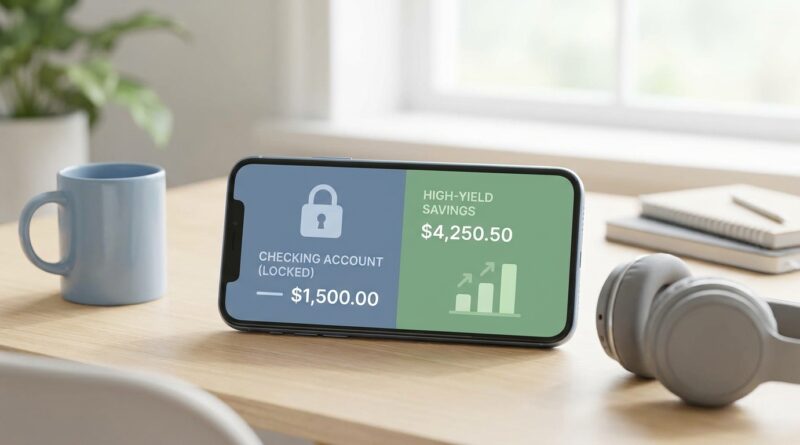
The ‘Low‑Balance Boost’ Habit: Turn Near‑Zero Checking Cash Into High‑Yield Interest Without Feeling Broke
You know that little checking account cushion you keep around “just in case”? Most of us do it. Maybe it is $200. Maybe it is $800. It feels comforting to see that extra money sitting there, ready for surprise groceries, a utility bill, or one of those months where everything hits at once. The problem is simple. That comfort is often costing you money. Big-bank checking accounts usually pay next to nothing, while high-yield savings accounts are still paying rates that are actually worth noticing. So the cash you are keeping close for peace of mind is quietly doing almost no work at all. The good news is you do not need a strict budget, a finance app obsession, or some no-fun savings plan to fix it. A simple low-balance rule can help you keep enough in checking to feel calm, while moving the rest into savings where it can finally earn something real.
⚡ In a Hurry? Key Takeaways
- A smart high yield savings habit for extra checking balance is to keep only a set comfort amount in checking and move the rest to high-yield savings.
- Start with a low-balance rule like “$300 stays in checking, anything above that gets moved once a week.”
- This keeps your spending money accessible, reduces overdraft stress, and lets idle cash earn far more interest than a typical checking account.
Why this habit works so well
Most people are not leaving extra money in checking because they have done the math and decided it is best.
They are doing it because seeing a cushion feels safer.
That makes total sense. Checking is where bills come out. It is where your debit card pulls from. It is the account you watch the most. So if the balance drops too low, your brain starts sounding alarms.
But there is a middle ground between “keep way too much in checking” and “run it down to almost nothing.”
That middle ground is the low-balance boost habit.
What the low-balance boost habit actually is
You pick a floor for your checking account. That is the smallest amount you want to keep there at all times so you do not feel stretched.
For one person, that number might be $150. For another, it might be $500.
Then you make one simple rule. Any money above that floor gets moved to a high-yield savings account on a regular schedule.
That is it.
You are not saving “whatever is left over” in a vague way. You are protecting your comfort amount and putting the rest to work.
How to choose your checking floor without overthinking it
The biggest mistake is picking a number that sounds disciplined instead of one that actually fits your life.
If you normally get anxious when your checking account drops below $400, do not set your floor at $100 just because it looks efficient on paper. You will hate the system and stop using it.
Start with your real comfort number
Open your checking account history and look at the past two or three months.
Ask yourself:
- At what balance do I start feeling nervous?
- What small surprise expense usually pops up?
- Do I have auto-pay bills that hit at odd times?
Your floor should cover normal life bumps, not every possible emergency. That is what your emergency fund is for.
A few practical examples
If you are paid weekly and your bills are predictable, your checking floor might be $200.
If you are paid twice a month and have several auto-pay charges, $400 to $600 may feel more realistic.
If your income changes from month to month, use a slightly larger floor until you trust the system.
What this looks like in real life
Let us say your checking floor is $300.
You get paid, and your checking balance rises to $1,050. You leave $300 in checking and move $750 to your high-yield savings account.
A few bills clear. Groceries happen. Your balance drops to $412. No problem.
Then your next paycheck lands, pushing the account to $1,100. Again, you move everything above $300 into savings.
Over time, that “extra” money is no longer sitting still. It is earning interest.
And because you still see your chosen cushion in checking, you do not feel broke.
Why this beats the old “leave a few hundred there” approach
The old habit feels safe, but it is messy.
There is no clear rule. The extra cash just hangs around. Some months it grows. Other months it vanishes into random spending because it looked available.
The low-balance boost habit fixes both problems.
It gives your money a job
Checking is for spending and bill-paying.
High-yield savings is for holding cash you do not need today, but still want available.
Once you separate those jobs, your money gets easier to manage.
It cuts down on accidental spending
People often spend what they can see.
If your checking account always looks fat, it is easier to mentally treat that money like it is up for grabs. Moving the excess out creates a little friction, and that friction is useful.
Not annoying. Just enough to make you pause.
It earns something while it waits
This is the whole point. Even a modest extra balance can earn more in a high-yield savings account than in a standard checking account. You are not getting rich overnight, but you are building a better default.
How to set it up without adding more financial chores
This habit should feel easy. If it turns into a whole system with color-coded spreadsheets, most people will not stick with it.
Option 1: Manual once-a-week transfer
Pick one day each week. Friday works well for many people.
Check your balance. Leave your floor amount in checking. Transfer the rest to high-yield savings.
This takes two minutes.
Option 2: Automatic sweep after payday
If your bank lets you schedule recurring transfers, set one for the day after payday.
You can use a fixed amount if your income is predictable. If not, manual may be better so you do not transfer too much.
Option 3: Hybrid system
Keep a recurring transfer in place, but do a quick weekly glance to make sure your checking floor still makes sense.
This is a nice option if you want automation without going fully hands-off.
Common worries, and the simple fix for each
“What if I need the money quickly?”
That is a fair concern. High-yield savings is still your money. It is not locked away like a certificate of deposit. Transfers can take a little time depending on your bank, but many people keep checking and savings linked for easy movement.
If instant access matters a lot to you, keep your checking floor a bit higher at first.
“What if I overdraft?”
This is exactly why the floor matters.
Do not make the floor too aggressive. Build in breathing room for subscriptions, auto-pay dates, and ordinary life. If you have had overdraft issues before, start with a bigger cushion and shrink it later only if it feels safe.
“Is this even worth it for a few hundred dollars?”
Yes, because habits matter more than heroic one-time moves.
A few hundred dollars earning interest is better than a few hundred dollars earning almost nothing. And once the system is in place, it works when the number gets bigger too.
Make the habit stronger by pairing it with payday routines
This strategy works especially well when it is connected to a payday check-in.
When money arrives, you decide what stays available for spending and what gets moved out of the way. That is a simple rhythm most people can keep.
If you are trying to build an even better savings setup from the ground up, The ‘First Paycheck Lock‑In’ Habit: Turn Your Starting Salary Into Automatic High‑Yield Savings is a smart next read. It uses the same idea of removing decision fatigue before your money drifts into old habits.
How to know your system is working
You do not need a perfect dashboard.
You just need to notice a few signs:
- Your checking account stays calm and usable, not bloated.
- Your high-yield savings balance slowly grows.
- You are less tempted to spend random extra money.
- You do not feel deprived or stressed.
That last one matters. A good savings habit should make you feel more in control, not constantly on edge.
Best practices if you are just starting
Keep your first rule boring
Do not try to optimize every dollar. Pick a floor. Move the extra. Repeat.
Review after one month
If your checking account still feels too tight, raise the floor. If you keep ending each pay period with far more than you need, lower it a little.
Use one high-yield savings account at first
You can always create separate savings buckets later. To begin, simple is better.
Turn on alerts
Low-balance alerts and transfer notifications can help you trust the system without staring at your banking app all day.
At a Glance: Comparison
| Feature/Aspect | Details | Verdict |
|---|---|---|
| Checking account cushion | Keeping a fixed comfort amount in checking reduces stress and helps avoid overdrafts. | Worth keeping, but only up to your chosen floor. |
| Extra balance above your floor | Money above that amount can be moved to a high-yield savings account to earn more interest. | Best place for idle cash you do not need for daily spending. |
| Setup effort | Can be managed with a simple weekly transfer or a basic payday automation, no spreadsheet required. | Low effort and easy to stick with. |
Conclusion
If you have been leaving extra cash in checking just because it feels safer, you are not doing anything wrong. You are doing what a lot of people do when they want a little breathing room. But right now, rates on high-yield savings are still far better than what most big-bank checking accounts pay, which means that old comfort habit is costing you more than it used to. A simple low-balance rule fixes that without making your money life more complicated. You keep enough in checking to stay relaxed, and the rest goes where it can earn. No budgeting spreadsheets. No new app to learn. No sacrifice to daily spending. Just a small, sustainable habit that turns dead cash into a steady yield engine, which is exactly the kind of quiet wealth-building move the Savers community can use today.