The ‘Round‑Up Auto‑Boost’ Habit: Turn Every Swipe Into High‑Yield Savings Without Feeling It
You know the advice by heart. Save first. Spend less. Move money every payday. Then real life shows up. Rent, takeout, a birthday gift, one suspiciously large Target run, and suddenly there is nothing left to “manually transfer” into savings. That is why so many people give up. Not because they do not care, but because the system asks them to remember, decide and be disciplined every single week. That gets old fast.
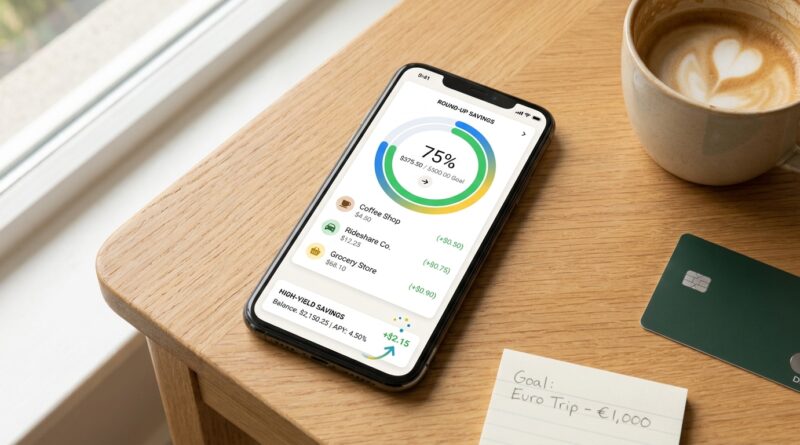
A better fix is simpler. Set up round up savings to high yield savings account tools so each purchase quietly sends spare change into savings. Buy a coffee for $4.40, and 60 cents moves over. Grab groceries for $23.15, and 85 cents follows. On its own, that sounds tiny. But when those tiny amounts land in a high-yield savings account earning around 4 to 5 percent, your money is finally doing something instead of sitting half-asleep in checking.
⚡ In a Hurry? Key Takeaways
- Round-up tools let every card swipe send small amounts into a high-yield savings account automatically, so you save without thinking about it.
- Pick one goal for the money, like an emergency fund or travel, then check progress once a week to stay motivated.
- Keep a small checking cushion so round-ups do not trigger overdrafts or throw off your bill payments.
Why this habit works better than “trying harder”
Most saving advice quietly assumes you have extra willpower lying around. A lot of people do not. Or rather, they do not have it at the end of a long workday when bills are due and life is noisy.
Round-up saving works because it removes three common roadblocks at once. You do not have to do math. You do not have to remember to transfer money. And you do not have to make a fresh decision every time.
That matters more than people think. Good money habits are usually less about big dramatic changes and more about making the good choice the default one.
What “round up savings to high yield savings account” actually means
Here is the plain-English version. Your debit card or linked spending account rounds each purchase up to the next whole dollar. The difference gets moved into savings automatically.
A few quick examples:
- $3.25 coffee becomes a 75-cent transfer
- $12.60 lunch becomes a 40-cent transfer
- $48.10 grocery run becomes a 90-cent transfer
Those amounts add up in the background. If you make 40 to 60 card purchases a month, you may save more than you expect without ever scheduling a transfer yourself.
The smart twist is not just using round-ups. It is sending those round-ups into a high-yield savings account instead of letting the money pile up in regular checking. If your checking account pays next to nothing, your spare cash is basically parked. A high-yield account gives it a job.
Where to set it up
Many banks, credit unions and fintech apps already offer this. Look for settings with names like “round-ups,” “spare change,” “save the change,” or “automatic savings.”
Option 1: Your current bank may already have it
This is usually the easiest route. If your bank offers a round-up feature and also has a savings account, check whether you can connect it to a high-yield option. Some traditional banks have the tool but weak savings rates, so read the fine print.
Option 2: Use a separate high-yield savings account
This is often the better move. Keep spending from checking, but route the round-up transfers into a separate high-yield savings account at an online bank. That gives you automation plus a stronger APY.
Option 3: Add a fixed micro-transfer too
If you want to speed things up, stack a small weekly transfer on top of round-ups. Even $5 or $10 a week can make the habit feel more real without pinching your budget.
How to start in one sitting
You can set this whole system up in about 15 minutes.
1. Open or choose your high-yield savings account
Look for a competitive APY, no monthly maintenance fee, and easy transfers. FDIC or NCUA insurance is important too, depending on the institution.
2. Turn on round-ups
Go into your bank or app settings and enable the feature. If there is a choice, send the money directly to your high-yield savings account.
3. Give the savings a job
This part is bigger than it sounds. Name the account or bucket after one goal. Emergency fund. Holiday travel. Car repair buffer. Credit card payoff.
People stick with a habit longer when the money means something. “Savings” feels vague. “Three months of bills” feels real.
4. Keep a checking cushion
Leave a little extra in checking so small transfers do not create stress. If your balance is often tight, start with just round-ups before adding any extra automation.
5. Check it once a week, not ten times a day
A quick Sunday check-in is enough. See how much moved over. That tiny ritual keeps the habit alive without turning your finances into a guilt app.
The trick that makes this habit stick
The best version of this habit is not just automation. It is automation plus a visible reason.
If your goal is an emergency fund, write down the first milestone. Maybe it is $500. Maybe it is one month of basic expenses. If it is a trip, estimate the hotel deposit. If it is debt, decide that every $100 saved gets sent as an extra payment.
This is where a lot of people lose steam. They set up the tool but never connect it to a real outcome. Then the transfers feel random. Give the money a mission and the habit feels rewarding instead of invisible.
If you want to go a step further, pair this habit with a spending reset like The ‘No-Buy Quarter’ Habit: One 90‑Day Reset To Supercharge Your High‑Yield Savings. That kind of reset can cut the “money leak” while your round-ups quietly build momentum in the background.
What this habit can realistically save
Let’s keep expectations honest. Round-ups alone probably will not make you rich. But they can absolutely help you build traction, which is what many people need most.
For example, if your average round-up is 55 cents and you make 50 card purchases a month, that is about $27.50 monthly. Add a $10 weekly transfer, and now you are closer to $67.50 a month, plus interest in a high-yield account.
Over a year, that can turn into several hundred dollars with very little effort. More important, it builds the identity of someone who saves automatically instead of “when there is something left.”
Common mistakes to avoid
Using a low-interest savings account
This is the big one. If you are going to automate savings, send it where it can earn more. A high-yield account is the whole point.
Saving with no buffer in checking
Automation should reduce stress, not create it. If your account runs close to zero, start small and leave breathing room.
Setting it and forgetting it forever
You do not need to babysit it, but you should review it. Make sure transfers are happening, the APY is still competitive, and the goal still fits your life.
Having too many savings goals at once
One target beats five vague intentions. Start with the goal that would make your life feel calmer fastest.
Who this works best for
This habit is especially good for people who:
- struggle to remember manual transfers
- hate strict budgeting apps
- use a debit card or linked spending account regularly
- want to build savings without feeling deprived
- have cash sitting in checking earning little or nothing
If that sounds like you, this is one of those rare money habits that is both low effort and genuinely useful.
At a Glance: Comparison
| Feature/Aspect | Details | Verdict |
|---|---|---|
| Effort required | Once set up, each purchase triggers a tiny transfer automatically. | Excellent for people who hate manual saving. |
| Growth potential | Round-ups alone grow slowly, but adding a weekly micro-transfer and earning 4 to 5 percent APY helps. | Best as a starter habit or support system, not your only savings plan. |
| Risk and downside | Main issue is overdraft pressure if checking runs too low, or using an account with a poor savings rate. | Safe and useful if you keep a checking cushion and choose a solid high-yield account. |
Conclusion
If you are tired of hearing that you should save more while your checking account just sits there doing nothing, this is a practical way to start. The beauty of round up savings to high yield savings account tools is that they do not ask you to become a different person overnight. They take the purchases you are already making and turn them into tiny moves toward a goal that matters. With high-yield savings rates still far better than what most checking accounts pay, even small transfers deserve a better home. Set the automation, give it a clear purpose, and check in once a week so you can see progress. That is the real win here. You are not trying to build wealth through guilt or giant sacrifices. You are building it with a system that works quietly in the background, one swipe at a time.