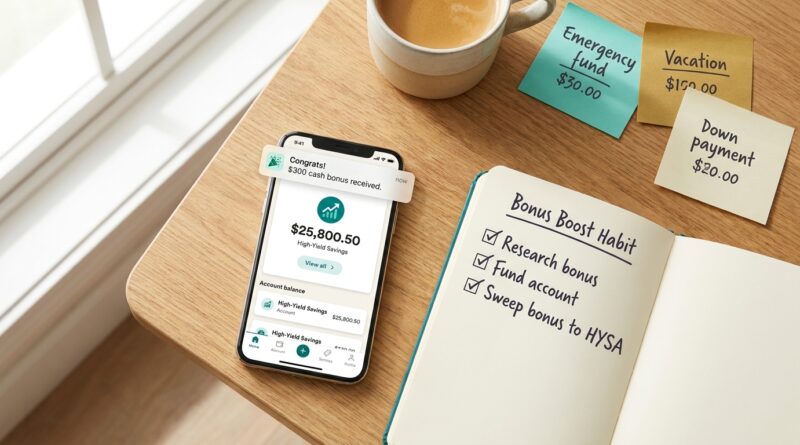
The ‘Bonus Boost’ Habit: Turn Bank Sign‑Up Perks Into Instant High‑Yield Savings Fuel
You are not lazy for being over rate-chasing. Most people do not want to move money every other week just to squeeze out another 0.15 percent. But it also stings to see banks hand out $200, $300, even $500 bonuses for opening and funding an account, especially when that bonus can beat a full year of interest on a smaller savings balance. That is where a simple high yield savings account signup bonus strategy can help. The goal is not to open a dozen accounts and build a spreadsheet that looks like a part-time job. The goal is to create one easy habit. A few times a year, you look for one solid bonus from a reputable bank or fintech, move cash you already keep in savings, meet the requirements, collect the bonus, then sweep that extra money back into your high-yield savings. It is a quick win, and your savings start compounding from a bigger base right away.
⚡ In a Hurry? Key Takeaways
- A smart high yield savings account signup bonus strategy means picking one good bank bonus at a time, not juggling a pile of accounts.
- Set a calendar reminder, move cash you already have in savings, meet the funding rules, then transfer the bonus back into your main high-yield account.
- Stick with FDIC- or NCUA-insured institutions, read the fine print on fees and holding periods, and do not tie up your emergency fund if you might need it soon.
Why this works so well right now
In a 4 to 5 percent APY world, interest is finally doing something again. But on smaller balances, it still takes time.
Let’s say you have $5,000 in cash savings at 5 percent APY. Over a year, that is roughly $250 in interest before taxes. If a bank offers a $300 signup bonus for opening and funding a new account, that bonus is actually better than a year of interest on that balance.
That is the whole appeal. You are not trying to outsmart the financial system. You are just taking the free cash offers seriously enough to use them a few times a year.
Done right, this is less about chasing every rate and more about giving your savings a jump start.
The “Bonus Boost” habit in plain English
Think of it like this. Your savings already have a job. They sit somewhere safe, earn interest, and stay available for goals or emergencies.
The Bonus Boost habit gives that same money a short side quest.
You temporarily move part of your cash to a new account that offers a signup perk. You follow the rules. You wait for the bonus to post. Then you move the money, plus the bonus, back into your main high-yield savings account or keep it there if the new account is better.
That is the strategy. No coupon-clipping energy required.
What counts as a good target
Look for offers tied to:
- New high-yield savings accounts
- Money market accounts
- Bank bundles where a savings account is paired with checking
- Fintech cash accounts with clear bonus terms and insured partner banks
You want the bonus to be easy enough that you will actually finish it.
How to spot a worthwhile bonus
Not every offer is a winner. Some look generous until you read the details.
Check the required deposit
If the bank offers $250 for bringing in $10,000 and leaving it there for 90 days, ask yourself a simple question. Is that worth it compared with just leaving the money where it is?
Often, yes. Sometimes, no.
A quick back-of-the-napkin check helps. If your current account earns 4.5 percent APY, $10,000 would earn about $112 over 90 days. If the new bank pays a similar rate plus a $250 bonus, that is a meaningful bump. If the new bank pays almost nothing and makes you jump through ten hoops, skip it.
Check the timeline
Some bonuses post quickly. Some take 60, 90, or even 180 days. If you hate loose ends, favor shorter timelines.
Check for fees
A monthly fee can quietly eat your “free money.” If an account requires direct deposit, debit card use, or a minimum balance to avoid fees, make sure that fits your real life.
Check insurance and reputation
This part matters. Stick with banks that are FDIC-insured or credit unions that are NCUA-insured. If it is a fintech app, find out which bank actually holds the money and whether your deposits are insured there.
The easiest high yield savings account signup bonus strategy for busy people
If your life already feels full, use the one-at-a-time method.
Step 1: Pick one bonus, not three
This is where people get themselves into trouble. They see a bunch of offers and start imagining a giant pile of easy money. Then they forget deadlines, miss requirements, and end up annoyed.
Choose one reputable offer with simple terms. That is enough.
Step 2: Use money that is already in cash
Do not put spending money, rent money, or your whole emergency fund into this. Use cash that is already sitting in a savings account and that you are unlikely to need during the bonus period.
This is not about investing more riskily. It is about making your existing cash work a little harder.
Step 3: Put every deadline on your calendar
The day you open the account, add reminders for:
- The funding deadline
- The required holding period end date
- The date the bonus is expected to post
- The date you plan to move the money back or decide whether to stay
This one step saves most of the stress.
Step 4: Keep notes in one place
A phone note is fine. Write down the bank name, the offer amount, the deposit requirement, and the date you can leave. You do not need a finance dashboard worthy of NASA.
Step 5: Sweep the bonus into your main savings
When the bonus arrives, move it into your primary high-yield savings account if that is where you want your long-term cash to live. Now your interest starts compounding on a bigger number.
What to avoid
This is the part that keeps the strategy useful instead of annoying.
Do not chase tiny bonuses with big hassles
A $50 perk is not exciting if it requires five card purchases, two payroll deposits, and three months of babysitting the account.
Do not ignore taxes
Bank bonuses are generally taxable. You may get a 1099-INT or 1099-MISC depending on how the bank reports it. That does not make the bonus bad. It just means the full amount is not all yours to keep.
Do not forget transfer limits or timing
Some banks take a few business days to move money. Some place holds on new deposits. Read enough of the terms so you are not surprised.
Do not let account clutter pile up
If you are done with an account and do not want it, close it cleanly after the bonus period and after confirming no fee or minimum time requirement applies. Fewer loose ends means less mental drag.
How much can this really add up to?
Let’s keep it realistic.
Say you do this three times a year and collect:
- $250 in spring
- $300 in summer
- $200 in fall
That is $750 in bonuses.
If that $750 then sits in a high-yield savings account earning around 4.5 percent, it keeps growing on top of the interest your original savings were already earning. You are not getting rich from bank promos. But you are speeding up the boring, important part of saving.
And honestly, for a lot of households, an extra few hundred dollars matters. It can cover a car repair, pad an emergency fund, or help you reach a vacation or holiday goal without touching a credit card.
Who this strategy is best for
This works best if you:
- Keep a decent amount of cash savings already
- Want easy wins without constant rate hopping
- Can follow a few simple deadlines
- Like getting paid for a small amount of admin work
It may not be a fit if you:
- Need every dollar of your cash available immediately
- Get overwhelmed tracking dates and requirements
- Are tempted to open lots of accounts at once
If that last one sounds like you, make a rule. One bonus at a time. That keeps the whole thing sane.
A simple checklist for this week
If you want to start now, here is the no-drama version:
- Find one reputable bank or fintech offer tied to savings or cash management.
- Confirm the account is FDIC- or NCUA-insured, or that a partner bank holds the insured deposits.
- Read the deposit requirement, the holding period, and any monthly fees.
- Move only money you already keep in cash.
- Set calendar reminders the same day you open the account.
- When the bonus posts, move it into your main high-yield savings unless the new account is better and worth keeping.
That is your high yield savings account signup bonus strategy in its simplest form.
At a Glance: Comparison
| Feature/Aspect | Details | Verdict |
|---|---|---|
| Bonus size vs. effort | A $200 to $500 bonus can beat months of interest, but only if the requirements are simple and fee-free. | Worth it when the terms are clean. |
| Best way to manage it | Open one account at a time, use calendar reminders, and keep a short note with the rules and dates. | Best for busy savers. |
| Safety and downside | Main risks are fees, missed deadlines, taxable bonuses, and tying up money you may need soon. | Safe enough if you read the fine print. |
Conclusion
You do not need to turn savings into a hobby to make faster progress. Right now, many banks and fintechs are quietly offering cash bonuses for funding new high-yield savings or related accounts, and in a 4 to 5 percent APY world those bonuses can be the equivalent of a full year of interest on smaller balances. If you are stressed, busy, and burned out on micro-optimizing rates, this is a calmer approach. Build a focused Bonus Boost habit. A few times a year, set a reminder, pick one reputable bonus, fund it with money you already have parked in cash, and collect the extra dollars. Then send that bonus back into your high-yield savings so compounding has more fuel. It is not flashy. It is just smart, manageable, and something you can actually do this week.