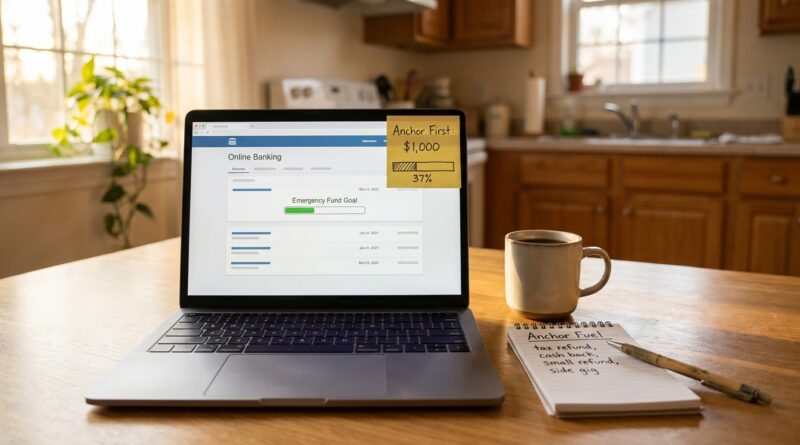
The ‘Anchor First’ Habit: Build a Bare‑Minimum Safety Net Before You Chase High Yields
Hearing that you “should” have three to six months of expenses saved can make you want to close the tab and give up. That number sounds responsible on paper, but for a lot of real people it feels so big that it becomes useless. So nothing gets saved, or money gets pushed into riskier places because a high yield savings account seems too slow to matter. That is where the anchor first habit helps. Instead of aiming straight for a giant emergency fund, start with a bare minimum safety net in a high yield savings account. Think one small, clear target. Maybe $500. Maybe one deductible. Maybe one month of must-pay bills. The point is not perfection. The point is getting off zero. If you are wondering how to start an emergency fund in a high yield savings account, this is the simplest version. Build the first layer of protection first. Chase bigger returns later.
⚡ In a Hurry? Key Takeaways
- Start your emergency fund with a small anchor goal, not a scary 3 to 6 month target.
- Use a high yield savings account for your first safety net, then automate even tiny weekly transfers.
- This gives you real protection for surprise bills while keeping your money safe and easy to reach.
Why the old advice can backfire
The classic emergency fund advice is not wrong. It is just often too big as a first instruction.
If someone is living paycheck to paycheck, hearing “save six months of expenses” can feel like being told to climb a mountain in flip-flops. It is technically a direction. It is not a useful starting point.
That is why the anchor first habit works better. You are not trying to finish the whole job at once. You are building the first layer that keeps small problems from turning into full-blown financial chaos.
What “anchor first” actually means
Your anchor is the smallest emergency fund that would make your life meaningfully less fragile.
Not perfect. Better.
For one person, that might be $500 for a car repair. For another, it might be $1,000 because their rent, groceries, and utility timing gets tight. For someone with a high insurance deductible, the anchor might be that deductible amount.
Good first anchor targets
Pick one of these:
- $500
- $1,000
- One month of bare-bones bills
- Your insurance deductible
- The amount of your most common “uh-oh” expense
This is how to start an emergency fund in a high yield savings account without making the goal so big that you never begin.
Why a high yield savings account is the right home for this money
An emergency fund has one job. Be there when life gets weird.
That means this money should not be in stocks, crypto, or anything else that can drop right when you need it. A high yield savings account is boring, and that is exactly why it works.
What you get from a high yield savings account
- Your money stays cash, not an investment that can swing up and down.
- You earn more interest than in many basic savings accounts.
- You can usually get to the money quickly when a real emergency hits.
- The account is easy to understand. No complicated strategy needed.
If you are tired of constant account hopping, that is fair too. Still, if you want a one-time boost to help fund your first safety net, The ‘Bonus Boost’ Habit: Turn Bank Sign-Up Perks Into Instant High-Yield Savings Fuel is worth a look. A bank bonus can do a lot of the early lifting.
How to start an emergency fund in a high yield savings account
Keep this simple. You do not need a color-coded spreadsheet and a 12-tab budget file.
Step 1: Open one dedicated account
Use a separate high yield savings account for emergency money only. Not vacation money. Not holiday money. Not “maybe I will buy a new phone” money.
Name it something clear like “Emergency Fund” or “Safety Net.” That label matters more than people think.
Step 2: Choose your anchor number
Do not choose the ideal number. Choose the first useful number.
If $1,000 makes you freeze, cut it. If $500 still feels heavy, start at $250. The best target is the one you can actually hit.
Step 3: Automate a small amount
Even $10, $20, or $25 a week counts. Small automatic transfers beat big intentions.
You are building the habit and the cushion at the same time.
Step 4: Put windfalls straight into the fund
Tax refund. Birthday cash. A small work bonus. A rebate. Money from selling stuff you do not use.
This is where progress can speed up fast. You do not need to save the whole anchor from your paycheck alone.
Step 5: Stop when the first layer is built, then reassess
Once you hit your anchor, pause and look at the bigger picture. Maybe then you start growing toward one month of expenses. Maybe you split new money between savings and debt payoff. Maybe you begin investing.
But the order matters. Safety first. Stretch goals second.
What counts as a real emergency
This part matters because people often raid savings for things that are not emergencies. Then they feel like saving “does not work.”
Usually a real emergency
- Car repairs that let you get to work
- Urgent medical or dental bills
- A sudden travel need for a family emergency
- Replacing a broken appliance you truly need
- Covering essentials after a short income disruption
Usually not an emergency
- Holiday shopping
- Concert tickets
- Sales you do not want to miss
- Upgrading something that still works
Your emergency fund should reduce stress, not quietly turn into a general spending account.
Why this works better than chasing high returns too early
There is a reason people get tempted by hotter ideas. Fast growth sounds more exciting than slow saving.
But if you have no cash buffer, every surprise bill can force a bad decision. You might sell investments at the wrong time. You might carry credit card debt. You might miss rent, skip a bill, or borrow from the future.
The anchor first habit fixes that weak spot. It gives your financial life a shock absorber.
And once that base exists, you can take smarter risks with the rest of your money because one flat tire or urgent copay will not knock everything over.
Common mistakes to avoid
Waiting until you can save a “real” amount
A real amount is whatever gets you off zero.
Keeping emergency money in checking
If it sits next to your spending money, it is easier to nibble away at it. Separate it.
Investing your emergency fund
This money is for stability, not maximum return.
Setting a goal so big that you quit
The first win matters. Momentum matters. Tiny progress beats fantasy planning.
At a Glance: Comparison
| Feature/Aspect | Details | Verdict |
|---|---|---|
| First goal size | A small anchor like $500, $1,000, one deductible, or one month of basic bills | Best for getting started and building momentum |
| Where to keep it | A dedicated high yield savings account with easy access and better interest than many standard savings accounts | Strong mix of safety, simplicity, and modest growth |
| Risk vs. return | Lower return than investing, but far more stable for true emergency money | The right choice for your first safety net |
Conclusion
Today’s feeds are full of hot investing takes and side hustle ideas, but the quieter truth is that many people feel stuck because the standard emergency fund rule sounds too big to even begin. If that is you, the answer is not to give up. It is to shrink the first target. A simple anchor in a high yield savings account gives you an easy win, real protection against surprise bills, and a clear use for that higher APY without needing a huge income or a complicated plan. Start small. Protect your footing. Then build from there.