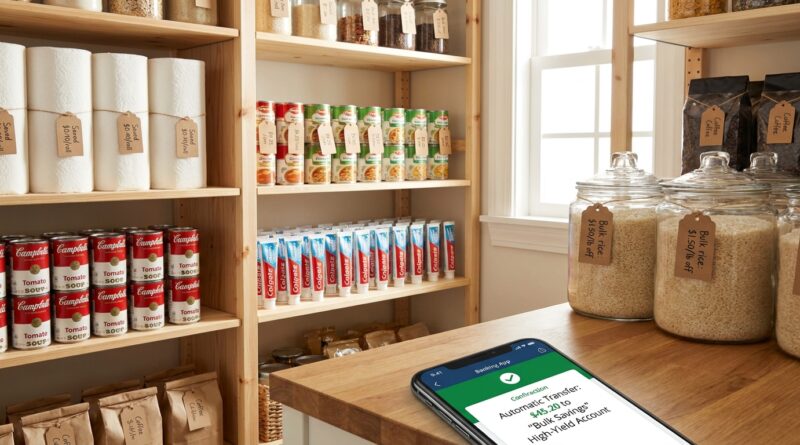
The ‘Bulk-To-Bank’ Habit: Turn Everyday Essentials Into Guaranteed High‑Yield Savings
You are not imagining it. A lot of your money really is disappearing in tiny, boring ways. Paper towels. Laundry pods. Toothpaste. Shampoo. Trash bags. You buy them when you need them, often at whatever store is closest, and somehow your cart total keeps jumping while your savings barely moves. That is what makes high yield savings feel frustrating. You know you should be building one, but everyday essentials keep eating the cash before it gets there. Here is the good news. There is a habit that can help without asking you to give up coffee, cancel every subscription, or turn into a coupon detective. Buy your replenishable basics in bulk when the math is actually in your favor, then send the difference you would have spent on random refill trips straight into savings. It is one of the simplest high yield savings hacks with bulk buying because it cuts waste, lowers impulse spending, and turns routine shopping into automatic progress.
⚡ In a Hurry? Key Takeaways
- Buying true essentials in bulk can act like a near-guaranteed return because it reduces your cost per use on things you already buy anyway.
- Pick 5 to 10 non-perishable or slow-spoiling items, track the unit price, buy only at a real discount, and auto-transfer the savings to a high-yield account the same day.
- This works only if you avoid overbuying, stick to products you consistently use, and have enough storage so nothing expires or gets forgotten.
Why this habit works better than a lot of “money-saving” advice
Most savings tips fall apart in real life because they depend on willpower. This one depends more on systems.
If your household always uses the same toilet paper, dish soap, coffee, soap refill, diapers, cat litter, or rice, then buying those items in larger quantities at the right price is not a gamble. It is just pre-paying future spending at a discount.
That is the key idea. You are not spending extra money. You are moving a purchase forward in time so you can pay less overall.
Then you take the amount you saved and send it to a high-yield savings account. That is where the second win happens. First, you lower spending. Second, you let those avoided costs start earning interest instead of vanishing into the next random store run.
The “Bulk-To-Bank” method
This is simple enough to do in one weekend.
Step 1: Make a short list of true replenishable essentials
Start with items that meet all three rules:
- You buy them regularly.
- You know your household will use them.
- They store well.
Good examples include:
- Toilet paper
- Paper towels
- Dish soap
- Laundry detergent
- Trash bags
- Toothpaste
- Shampoo or body wash
- Pet food, if your pet tolerates bulk bags well
- Dry pantry goods like rice, pasta, oats, and beans
- Diapers or wipes, if sizes are predictable enough
Do not start with trendy snack hauls, giant condiment bottles you never finish, or perishables that can spoil before you use them. That is how a money-saving plan turns into clutter.
Step 2: Ignore the shelf price. Check the unit price.
This is where stores count on people zoning out.
A jumbo pack is not always cheaper. Warehouse sizes can be worse deals than sale items at grocery stores. The number that matters is the unit price. Look for cost per ounce, per roll, per load, or per count.
If one bottle of detergent costs $14 for 64 loads, and another costs $19 for 100 loads, the second one is probably the better deal even though the sticker price is higher.
That is the whole game. Buy based on cost per use, not package size.
Step 3: Set a “buy only below this price” rule
For each essential, decide what counts as a good price.
Example:
- Toilet paper: buy only if cost per roll is under your target
- Laundry detergent: buy only if cost per load hits your target
- Toothpaste: buy only if cost per ounce is below your normal refill price
After a month or two, you will know your numbers. At that point, shopping gets much easier. You are no longer asking, “Should I get this?” You are asking, “Is this below my buy price?”
Step 4: Send the savings to your high-yield account right away
This is the part most people skip, and it is why the habit never turns into real wealth.
Let’s say your normal refill pattern would have cost you $68 this month, but your bulk buy on sale cost $49 for the same amount of future use. That $19 difference should not stay in checking where it gets absorbed by takeout and impulse buys.
Move it to savings immediately.
Better yet, set up an automatic transfer that happens every time you do one of these smart stock-up runs. Even a flat transfer of $25 or $50 after each low-cost household reset works well.
Why this feels like a guaranteed return
No, it is not an investment in the formal sense. But it can act like one in your daily life.
If inflation pushes routine items up over time, locking in a lower cost now on products you were definitely going to use anyway is a very real benefit. You avoid future price increases on those units. You reduce emergency top-up trips. You often cut the “while I’m here” purchases that happen during random Target or pharmacy runs.
That is why this is one of the more practical high yield savings hacks with bulk buying. It gives you a return in the form of reduced spending, and then the bank account adds a second layer of return through interest.
Small numbers add up fast here. Saving $15 a week on household basics is about $780 a year. Put that into a high-yield savings account instead of letting it disappear, and now your everyday supplies are quietly helping fund your cushion.
Where people mess this up
There are three big traps.
Buying “bulk” that is not actually a deal
This is the easiest mistake. Big package. Big cart. Big sense of accomplishment. No real savings.
Always check the unit price. Always.
Buying things you only kind of use
If your family is picky, do not buy the 40-pack because it looked cheap. If you like trying new products all the time, bulk buying may work better for boring staples than for personal care items.
Only bulk buy things with a near-certain use rate.
Forgetting storage and expiration
A discount is not a discount if food goes stale in the garage or if supplies get buried in a closet and you buy duplicates later.
Have a place for the items before you bring them home. Keep the system visible and simple.
What to buy in bulk, and what to skip
Usually smart bulk buys
- Paper goods
- Cleaning supplies
- Laundry products
- Toiletries you use consistently
- Dry goods with long shelf lives
- Pet supplies you go through steadily
Usually risky bulk buys
- Fresh produce unless you meal plan carefully
- Huge snack packs you eat faster just because they are there
- Products you are testing for the first time
- Oversized beauty or skincare items that can expire
- Anything bought only because it “felt like a deal”
A simple example with real-life math
Say your household buys these every month in smaller trips:
- Toilet paper: $18
- Laundry detergent: $16
- Dishwasher pods: $14
- Trash bags: $9
- Toothpaste and soap refills: $13
Total: $70
Now suppose you buy those same categories in better-value quantities when prices drop, and your average monthly equivalent falls to $56.
You have not changed your lifestyle. You have not “cut back.” You still use the same stuff. But you saved $14 a month, or $168 a year, on a very short list of basics.
If your household is bigger, the number can be much higher. Add diapers, wipes, coffee, protein staples, and pet products, and the gap can easily become $30 to $60 a month.
That is money that can be redirected, automatically, to a high-yield account without feeling like punishment.
How to automate this so it actually sticks
The best version of this habit is boring. That is a compliment.
Use this setup:
- Keep a note on your phone with 10 target items and your buy prices.
- When one of those items hits the target, stock up within reason.
- Estimate the savings versus your normal refill cost.
- Transfer that amount to your high-yield savings account that day, or have a recurring transfer set for your average monthly savings.
You can also keep a small “household stock-up” line in your budget. That makes bulk purchases feel planned, not chaotic.
The point is to create a loop. Lower cost per use. Fewer emergency trips. More cash left over. Automatic transfer. Repeat.
Who this works best for
This habit is especially good for:
- Families with predictable household usage
- Anyone tired of overspending on convenience store or last-minute runs
- People who want savings progress without extreme budgeting
- Shoppers who already use warehouse clubs, grocery sales, or online subscriptions wisely
It is less useful if your living space is tiny, your preferences change a lot, or your cash flow is so tight that buying ahead creates stress. In that case, start very small. Even two or three core items can make a difference.
At a Glance: Comparison
| Feature/Aspect | Details | Verdict |
|---|---|---|
| Bulk buying essentials | Best for non-perishables and products you use repeatedly. Savings come from lower unit prices and fewer refill trips. | Worth it if you track unit cost and avoid overbuying. |
| Random convenience shopping | Higher per-item costs, more impulse purchases, and no clear system for capturing savings. | Most expensive option over time. |
| Auto-transferring savings to HYSA | Turns reduced household spending into visible cash growth, plus interest earnings. | The step that makes the habit pay off for real. |
Conclusion
You do not need to become a stock picker or a hardcore coupon person to make smarter money moves. Sometimes the best return is sitting in your laundry room, pantry, or bathroom cabinet. Buying everyday essentials in bulk at the right price is one of those rare habits that can feel almost unfairly practical. You lower the cost of things you already need, reduce those sneaky last-minute shopping trips, and free up money that can start earning in a high-yield account. That is why this trend is catching on again. It is concrete, it fits real life, and it does not ask you to shrink your lifestyle just to grow your balance. Start with a few basics, automate the transfer, and let the quiet math do its job month after month.